

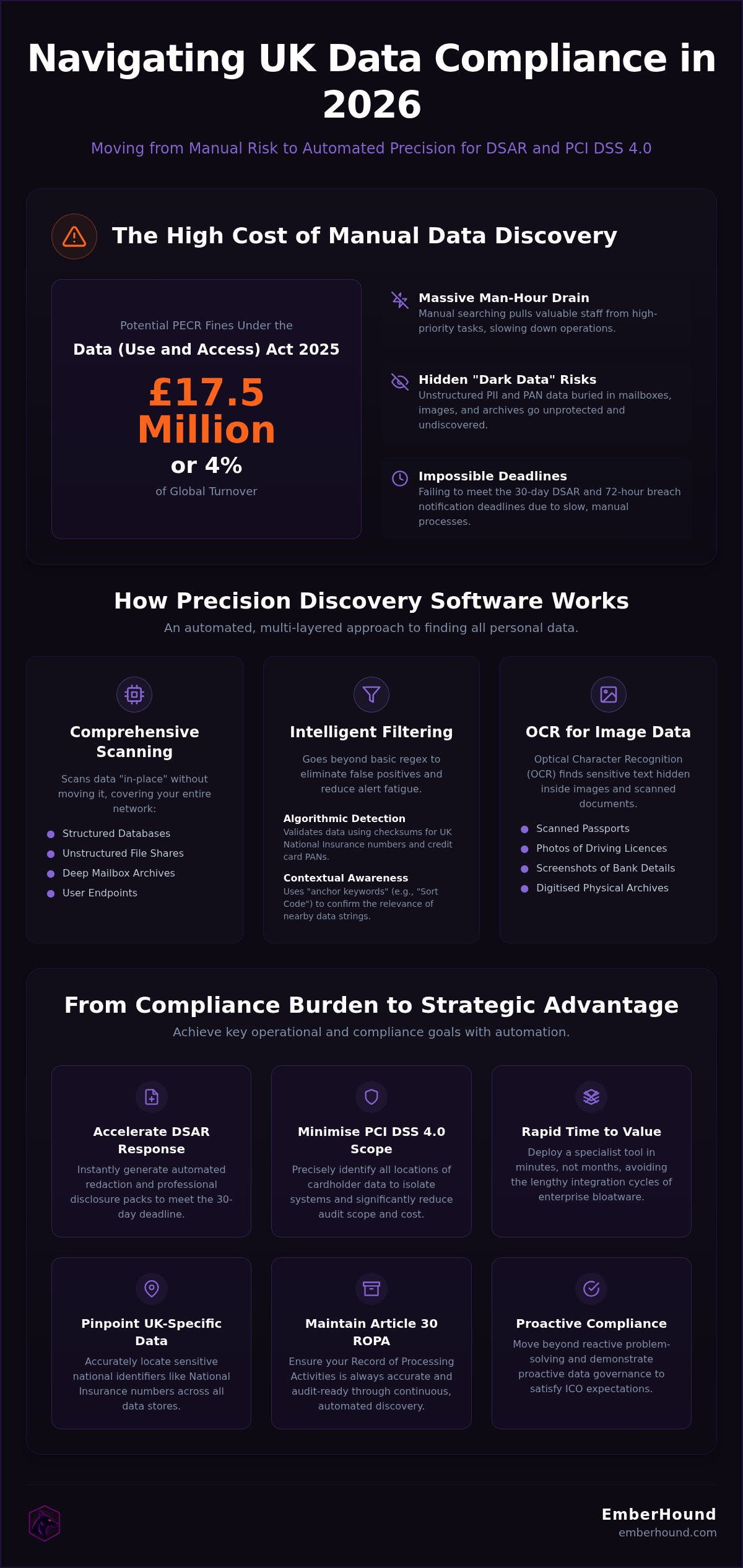
Your 30-day DSAR clock is already ticking; yet, your team is still manually sifting through thousands of mailboxes for hidden "dark data." It's a high-stakes gamble. With the Data (Use and Access) Act 2025 now in full force, the cost of oversight has reached a breaking point. You're facing potential PECR fines of up to £17.5 million or 4% of global turnover. Relying on generic data privacy discovery software that buries you in false positives isn't just frustrating; it's a liability to your UK operations.
We understand the pressure of maintaining total visibility over PII and PAN data whilst keeping your team lean. You need a solution that finds what others miss, including text trapped in images. This 2026 buyer’s reference cuts through the noise to help you secure every scrap of personal information across your network. You'll learn how to eliminate manual scanning, generate automated DSAR disclosure packs instantly, and significantly reduce your audit scope for PCI DSS 4.0. We're moving past the era of "good enough" security and into a future of total, automated clarity.
Key Takeaways
- Replace manual spreadsheet mapping with automated scanning to avoid the heightened penalties of the Data (Use and Access) Act 2025.
- Learn how to pinpoint UK-specific sensitive data, such as National Insurance numbers, across both structured databases and unstructured file shares.
- Prioritise "Time to Value" by choosing data privacy discovery software that deploys in minutes rather than months of enterprise integration.
- Accelerate your DSAR response process by automating the redaction and compilation of professional disclosure packs.
- Minimise PCI DSS 4.0 audit scope and clear out "dark data" from mailboxes using combined GDPR and PCI scanning.
Personal Data Proliferation: Why Manual Discovery Fails in 2026
Data is growing. Your team isn't. In 2026, the sheer volume of digitised information makes spreadsheet-based mapping obsolete. Modern data privacy discovery software is the only way to keep pace. It is an automated process that identifies personally identifiable information (PII) and sensitive records across your entire network. Manual mapping relies on memory and guesswork. Real-time scanning relies on precision. It finds the data you forgot you had.
The real danger is "dark data." This is unstructured information buried in forgotten archives, legacy folders, or abandoned mailboxes. If you don't know it exists, you can't protect it. The Information Commissioner’s Office (ICO) no longer accepts ignorance as a valid defence. They expect proactive discovery. Waiting for a problem to appear is a reactive strategy that invites heavy fines and reputational damage. Visibility is the only path to compliance.
The Hidden Cost of Manual Data Mapping
Manual searching is a massive man-hour drain. It pulls your most valuable staff away from high-priority tasks to play data detective. Human error is inevitable. A single missed folder can contain thousands of sensitive records. This creates a massive liability. Under the UK GDPR, you have a 72-hour window to notify the ICO of a breach. You cannot meet this deadline if you're still manually trying to figure out which data was compromised. Speed is your best protection. Precision data privacy discovery software removes the guesswork and provides immediate answers.
Meeting UK GDPR and PCI DSS 4.0 Standards
Compliance isn't a one-time event. It requires sustained Article 30 accountability. For UK businesses, this means maintaining an accurate Record of Processing Activities (ROPA). Automation ensures your records are always audit-ready without constant manual intervention. It transforms a complex chore into a background process.
It also plays a critical role in PCI DSS 4.0 compliance. By identifying exactly where card data lives, you can isolate it and reduce your audit scope. This saves time and money during the assessment process. Under the UK Data Protection Act 2018, every organisation has a strict duty of documentation to prove they are handling personal data lawfully and transparently. Automated scanning provides the evidence you need to satisfy regulators instantly.
Technical Architecture: How Privacy Discovery Software Locates PII
Finding data is a game of patterns and logic. Most data privacy discovery software uses basic regular expressions to spot sequences. But regex alone is a blunt instrument. It triggers too many false positives. Precision tools use algorithmic detection to validate findings. They check if a string of digits actually follows the checksum rules of a UK National Insurance number or a credit card PAN. This filtering ensures your team only investigates real risks rather than wasting hours on random digit strings.
The architecture must span your entire environment. Structured data lives in neat rows. Unstructured data lives in chaos. Think of project folders, chat logs, and temporary downloads. These are the areas where PII proliferates unnoticed. Your software should scan both without moving a single byte. By analysing metadata, the system classifies sensitivity whilst keeping files in their original, secure location. This "scan-in-place" model follows the latest UK GDPR guidance by minimising unnecessary data handling and reducing your overall risk profile.
Noise is the enemy of efficiency. If your software flags every ten-digit number as a potential breach, your team will stop looking. Advanced filtering uses context. It looks for "anchor keywords" like "Account Number" or "Sort Code" near the identified string. This contextual awareness separates a random sequence from a genuine security threat. It transforms a flood of alerts into a prioritised task list.
OCR and Image-Based Data Detection
Standard scanners are blind to images. A scanned passport, a photo of a driving licence, or a screenshot of a credit card is invisible to them. OCR (Optical Character Recognition) changes that. It converts pixels into searchable text. If your business digitises physical archives or handles identity documents, OCR isn't a luxury. It's a requirement. Without it, your "dark data" remains hidden in plain sight, creating a massive compliance gap that manual checks will never close.
Deep Mailbox and Endpoint Scanning
Data leaks don't just happen in databases. They happen in Outlook. Sensitive attachments and body text often sit in employee mailboxes for years. Specialist tools extend their reach to these corners. They also scan remote worker hard drives and local folders. This ensures your visibility isn't limited by your office walls. The scanning process itself must be secure. Precision tools process data via encrypted channels to avoid creating new vulnerabilities whilst they search. To see how this looks in practice, you can explore the scanning capabilities of EmberHound for your network.
Comparison Framework: Specialist Tools vs Enterprise Bloatware
Speed is the ultimate metric. If your data privacy discovery software takes six months to configure, it's not a solution; it's a project. Enterprise "bloatware" often arrives with endless consulting hours and complex data mapping requirements. You don't need a map of every byte. You need immediate visibility of your highest risks. This is the "Agile Guardian" approach. It prioritises the first scan over the perfect configuration. Result over theory. Every day spent in setup is another day of exposure.
Traditional on-premise installations are heavy. They require server resources, constant maintenance, and heavy internal IT support. SaaS-based delivery removes this friction. It scales instantly. When calculating the total cost of ownership, look beyond the initial licence fee. Include the cost of implementation, staff training, and the inevitable "shelfware" risk of overly complex tools. Following technical standards like the NIST Guide to Protecting PII ensures your chosen architecture is robust without being burdensome. Efficiency is about doing more with less, not adding more layers to an already stressed team.
The Accuracy Trap: Precision vs Recall
Beware the tool that claims to find everything. High "recall" often results in thousands of false positives. For a lean UK team, reviewing 10,000 alerts is a productivity killer. It leads to alert fatigue and missed threats. You need precision. Accuracy matters more than volume. EmberHound organises results to highlight high-risk data leaks first. It separates the signal from the noise. You deal with the critical exposures today. You leave the background noise for later. This prioritisation keeps your compliance efforts focused and effective.
Scalability Without Complexity
Growth shouldn't require a dedicated consultant. Your discovery tool must expand with your data volume effortlessly. Modular pricing is key here. Why pay for OCR or mailbox scanning if you don't need them yet? Specialist tools offer add-on modules for mailboxes and OCR, allowing you to pay for what you use. This keeps your compliance budget lean and your operations fast. It's about agility. As your data landscape changes, your tool should adapt without a total system overhaul. To see how to get started, read our guide on GDPR Data Discovery Software UK: Automate Your Compliance in 2026. Scalability is a feature, not a headache.
Operationalising Discovery: Meeting DSAR and Audit Deadlines
The clock starts the moment a subject access request hits your inbox. You have 30 days. Under the Data (Use and Access) Act 2025, you are required to perform a "reasonable and proportionate search" for the requester's information. Doing this manually across a fragmented UK network is a recipe for failure. High-precision data privacy discovery software transforms this panic into a repeatable process. It doesn't just find data; it operationalises your response. It provides the defensible record you need to prove to the ICO that your search was exhaustive and compliant.
Audit readiness is the other side of the coin. Whether it is an ICO enquiry or a PCI QSA assessment, you need evidence. You cannot rely on "we think we found it all." Automated discovery generates audit-ready reports that show exactly where PII and PAN data reside. It documents your efforts and your remediation actions. This transparency reduces friction with assessors and demonstrates a high level of data maturity. You move from a state of constant anxiety to one of quiet confidence.
The 48-Hour DSAR Workflow
Why wait weeks to fulfil a request? Pre-scanned indexes allow you to locate requester data in seconds. You aren't starting a fresh search every time a request arrives. The real value lies in the tangible output. A dedicated DSAR Disclosure Pack organises the findings into a structured, legal-ready format. It handles the heavy lifting of data compilation so your team can focus on final redaction and review. This efficiency allows you to meet the 30-day deadline whilst maintaining business-as-usual operations. You stop being a data detective and start being a data governor.
PCI DSS 4.0 and Card Data Discovery
Audits are a non-negotiable reality for businesses handling payments. PCI DSS 4.0 demands tighter control over unencrypted PAN data on servers and workstations. If card data is sitting in a forgotten folder, you are at risk of non-compliance and heavy fines. Automated scanning supports 'Requirement 12' governance standards by providing a continuous record of your cardholder data environment. It proves to your Qualified Security Assessor (QSA) that your scope is tightly managed. You can find more detail on this in our guide to PCI DSS Card Data Scanning: A Guide to Scope Reduction in 2026.
Regulators don't demand perfection, but they do demand accountability. Maintaining a defensible record of your discovery efforts is your best insurance policy. It shows you've taken every reasonable step to secure personal information. If you're ready to automate this burden, you can generate your first DSAR Disclosure Pack with EmberHound today.
EmberHound: Precision Data Discovery for UK Compliance
EmberHound isn't a generalist. We are a UK-based specialist built for the lean professional who is tired of enterprise bloat. Whilst global giants push "shelfware" that takes months to configure, we provide high-velocity data privacy discovery software that works from day one. Our SaaS model is designed for immediate deployment. No endless configuration meetings. No hidden implementation fees. Just instant visibility of your risk. We help you find the data that matters so you can get back to your real job.
Most scanners have massive blind spots. They ignore mailboxes and can't read images. We've solved that. Our OCR Scanning add-on finds PII trapped in scanned PDFs, photos, and ID documents. The Mailbox and Hard Drive add-ons extend your reach to the furthest corners of your network, including remote worker devices. This is total coverage without the enterprise friction. It’s about protection, not just checkboxes. We don't sell complexity; we sell the tools to eliminate it.
We've already discussed the mounting pressure of the 30-day DSAR deadline. The EmberHound DSAR Disclosure Pack removes the panic from this process. It generates a structured, professional output that is ready for legal review. You stop digging through fragmented folders and start delivering results. It transforms a high-stakes crisis into a routine administrative task. This is how you maintain a defensible position with the ICO whilst keeping your team focused on growth.
Why UK Businesses Choose EmberHound
We understand the specific nuances of UK data protection law. We are registered in England & Wales and designed our platform to meet the strict requirements of the Data (Use and Access) Act 2025. Our team provides authoritative support because we understand the daily "grind" of compliance in a fast-moving market. You get direct access to specialists who know how to solve your specific technical challenges. EmberHound focuses entirely on software efficiency rather than padding out billable consulting hours.
Getting Started with EmberHound
Onboarding is fast and methodical. Sign up. Connect your network. Run your first scan. You don't need a degree in data science to navigate our interface. You can combine GDPR and PCI coverage for a unified compliance posture in a single motion. This combined approach reduces your audit scope for PCI DSS 4.0 and secures your PII simultaneously. It is the most efficient way to achieve total data peace of mind without the traditional overhead of multiple, disconnected tools.
Secure your data with EmberHound’s automated discovery tools today and see your network clearly for the first time.
Secure Your Network with Precision
The era of manual mapping is over. It was slow, error-prone, and dangerously reactive. In 2026, UK businesses can't afford to play hide-and-seek with sensitive data whilst the DSAR clock ticks down. You've seen how specialist data privacy discovery software eliminates the "dark data" anxiety that keeps lean teams awake at night. By prioritising precision over enterprise bloat, you achieve total visibility without the six-month implementation headache.
True compliance isn't about ticking boxes; it's about active protection. You now have the framework to choose a tool that identifies National Insurance numbers and credit card PANs with surgical accuracy. Whether it's through OCR for scanned documents or specialised DSAR Disclosure Packs, the goal is clarity. You reduce your audit scope, hit your deadlines, and protect your reputation. It's about moving faster with more confidence.
Don't let legacy processes leave you exposed to the ICO's new enforcement powers. It's time to trade complexity for speed. Start your precision data discovery journey with EmberHound and leverage our UK-based compliance expertise today. Your network is waiting to be secured. You're ready to take control.
Frequently Asked Questions
What is the difference between data mapping and data discovery software?
Data mapping is a static inventory of where data should be, while data privacy discovery software actively scans your network to find where it actually resides. Mapping often relies on manual interviews and spreadsheets that go out of date instantly. Discovery tools provide real-time visibility by probing databases and file shares. It is the difference between a theoretical plan and a live radar.
Can data privacy discovery software find PII inside scanned images or PDFs?
Yes, provided the tool includes Optical Character Recognition (OCR) technology. Standard scanners only read text-based files, but OCR converts pixels in scanned passports, ID photos, and PDFs into searchable text. This is vital for UK businesses that digitise physical records. Without this capability, your "dark data" remains invisible to compliance audits, creating a significant gap in your security posture.
How long does it take to implement a data discovery tool in a UK business?
Implementation typically takes minutes for SaaS-based data privacy discovery software rather than the months required for legacy enterprise platforms. Once you sign up, you can connect your network and begin your first scan immediately. There is no need for extensive hardware procurement or complex on-site configuration. This speed allows lean teams to move from total blindness to actionable visibility within a single working day.
Does the software move or store our sensitive data during the scan?
No, precision tools use a "scan-in-place" model that keeps your sensitive information in its original, secure location. The software analyses the data to identify PII but does not move, copy, or store the content itself. Only the metadata and location of the findings are recorded in the reporting dashboard. This approach ensures the discovery process doesn't create new security risks or storage liabilities for your business.
How does discovery software help with PCI DSS 4.0 compliance?
Discovery software automates the identification of unencrypted Primary Account Numbers (PAN) across your servers and workstations. This is essential for meeting PCI DSS 4.0 'Requirement 12' and reducing your overall audit scope. By proving exactly where card data does and does not exist, you can isolate sensitive environments. This saves significant time and money during your annual Qualified Security Assessor (QSA) assessment.
Can the tool scan employee mailboxes for GDPR compliance?
Yes, the software can scan Outlook and other mailbox environments for sensitive attachments and body text. This is a critical area for GDPR compliance, as mailboxes are often the largest repositories of forgotten personal data. Using a dedicated mailbox add-on ensures that PII shared via email doesn't sit unmonitored in local folders or cloud archives, which would otherwise lead to a breach of the principle of storage limitation.
What happens if the software identifies a false positive?
If a false positive is identified, you can simply flag it within the system to improve future accuracy. Specialist tools use algorithmic validation and checksums to ensure strings like National Insurance numbers are genuine rather than random sequences. You don't have to review every alert manually. The software learns from your feedback, refining its detection patterns to ensure your team only focuses on legitimate data risks.
Is automated discovery a legal requirement under the UK GDPR?
While the legislation doesn't name "discovery software" specifically, it mandates that you maintain an accurate Record of Processing Activities (ROPA) and respond to DSARs within 30 days. Meeting these accountability requirements is practically impossible without automated tools. The ICO expects you to take "reasonable and proportionate" steps to locate data. In 2026, relying on manual searches for complex networks is rarely considered reasonable by regulators.


