

What if your biggest compliance risk isn't the data you've secured, but the "ghost" PANs hiding in your team's forgotten email attachments and scanned receipts? You've likely spent months hardening your primary systems, yet the dread of audit scope creep remains. It's a heavy burden for lean IT teams who are already juggling a dozen priorities. You understand that one unencrypted file hidden in a subfolder can lead to crippling fines. This guide shows you how to regain control through automated PCI DSS card data scanning, allowing you to identify and neutralise hidden risks instantly.
Compliance shouldn't be a manual grind. You need a strategy that moves as fast as your business. We'll show you how to leverage OCR technology and mailbox discovery to drastically minimise your audit scope for 2026. You'll learn to automate PAN detection and replace manual drudgery with a high-velocity security programme. It's time to stop fearing the auditor and start simplifying your data environment.
Key Takeaways
- Understand why the shift to PCI DSS 4.0 makes continuous PCI DSS card data scanning a fundamental requirement for modern security.
- Uncover unencrypted data hidden in complex locations like mailboxes and images by utilising automated OCR detection.
- Shrink your audit scope by using baseline scans to identify exactly where data resides, allowing you to delete or isolate redundant records.
- Minimise the burden on your IT team by choosing agile tools that prioritise speed and accuracy over bloated enterprise features.
- Protect your UK business from heavy fines by moving away from manual discovery towards a high-velocity, automated compliance strategy.
The Reality of PCI DSS Compliance in 2026
The grace period is over. PCI DSS 4.0 has transformed compliance from an annual hurdle into a continuous obligation. You can't just "get ready" for an audit anymore; you have to stay ready. For UK businesses, this means moving away from manual spot-checks and embracing automated visibility. The stakes are too high for guesswork.
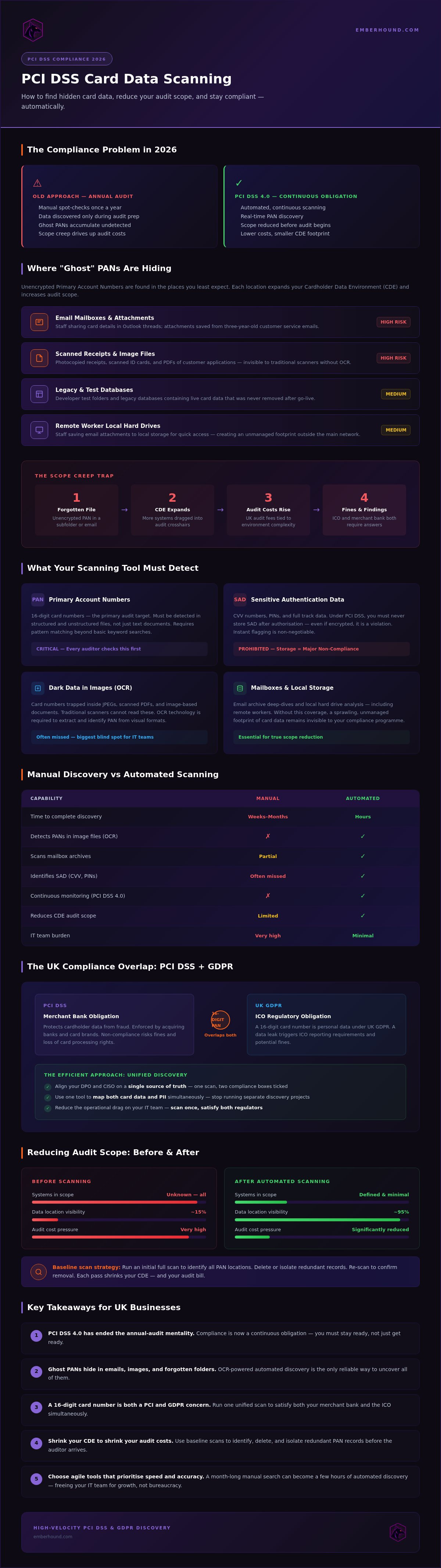
Unencrypted Primary Account Numbers (PAN) are the single biggest liability on your network. They're often found in the places you'd least expect: a legacy database, a developer's test folder, or a customer service email from three years ago. This is the "Scope Creep" trap. Every forgotten file expands your Cardholder Data Environment (CDE), dragging more systems into the audit's crosshairs and driving up costs. Effective PCI DSS card data scanning is the only way to find these digital ghosts before an auditor does.
Understanding the Cardholder Data Environment (CDE)
Your CDE includes every person, process, and technology that touches cardholder data. If you don't know where the data lives, your entire network is effectively in scope. This bloat is expensive. UK audit fees are tied directly to the complexity and size of your environment. By using PCI DSS card data scanning to pinpoint and purge unnecessary PAN storage, you can safely exclude non-essential systems. Visibility isn't just about security; it's about financial sanity.
PCI DSS vs GDPR: The UK Compliance Overlap
Don't make the mistake of treating these as separate silos. In the UK, a 16-digit card number is both a PCI concern and personal data under the UK GDPR. If you have a data leak, you're answering to the ICO as well as your merchant bank. It's inefficient to run separate discovery projects for each. A unified approach is better.
- Align your DPO and CISO on a single source of truth.
- Use one tool to map both card data and PII.
- Reduce the operational "drag" on your IT team by scanning once and ticking two boxes.
Efficiency is the hallmark of a lean, modern business. When you consolidate your discovery efforts, you free up your team to focus on growth rather than bureaucracy. Stop chasing two different sets of requirements with two different tools. It's time to simplify.
Technical Requirements: What Your Scanning Tool Must Find
Primary Account Numbers (PAN) are the primary target. Every auditor starts there. But modern compliance demands more than just finding the obvious. Standard keyword searches or basic pattern matching often miss the nuances of how data is actually stored. If your tool only looks for 16-digit strings in text files, you're leaving the door wide open. You need a solution that understands the structure of cardholder data across diverse environments.
Then there's Sensitive Authentication Data (SAD). This includes CVV numbers, PINs, and full track data. Under PCI DSS, you can almost never store this after authorisation. Even if it's encrypted, it's a violation. A robust PCI DSS card data scanning programme must flag these prohibited data points instantly. Finding SAD is often the difference between a clean audit and a major non-compliance finding.
OCR Scanning: Finding Data in Images and Scanned Docs
Compliance risks don't just live in spreadsheets. They're often trapped in "Dark Data", which are unstructured files that traditional scanners ignore. Think about scanned ID cards, photocopied receipts, or PDFs of customer applications. These image-based files are a goldmine for auditors and a nightmare for IT teams. Without OCR scanning, this data remains invisible, creating a massive gap in your security posture. Your tool must be able to "read" these images to extract and identify PAN automatically. It's about closing the loopholes that manual processes always miss.
Mailbox and Hard Drive Analysis
Email is the primary culprit for accidental data leakage. Staff often share card details in Outlook threads or save attachments to their local hard drives for quick access. These habits create a sprawling, unmanaged footprint of card data. To achieve true scope reduction, your scan must extend to these peripheral areas. This includes deep dives into mailbox archives and the local storage of remote workers. It's about total visibility, leaving no stone unturned in your pursuit of a smaller CDE.
For UK businesses looking to automate this process, using specialised PCI card data scanning tools can turn a month-long manual search into a few hours of automated discovery. By extending your reach to every corner of the network, you ensure that "ghost" data doesn't come back to haunt you during your next assessment. Don't let old emails dictate your audit scope. Take the decisive step of scanning your entire digital estate today.
Evaluating PCI Scanning Software: A Buyer’s Framework
Choosing the right tool isn't just about ticking a box. It's about protecting your time. Many enterprise solutions are "bloatware" in disguise. They take weeks to deploy and require extensive training to operate. You need velocity. Can you install and start your first scan in minutes? If the answer is no, you're already losing ground to the audit clock.
Accuracy matters just as much as speed. High false-positive rates create "ghost" data that your team has to investigate manually. That's a drain on resources you can't afford. Your PCI DSS card data scanning software should provide actionable clarity, not a list of thousands of "potential" matches that lead nowhere. Finally, consider the reporting. Your Qualified Security Assessor (QSA) doesn't want a massive dump of raw data. They want clear, organised evidence of remediation and a defined scope that they can verify quickly.
SaaS vs Managed Services
Traditional managed services are often slow and consultancy-led. You're forced to work on their schedule, not yours. Owning your own scanning tool allows for continuous compliance. You find the risks on Monday and fix them by Tuesday. For UK SMEs, a SaaS model is usually the most cost-effective path. You pay for what you scan, avoiding the heavy overheads of large-scale enterprise contracts. It's about staying lean and maintaining control over your own data environment.
Automation: The Key to Efficiency
Manual discovery is a relic of the past. Automation is the only way to keep up with the pace of modern data creation. Scheduled scans ensure that new folders, mailboxes, or hard drives are checked as soon as they're added to the network. There is also a massive efficiency gain in combined coverage. If your tool identifies both PII for the GDPR and PAN for PCI DSS simultaneously, you've effectively halved your compliance workload. This automation also simplifies the Subject Access Request (DSAR) process, allowing you to locate a customer's total data footprint across the entire estate in seconds.
Efficiency is the hallmark of the "Agile Guardian." When you automate the heavy lifting, you allow your IT team to focus on security strategy rather than digital housekeeping. Don't let your compliance programme become a manual grind. Invest in a tool that works as hard as you do.
Reducing Audit Scope: Strategy and Implementation
Audit scope reduction is a velocity strategy. It's not just about security; it's about making your business faster and leaner. By identifying exactly where cardholder data resides, you can build a defensive perimeter that excludes non-essential systems, saving you thousands in audit fees. This requires a methodical approach. You can't guess your way to compliance. You need a map.
- Step 1: Conduct a baseline scan. Use automated PCI DSS card data scanning to find every instance of PAN across your network, mailboxes, and hard drives.
- Step 2: Isolate or delete. If you don't need the data for a specific business process, delete it securely. If you do need it, move it to a centralised, hardened location.
- Step 3: Implement network segmentation. Use your scan results to define the boundaries of your CDE. If a server doesn't hold card data, it shouldn't be in scope.
- Step 4: Establish a continuous schedule. Scope creep is inevitable without oversight. Schedule monthly scans to catch new data before it becomes an audit problem.
Start your scope reduction journey by running an automated PCI scan to identify your current data footprint instantly.
The "Find and Fix" Methodology
You cannot protect what you cannot see. Many UK businesses suffer from "data hoarding" on legacy servers and forgotten backup drives. These are landmines waiting for an auditor to step on them. The find and fix approach is simple: locate unencrypted data, verify its necessity, and dispose of it if it serves no purpose. Secure disposal means more than just hitting delete; it requires ensuring the data is unrecoverable. Once the "ghost" data is gone, your CDE shrinks, and your risk profile drops. It's about cleaning the digital house to prepare for growth.
Preparing for Your QSA Audit
A Qualified Security Assessor (QSA) doesn't take your word for it. They want evidence. They expect to see detailed logs that prove you're actively managing your data environment. Automated scanning logs are the perfect evidence for Requirement 3 of PCI DSS, which mandates the protection of stored cardholder data. These logs show when you scanned, what you found, and how you remediated the risk. More importantly, this data justifies your segmentation strategy. When you can prove a server is "clean," you have the technical leverage to exclude it from the audit. This transparency builds trust with your QSA and significantly speeds up the assessment process.
EmberHound: High-Velocity PCI DSS and GDPR Discovery
Compliance shouldn't feel like a weight around your neck. You need a partner that understands the high-stakes pressure of UK regulations without the burden of enterprise-speak bloatware. EmberHound is the agile alternative. We've stripped away the complexity to give you exactly what you need: speed, accuracy, and visibility. Our platform is built for lean teams who value time above all else. You can deploy and begin your PCI DSS card data scanning journey today, not next month.
We recognise that for a UK business, card data is never just about PCI. It's also a GDPR concern. Managing two separate discovery projects is a waste of your most valuable resource. EmberHound provides combined GDPR and PCI coverage, allowing you to secure your entire data footprint in a single, efficient pass. It's about working smarter. You find the PAN, you find the PII, and you move on with your day. It's a no-nonsense approach for professionals who don't have time for fluff.
Feature Spotlight: OCR and Mailbox Add-ons
Data doesn't always hide in neat text files. Our OCR Scanning is designed to find the card details others miss, pulling PAN from images, scanned receipts, and PDFs. This closes the "Dark Data" gap that often causes audit failures. Additionally, our specialised Mailbox Add-on secures your inboxes, scanning deep into archives to find unencrypted data shared in old threads. For remote teams, the Hard Drive Add-on extends this protection to employee laptops, ensuring that no pocket of sensitive data remains invisible. It's total coverage without the friction.
The EmberHound Advantage
We are a UK-based technology company. We understand the specific grind of local compliance because we live it every day. Our scanning process is rhythmic and methodical, designed to provide maximum visibility without bogging down your network's performance. You get the evidence you need for your QSA without the operational drag. If you want to automate your entire compliance estate, you can also explore our GDPR data discovery software UK to see how we handle PII with the same high-velocity precision. Stop wrestling with slow, legacy tools. Choose the agile guardian that hands you the tools to fix your compliance problems instantly.
Reclaim Your Time and Compliance Confidence
The transition to PCI DSS 4.0 has changed the rules. Compliance is no longer an annual event; it's a constant state of readiness. You've seen how easily unencrypted data escapes your primary systems. It settles in mailboxes, old hard drives, and scanned documents. These digital ghosts don't just increase your risk; they inflate your audit scope and drain your budget. Reclaiming control starts with visibility.
Shrinking your CDE is a strategic win for your entire business. By automating PCI DSS card data scanning, you eliminate the manual drudgery that bogs down your IT team. You find the risks, you neutralise them, and you move forward with confidence. EmberHound is designed for this high-velocity environment. We provide UK-based expert support and integrated OCR scanning to ensure nothing is left to chance. It's time to stop fearing the auditor and start simplifying your estate.
Secure your network with EmberHound PCI card data scanning
You have the strategy. Now you need the tools. Take the decisive step toward a simplified, secure future today.
Frequently Asked Questions
What is PCI DSS card data scanning?
It is the automated process of searching your entire digital estate for unencrypted cardholder data. The software replaces manual checks by identifying 16-digit Primary Account Numbers (PAN) and other sensitive strings across servers, mailboxes, and hard drives. This visibility is the foundation of any compliance programme. It ensures you know exactly where risk resides before an auditor arrives on site.
How does PCI scanning help reduce audit scope?
Scanning reduces scope by proving where card data is not stored. Once you identify and delete unnecessary data, you can technically exclude those "clean" systems from the Cardholder Data Environment (CDE). This shrinks the boundary your QSA needs to assess. A smaller CDE leads to lower audit fees and fewer technical controls for your IT team to maintain.
Can scanning software find credit card data in images?
Yes, provided the tool utilises Optical Character Recognition (OCR) technology. Standard scanners only look at text files, but OCR "reads" image-based files like scanned receipts, ID cards, and PDFs. This is a critical requirement for modern compliance. "Dark data" trapped in images is a frequent cause of unexpected audit failures and unmanaged security leaks.
Is email scanning required for PCI DSS compliance?
While not explicitly named as a "mailbox requirement," PCI DSS Requirement 3 mandates the protection of all stored cardholder data, regardless of location. Email is the most common place for accidental PAN storage. If card data exists in your inboxes, it is in scope. Automated PCI DSS card data scanning of mailboxes is the only way to ensure these archives don't trigger non-compliance.
How often should a UK business scan for cardholder data?
You should scan at least quarterly, though monthly is the standard for high-velocity environments. PCI DSS 4.0 emphasises continuous monitoring over annual checks. Regular scans prevent "scope regrowth," where new data is accidentally saved in non-compliant locations. Frequent discovery ensures your CDE remains small and manageable throughout the entire year.
What happens if unencrypted PAN is found on our network?
You must remediate the risk immediately by either encrypting the data or deleting it securely. Finding unencrypted PAN during an internal scan is a success; it is a chance to fix the leak before a breach or an audit occurs. You should also investigate the source of the data to prevent future "ghost" storage in that location.
Does PCI scanning cover GDPR requirements as well?
Agile tools often provide combined coverage for both frameworks. Since card numbers are considered personal data under the UK GDPR, identifying them helps satisfy your data protection obligations. Using a single tool for PCI DSS card data scanning and PII discovery halves your operational burden. It ensures your DPO and CISO share a single source of truth.
How long does it take to deploy a PCI scanning tool?
Modern SaaS solutions can be deployed in minutes. Unlike legacy enterprise software that requires weeks of consultancy and setup, agile tools are designed for immediate impact. You should be able to install the software, configure your first scan, and see actionable results on your dashboard within the same hour. Speed is essential for lean IT teams.


