

Your manual data spreadsheet is already a liability. It's static and incomplete. You might believe you've organised your network, but PII hides in places a spreadsheet can't reach - like buried email attachments or forgotten image files. Understanding what is GDPR data discovery is the difference between a controlled audit and the threat of a £17.5 million fine.
The 30-day DSAR deadline is a race against the clock that you can't win with manual searches. It's a source of constant anxiety for overworked compliance teams. This guide provides a no-nonsense path to locating every scrap of personal data across your entire network. You'll learn how to eliminate compliance blind spots and replace guesswork with total visibility. We'll examine how to automate your workflow using tools like OCR scanning, mailbox audits, and hard drive searches to find the data you didn't even know you had.
Key Takeaways
- Understand what is GDPR data discovery and why it provides the forensic evidence that static data mapping often misses.
- Identify hidden PII across your network - including email attachments and image files - to eliminate the compliance blind spots that lead to regulatory fines.
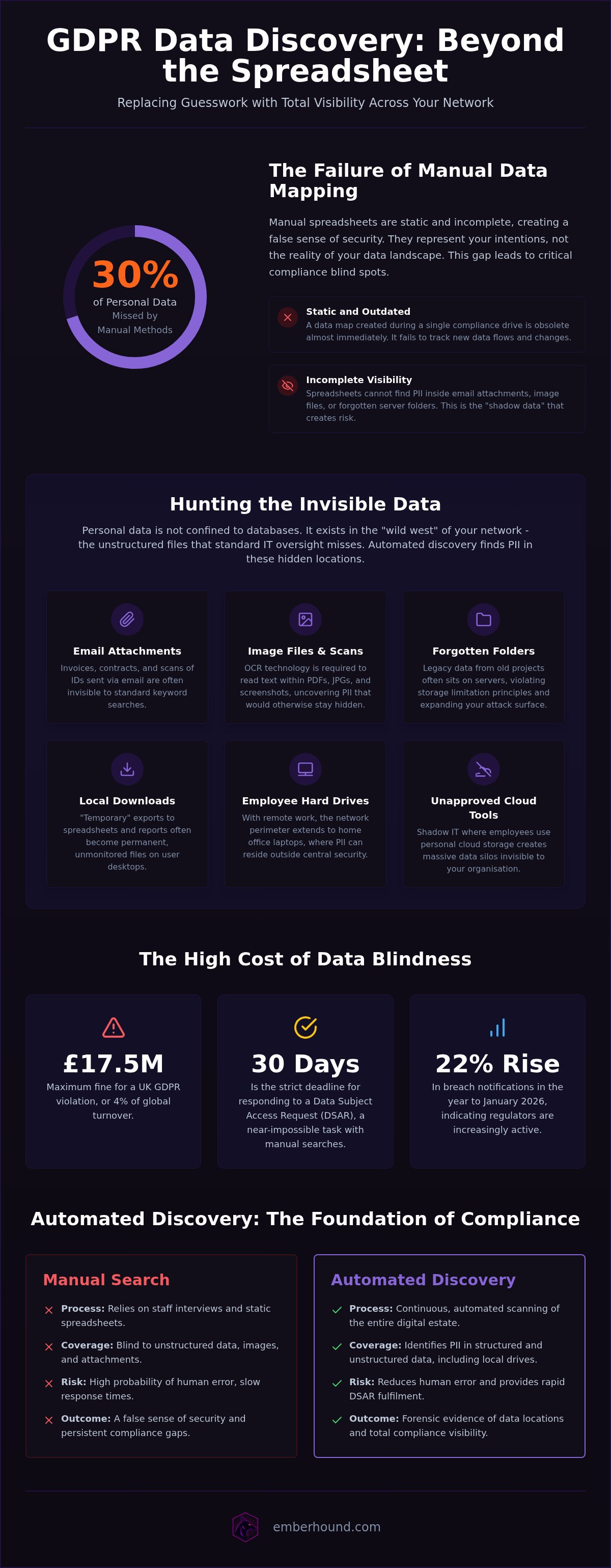
- Recognise why manual spreadsheets fail to capture up to 30% of personal data and how automated scanning reduces the risk of human error.
- Prepare for the 30-day DSAR deadline by using automated disclosure packs and OCR technology to find and redact sensitive information.
- Organise a faster compliance workflow that covers remote work risks by scanning local hard drives and cloud mailboxes.
Defining GDPR Data Discovery: More Than Just a Search
Most UK businesses rely on a data map. This is usually a static Excel sheet created during a frantic compliance drive. It represents your best intentions. In contrast, data discovery represents your reality. A data map is the plan; discovery is the forensic evidence of what is actually happening on your servers.
So, what is GDPR data discovery? It is the automated process of scanning your entire digital estate to identify and classify personally identifiable information (PII). It doesn't rely on what your staff say they do. It looks at what they actually do. This technology identifies names, addresses, and financial details across every corner of your network, ensuring you aren't harbouring data you've forgotten about.
Data exists in two states: structured and unstructured. Databases are structured. They are organised and easy to audit. The "wild west" of your network is the unstructured data. This includes emails, PDFs, and screenshots. These files often sit in "temp" folders or local downloads, invisible to standard IT oversight. Automated discovery tools use pattern matching to find these needles in the haystack before they become a liability.
Why Visibility is the Foundation of Compliance
You can't protect data if you don't know it exists. The Information Commissioner's Office (ICO) treats "data blindness" as a failure of security. Under the General Data Protection Regulation (GDPR), you are responsible for every byte of PII you hold. Claiming you didn't know a file existed is not a valid defence during an investigation. Modern compliance requires a shift from annual "point-in-time" audits to continuous, automated discovery. If you aren't looking, you aren't compliant.
The Cost of Data Blindness in 2026
The financial stakes are high. As of 2026, the maximum fine for a UK GDPR violation remains £17.5 million or 4% of global turnover. But the operational cost is often worse. Shadow data - PII stored on personal devices or unapproved cloud tools - creates a massive attack surface. Regulators are increasingly active; cumulative fines reached approximately €5.88 billion by early 2025 across over 2,000 enforcement actions. If you suffer a breach, you can't notify the affected parties if you don't know who they are. Data discovery identifies these risks before a hacker finds them. It stops your network from becoming a compliance ticking time bomb.
Hunting the Invisible: Where Your Personal Data Actually Hides
Personal data is nomadic. It rarely stays within the secure walls of your CRM or HR system. Instead, it leaks into spreadsheets, "temp" folders, and local downloads. This is where the real risk lives. To understand what is GDPR data discovery, you must look beyond your primary databases. It is the process of finding the data your employees have moved, copied, or forgotten.
Beyond Databases: The Danger of Unstructured Files
Spreadsheets are the primary source of PII leaks in UK businesses. A quick export for a report often becomes a permanent file on a desktop. These "temporary" files are liabilities. They bypass central security controls. Legacy data also sits in forgotten server centres, often from projects completed years ago. Without an automated data discovery strategy, these files remain invisible until a breach occurs. This visibility is required to prevent data from sitting in "archive" folders that no one has opened in five years. If this data contains PII, you are in breach of the GDPR principle of storage limitation. Discovery tools identify these stale files. This allows you to delete them and reduce your attack surface.
Email, Images, and OCR: The Modern Discovery Frontier
Your mailboxes are a compliance ticking time bomb. Standard search tools fail because they are blind to image content. If an employee emails a photo of a customer's ID, that data is invisible to a basic keyword search. OCR (Optical Character Recognition) is the solution. It converts images into machine-readable text. This allows you to find PII inside PDFs and JPGs that would otherwise stay hidden. Scanning mailboxes is a requirement for total coverage. Standard search tools are insufficient. They can't see inside passport scans, receipts, or handwritten notes attached to emails. This is where what is GDPR data discovery becomes a technical necessity.
Remote work has pushed the perimeter to employee hard drives. PII now sits on home office laptops, far from the central server. If you aren't scanning these endpoints, you have a blind spot. EmberHound provides the tools to scan local hard drives and mailboxes. This level of visibility is the only way to meet the 22% rise in breach notifications seen in the year to January 2026. Breach notifications in Europe reached 443 notifications per day in early 2026. This increase reflects the difficulty of managing distributed data. Using a tool to scan local hard drives identifies these risks before they result in a penalty.
Manual vs Automated Discovery: Choosing Your Strategy
Manual data inventories are a performance. They look good in a folder but fail the moment a file is moved. If you are still asking what is GDPR data discovery in the context of a yearly manual review, you are already behind. Modern data moves too fast for human eyes. You need a strategy that matches the velocity of your business.
The Myth of the Manual Spreadsheet
A spreadsheet is a snapshot of the past. It is static. It is also prone to the "fatigue factor." Staff tasked with manual reviews often miss sensitive data because the work is repetitive and high-volume. Some industry professionals report that manual searches miss up to 30% of relevant PII. This creates a compliance gap you can't see. When the ICO asks for evidence of your data processing, a six-month-old Excel sheet is a weak defence.
Manual processes fail the "demonstrable compliance" test under Article 5. You must prove you are actively managing risk. A manual list doesn't prove you are protecting data; it only proves you had a list once. It provides no visibility into new files created this morning or "shadow data" sitting on a remote laptop. Relying on staff to self-report their data usage is a high-risk strategy that leads to oversight.
How Automated Scanning Reclaims Your Time
Automation replaces weeks of manual labour with hours of background scanning. It allows you to set "guardrails" for your data without constant supervision. You can schedule scans to run whilst your team focuses on strategy or revenue-generating work. This is the core of what is GDPR data discovery in a professional environment: it is a set-and-forget solution that maintains visibility 24/7.
Intelligent classification is the key differentiator. Automated tools sort data by risk level, separating general PII from sensitive categories like health data or financial records. This prioritisation ensures you fix the biggest risks first. The ROI of automation is undeniable. Comparing the cost of a software licence to the hundreds of man-hours required for a manual audit reveals a massive saving. You aren't just buying software; you are buying back your team's time and reducing your liability.
From Discovery to Action: Handling DSARs and Audits
Locating your data is only the first half of the compliance battle. The second half is what you do with it. In the UK, the Data Subject Access Request (DSAR) is the ultimate stress test for any business. You have a 30-day window to respond. If your data is scattered across local hard drives and unmapped mailboxes, you will spend most of that time just searching. This is where what is GDPR data discovery moves from a technical concept to a practical survival tool. It turns a chaotic manual hunt into an organised, automated export.
Meeting the 30-Day DSAR Deadline with Precision
A DSAR panic usually starts with a vague request for "all personal data held." Without discovery, your team will check the CRM and then ask staff to search their own folders. This is slow. It is also unreliable. Automated discovery tools allow you to compile a complete disclosure pack instantly. These tools find PII in places humans often forget to check - such as a passport scan buried in a sent-items folder or an old CV on a "temp" drive. This precision ensures that no forgotten data surfaces after you have already responded to the request. A late or incomplete response is an easy win for a complainant looking to involve the ICO.
Preparing for an ICO Audit Without the Panic
The Information Commissioner's Office (ICO) expects you to demonstrate accountability. They want to see your Record of Processing Activities (RoPA). If your RoPA is based on a yearly manual audit, it is likely out of date. Real-time data discovery provides the audit logs and scan history that prove you are in control of your digital estate. It shows the regulator that you know exactly what data you hold, where it sits, and why you still have it.
Discovery also justifies your data retention policies. If you discover files that are five years old with no legal basis for storage, you must delete them. This is data minimisation in practice. By reducing the volume of data you hold, you reduce the burden of every future DSAR. You cannot be forced to disclose data that you no longer possess. Using an automated DSAR Disclosure Pack allows you to manage these requests with speed and accuracy whilst maintaining a clean, compliant network. This proactive approach replaces audit anxiety with a repeatable, defensible process.
Implementing Intelligent Data Discovery with EmberHound
EmberHound is a UK-based technology company. We build tools for professionals who prioritise speed and visibility. We don't sell legal consulting or managed security services. We sell the ability to see your data. If you are still asking what is GDPR data discovery, it is the technical foundation of your entire compliance strategy. It must be fast and easy to deploy. You can get your first scan running in minutes, not months. This is the agile alternative to enterprise software that takes half a year to configure.
Swift Setup, Deep Scanning, Total Clarity
Our GDPR data discovery software is designed to eliminate the guesswork of manual inventories. It is not bloatware. You don't need a month of training to use it. The OCR Scanning feature is a core component. It finds PII inside image files that standard search tools miss. This includes scanned IDs, receipts, and handwritten notes attached to emails. By turning these images into searchable text, you close the blind spots that often lead to regulatory fines. You fix the problem before it becomes a liability.
The software includes customisable compliance packs. These cover both UK GDPR and PCI DSS requirements. You choose the rules that apply to your business. The scanner then identifies matches across your digital estate, from central servers to the "wild west" of unstructured folders. It provides a clear view of your risk without the ceremony of traditional audits.
Scaling Your Compliance Without the Complexity
Scaling is simple. You can add coverage for specific risks as they arise. The Mailbox Add on and Hard Drive Add on are essential for modern, distributed teams. They allow you to scan endpoints and cloud archives without complex on-premise hosting. You can audit employee laptops and mailboxes whilst they work, ensuring that PII hasn't leaked onto local machines. This is what is GDPR data discovery looks like in a lean, efficient business. It is a repeatable process that replaces anxiety with visibility.
The automated reports are factual and grounded in reality. They provide the "Record of Processing" evidence required by the ICO. This documentation proves your accountability. It shows you are actively identifying and managing PII across your entire network. Stop guessing where your sensitive data is hiding. Start your first EmberHound scan today.
Master Your Data Visibility and Control
Static spreadsheets are a liability. They provide a false sense of security whilst PII accumulates in unmapped mailboxes and local downloads. Understanding what is GDPR data discovery requires moving beyond simple file searches. It is the establishment of a repeatable, defensible process that stands up to ICO scrutiny. You must move from a state of data blindness to total visibility to protect your business from the operational paralysis of a breach.
EmberHound provides the technical tools to automate this transition. Our UK-based experts have built a platform that handles the heavy lifting. We offer OCR-enabled scanning for images and specialised DSAR disclosure packs that meet the 30-day deadline with ease. You don't need complex enterprise bloatware to stay compliant. You need speed, accuracy, and clarity across every endpoint in your network.
Take the guesswork out of your compliance strategy. Secure your data and simplify compliance with EmberHound. You've built your business; now give yourself the tools to protect it.
Frequently Asked Questions
What is the meaning of data discovery in GDPR?
Data discovery is the automated process of scanning your network to find and classify personally identifiable information (PII). It identifies names, addresses, and financial details across every corner of your digital estate. This provides the evidence required for a Record of Processing Activities (RoPA). If you are asking what is GDPR data discovery, it's the shift from assuming you know where data sits to having forensic proof of its location.
Is data discovery mandatory under UK GDPR?
Mandatory compliance hinges on Article 5 and Article 24 of the UK GDPR. These require you to demonstrate accountability and implement security by design. Whilst the text doesn't use the word "discovery," you cannot fulfill these obligations if you are blind to your data. Discovery is the only reliable way to prove you are managing PII according to the law. Failure to identify data is a failure of control.
How does data discovery help with Subject Access Requests (DSARs)?
Discovery tools reduce the time spent on a DSAR from weeks to minutes. They allow you to compile a complete disclosure pack by searching every server, mailbox, and hard drive simultaneously. This speed is required to meet the 30-day legal deadline. By identifying PII in forgotten folders or image attachments, you avoid the risk of a complainant reporting an incomplete response to the ICO.
Can data discovery tools find PII in scanned documents and images?
Standard search tools are blind to images, but specialised discovery software uses OCR to find PII in scans. Optical Character Recognition converts images into machine-readable text. This allows the scanner to identify names or numbers inside passport photos, receipts, and handwritten notes. Without OCR, these files remain hidden liabilities on your network. It is a technical necessity for any business that handles scanned identity documents or physical mail.
What is the difference between data discovery and data mapping?
Data mapping is a plan; data discovery is the reality. A map is a high-level document that describes how data should flow through your organisation. It is often a static spreadsheet. Discovery is the forensic process of finding where that data actually resides. Mapping tells you where the data is supposed to be. Discovery tells you where it actually is, including the "shadow data" that bypasses your official processes.
How long does a GDPR data discovery scan typically take?
A scan typically takes between 15 minutes and several hours. The exact duration depends on the volume of data and the number of endpoints being searched. Modern tools run in the background, so they don't interrupt your team's work. Unlike manual audits that take weeks of staff time, automated discovery provides results quickly. This allows you to fix compliance gaps the same day they are identified.
Can I perform GDPR data discovery manually using spreadsheets?
Manual discovery is technically possible but practically dangerous. Spreadsheets are static and prone to human error. Staff often suffer from fatigue during manual reviews, leading to a miss rate of 20-30% for relevant PII. Manual lists are out of date the moment they are finished. Automated tools provide a level of accuracy and speed that a human team cannot match, especially when dealing with unstructured data like emails.
Does data discovery software work for remote employee laptops?
Software can scan remote laptops provided you use a hard drive add-on. This technology allows the central scanner to audit local drives on employee machines, even when they aren't on the office network. This is required for remote work compliance. It ensures that PII stored in local "Downloads" or "Documents" folders is visible to your security team. This visibility prevents remote devices from becoming invisible compliance blind spots.


