

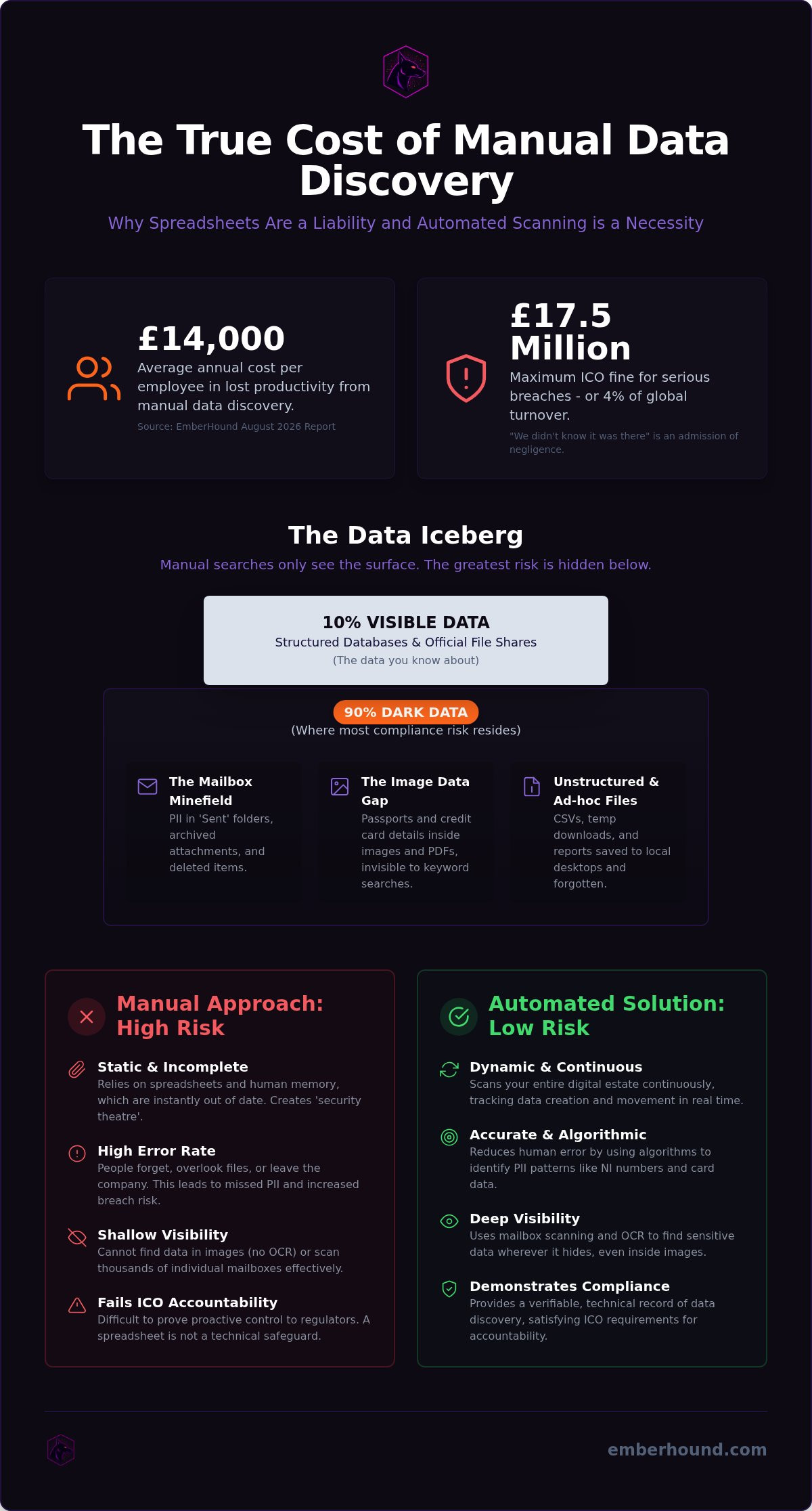
Manual data discovery costs UK businesses an average of £14,000 per employee every year in lost productivity. This data - sourced from EmberHound's August 2026 report - describes a process that is both expensive and dangerous. Manual mapping is security theatre. You are likely buried in spreadsheets and struggling to meet the 30-day DSAR deadline. It's a stressful cycle. You worry about 'dark data' hiding in mailboxes whilst the clock ticks toward a potential audit. You must stop manual data discovery before a missed record results in an ICO fine of up to £17.5 million.
We understand the weight on lean teams. You need a system that works without the heavy manual labour. This article explains why manual mapping is a liability and how to transition to automated discovery to protect your business. We will debunk five myths that put your operations at risk and provide a clear path to faster DSAR fulfilment. You can build a scalable compliance process that finds all your PII and reduces your regulatory exposure.
Key Takeaways
- Recognise why relying on spreadsheets creates security theatre rather than genuine compliance.
- Locate the 90% of sensitive information hidden in mailboxes and images that human searches miss.
- Calculate the hidden labour costs of manual DSAR fulfilment compared to algorithmic scanning.
- Implement a lean strategy to stop manual data discovery and build a scalable process.
- Protect your business from ICO fines by identifying PII and unencrypted card data in one scan.
The Illusion of Control: Why Manual Data Discovery is Failing UK Businesses
Manual data discovery is the reliance on human memory, anecdotal knowledge, and static spreadsheets. It is the practice of asking department heads to list their data sources and hoping they remember every sub-folder. This approach is a form of Data exploration, but in a modern security context, it is dangerously incomplete. It creates "security theatre" - a polished presentation of compliance that lacks technical substance. You might have a colourful spreadsheet for the board. It does not reflect the messy reality of your servers.
UK data landscapes in 2026 are too fragmented for human oversight. Data moves fast. It lives in mailboxes, hard drives, and cloud backups. According to the Cyber Security Breaches Survey 2025/2026, 43% of UK businesses reported a breach in the last year. If you don't know where your data is, you cannot protect it. You must stop manual data discovery and transition to dynamic, automated scanning. Static maps are no longer a tool. They are a liability.
The Myth of the "Complete" Spreadsheet
A spreadsheet is out of date the second you press "Save". It is a fossil. Employees create ad-hoc files every day to solve immediate problems. They download customer reports, export CSVs for one-time use, and save sensitive PII to local desktops. Relying on staff memory is a high-risk strategy. People forget. They leave the company. They overlook the "temporary" folder they created six months ago that now contains five thousand email addresses. Manual records fail because they cannot track the constant creation and movement of data. Your asset list is a snapshot of the past. It is not a safeguard for the future.
Regulatory Pressure from the ICO
The Information Commissioner's Office (ICO) focuses heavily on "accountability". Under the UK GDPR and the Data Protection Act 2018, you must prove you have active control over your data environment. As of February 2026, the ICO can impose fines of up to £17.5 million or 4% of global turnover for serious breaches. "We didn't know the data was there" is a failed legal defence. In the eyes of the regulator, it is an admission of negligence. Automated discovery allows you to demonstrate proactive compliance. It shows the ICO that you aren't just guessing. To protect your reputation, you need to stop manual data discovery before the next audit begins. You are scanning, identifying, and securing PII with technical precision.
The Data Iceberg: Where Manual Searches Miss Critical Risk
Most UK businesses only see the tip of their data volume. They focus on structured databases and official file shares whilst ignoring the vast majority of their digital estate. This is the Iceberg Effect. In reality, 90% of sensitive information is "dark data" hidden from manual view. Dark data is uncatalogued, unstructured information that poses a silent compliance threat. If you rely on staff to report every file they create, you are ignoring the highest concentration of your risk. You must stop manual data discovery to find what is actually there.
Remote working has deepened these data governance challenges. PII is now scattered across home-office hard drives, local downloads, and temporary caches. Manual audits cannot reach these disconnected devices. This visibility gap often contains unencrypted cardholder data (PAN) that sits in "Recent Files" lists or browser download folders. According to the Verizon 2026 Data Breach Investigations Report, vulnerability exploitation is now the primary access route for attackers. If a hacker exploits a system and finds uncatalogued PII, your liability increases because you had no record of that data existing.
The Mailbox Minefield
Searching a central server is not the same as scanning individual inboxes. PII frequently lives in "Sent" folders, archived attachments, and deleted items. Employees often email sensitive documents to themselves or colleagues to work from home. These files remain in the mailbox for years, long after the original project is finished. A manual audit ignores these personal silos. Automated mailbox scanning uncovers these risks by checking every message for patterns like National Insurance numbers or credit card digits. It finds the data your staff forgot they ever handled.
OCR and the Image Data Gap
Many teams assume sensitive data only exists in text files or databases. This is a myth. Manual discovery cannot "see" a scanned passport, a photo of a driving licence, or a credit card number inside a PDF. These images are invisible to basic keyword searches. You need Optical Character Recognition (OCR) to read the text inside these files and identify the PII they contain. Without it, your compliance report is a work of fiction. To protect your business from the risks of dark data, you need to stop manual data discovery and adopt automated scanning. You can secure your entire estate by using GDPR Data Discovery tools that include OCR as standard. This closes the image gap and ensures no sensitive file remains hidden.
Manual vs Automated Data Discovery: The True Cost of "Free" Methods
Manual discovery is a hidden tax on your payroll. It feels free because you aren't paying a software vendor. In reality, you're paying your most expensive staff to do low-value admin. A Data Protection Officer fulfilling a single Subject Access Request manually can spend days coordinating across departments. They chase HR for employee records, Sales for CRM notes, and IT for server logs. This is not a scalable process. You must stop manual data discovery to reclaim this time for strategic security work. Speed is the primary differentiator here. Humans work in hours; algorithms work in seconds.
The opportunity cost for your IT team is severe. Every hour spent manually auditing a file share is an hour lost to core infrastructure projects or threat mitigation. According to the Cyber Security Breaches Survey 2025/2026, 65% of medium-sized UK firms reported a breach last year. Your security team needs to be proactive, not buried in spreadsheets. Manual methods are slow and reactive. Automated scanning allows you to identify risks before they become incidents. It replaces human guesswork with technical certainty.
Calculating the Labour Burden
The cost of manual searching scales poorly. As your data volume grows, the time required to map it increases exponentially. If a manual finding is proven incomplete during a DSAR, you face the high cost of re-work. This means performing the entire search again whilst the 30-day deadline looms. EmberHound's August 2026 report found that manual data methods result in a productivity loss of £14,000 per employee annually. Automation replaces this variable labour with a fixed, predictable cost. It turns a week of departmental coordination into a background task that requires no human intervention.
The Financial Risk of Inaccuracy
Human-led searching is prone to fatigue and oversight. An IT manager might miss a sub-folder or an old archive during a late-night audit. Algorithmic scanning is consistent. It doesn't get tired or skip files. Inaccurate manual records lead directly to ICO fines, which can reach £17.5 million for serious breaches. Automated tools provide a verifiable audit trail that manual logs cannot match. This log shows exactly when a scan occurred, what was found, and where it was moved. Investing in GDPR data discovery software is an insurance policy for your balance sheet. It protects you from the financial fallout of human error and ensures your compliance claims are backed by data.
Breaking the Habit: Transitioning to Automated Discovery
Transitioning to automation doesn't require a multi-month consultancy project. Most UK SMEs fail because they attempt to map every system before they ever run a scan. This is a mistake. You must stop manual data discovery by adopting a "scan first" mentality. This approach provides immediate visibility into where your actual risk lives. In the age of hybrid work, your visibility must extend to local hard drives and home-office devices. According to the Cyber Security Breaches Survey 2025/2026, 69% of large UK firms reported a breach. Smaller firms are equally at risk but often have fewer resources to recover. Automation is the only way to close this gap without hiring a dedicated army of auditors.
Step 1: Identifying the High-Risk Zones
Prioritise the areas where data is most likely to leak. Databases are usually known entities. The real danger lives in mailboxes and local drives. You should set up initial scans to find "low hanging fruit" like unencrypted cardholder data (PAN) or National Insurance numbers. These scans often reveal PII in locations your staff promised were clean. Use these automated findings to validate your existing manual records. It is a reality check for your compliance team. If the software finds a thousand records your spreadsheet missed, you know your manual process is broken. To protect your balance sheet, you must stop manual data discovery and let the software handle the heavy lifting. You can automate your GDPR data discovery now to find these hidden liabilities.
Step 2: Automating the DSAR Workflow
Finding the data is only half the battle. You must also handle it within the 30-day statutory window. Move from a "search and find" model to a "locate and redact" workflow. Automated disclosure packs reduce the administrative burden of subject requests by bundling all relevant PII into a single, organised file. This eliminates the need for manual copy-pasting from various sources. To maintain a clean environment, you should schedule recurring scans. This ensures that as new files are created or downloaded, they are identified and secured. This turns compliance from a panic-driven event into a quiet background process.
When selecting a tool, avoid enterprise-level bloatware. You need a solution that fits a lean team. Look for these specific features to ensure the tool is practical:
- Native OCR for scanning passports, driving licences, and IDs.
- Dedicated agents for local hard drives and individual mailboxes.
- Specialised DSAR disclosure packs that bundle findings instantly.
- Lightweight installation that doesn't require complex server overhauls.
EmberHound: The Agile Alternative to Manual Compliance
EmberHound is built for teams that need to stop manual data discovery today. We replace fragile spreadsheets with technical certainty. Most businesses treat GDPR and PCI as separate burdens. They use different teams and different tools for each. We provide Combined GDPR + PCI Coverage in a single scan. This eliminates the need for double handling. You find PII and unencrypted card data simultaneously. This is the difference between guessing where your risk is and knowing exactly where it lives. You stop the cycle of anxiety and start a process of proactive security.
The DSAR Disclosure Pack turns a 30-day panic into a 48-hour task. Manual DSAR fulfilment is an administrative nightmare. You spend weeks hunting for data across the organisation. EmberHound locates the data instantly and bundles it into a professional disclosure pack. You meet your statutory obligations without the stress of a looming deadline. It is about speed and precision. We also include OCR Scanning to solve the image data gap. Manual discovery cannot read a scanned ID or a photo of a credit card. Our software reads the text inside images and PDFs to ensure no PII remains hidden. This level of visibility is essential for modern compliance.
Specialist Scanning for UK Regulations
Our tools are designed for the UK market. We provide built-in support for UK GDPR and the latest PCI DSS 4.0 standards. This includes specialised Mailbox and Hard Drive add-ons. These tools reach into the dark data repositories that manual audits ignore. You see the files sitting in individual inboxes and on remote laptop drives. Being a UK-based technology company matters. We understand the local regulatory environment. Our support team is in your time zone. You aren't dealing with a detached global giant. You're working with an agile guardian that understands the specific pressures of UK business operations.
Start Your Automated Journey
You don't need a complex server overhaul. The EmberHound dashboard is designed for clarity. It prioritises high-risk areas like unencrypted PAN data and hidden PII. You can start with a targeted scan of your most vulnerable zones. This provides immediate results without the friction of enterprise-level bloatware. You see the results within minutes of installation. It's time to move away from the fragility of manual mapping. Stop the manual struggle and start your first scan with EmberHound. You can secure your business and reduce the risk of ICO fines with one decisive action. You move from the illusion of control to genuine, verifiable compliance.
Secure Your Data Estate with Technical Certainty
Manual mapping is a liability that leaves 90% of your sensitive data invisible. Relying on staff memory or static spreadsheets is no longer a valid defence against ICO audits. You need technical visibility that reaches into mailboxes, local hard drives, and scanned images. This transition replaces the high cost of manual labour with a predictable, algorithmic process. By moving away from "security theatre," you ensure your compliance claims are backed by technical evidence rather than guesswork.
You must stop manual data discovery to protect your balance sheet and reclaim your team's time. EmberHound provides the tools you need to succeed. Our platform features OCR technology to scan every document type, specialised DSAR Disclosure Packs, and UK-based regulatory expertise. You can move from the anxiety of the unknown to a state of total visibility. It is time to replace the 30-day panic with a streamlined, automated workflow.
Automate your compliance and stop manual data discovery today. You can build a scalable process that grows with your business and keeps your data secure.
Frequently Asked Questions
Is manual data discovery enough for a GDPR audit?
No. The ICO requires accountability, which means proving you have technical control over your data. Manual lists are static and often incomplete. They fail to capture the dark data that makes up 90% of an organisation's risk. Audits focus on your ability to find data you didn't know you had. If you don't stop manual data discovery, you cannot demonstrate a proactive security posture to regulators.
How long does it take to move from manual to automated discovery?
Transitioning happens in minutes, not months. Unlike complex enterprise platforms, agile tools install quickly and begin scanning high-risk areas immediately. You can identify unencrypted PAN data or hidden PII within the first hour. The time-consuming part of compliance is the manual chasing of departments. Automation removes this friction instantly. You move from guessing to knowing as soon as the first scan completes.
Can automated tools find PII inside images and PDFs?
Yes, provided they use Optical Character Recognition (OCR). This technology reads the text within scanned passports, driving licences, and IDs that manual searches miss. Most manual audits ignore these files because they are invisible to standard keyword searches. OCR scanning ensures that image-based PII is catalogued and secured. This closes a major gap in your compliance estate that human-led audits cannot address.
What happens if my manual data map is incorrect?
An incorrect map leads to regulatory negligence. If the ICO finds PII that your records didn't account for, your liability increases. "We didn't know it was there" is not a valid legal defence. It suggests a lack of control over your data environment. Automated scanning validates your records by finding the files your staff forgot. It turns a work of fiction into a verifiable audit trail.
Does automated scanning work for remote employee laptops?
Yes. Dedicated agents can scan local hard drives even when employees work from home. This is critical in the hybrid work era where PII is often downloaded to personal caches or temporary folders. Manual discovery cannot reach these disconnected devices. Automated tools bridge this gap by scanning the physical drive and reporting findings back to a central dashboard. You maintain visibility regardless of where your staff are located.
How much does it cost to automate GDPR data discovery?
Automation replaces variable labour costs with a fixed software investment. The financial benefit comes from reclaiming the productivity lost annually to manual data mapping tasks. You should evaluate the cost against the potential £17.5 million ICO fine for non-compliance. It is a shift from an unpredictable payroll expense to a predictable operational cost that scales with your data volume without increasing your headcount.
Will automated scanning slow down my company network?
No. Modern scanning agents are designed to be lightweight and non-intrusive. They perform low-priority scans that use minimal CPU and memory resources. This ensures that daily operations continue without disruption. You can also schedule scans for out-of-hours periods to further reduce impact. The goal is total visibility without the performance drag associated with traditional bloatware enterprise solutions that struggle with modern network speeds.
How does automation help with Subject Access Requests (DSARs)?
Automation turns a 30-day panic into a 48-hour task. Instead of manually hunting through folders, the software locates all PII associated with a subject instantly. Specialised DSAR Disclosure Packs then bundle these findings into a secure, organised file for review. This eliminates the manual administrative burden of copy-pasting and redacting. You meet the statutory deadline with confidence and significantly reduce the risk of incomplete disclosure.


