
If the ICO asks for your data map tomorrow, can you prove where every scrap of personal data lives on your remote team's laptops? Most UK SMEs rely on manual spreadsheets that are outdated the moment they are saved. It is a high - stakes gamble. You likely feel the pressure of the 30 - day DSAR limit whilst worrying about sensitive files hidden on unmanaged endpoints. This anxiety is valid. Manual mapping is slow, inaccurate, and leaves your business exposed.
Establishing a data inventory for gdpr compliance does not have to be a manual burden. We have designed this guide to help you move beyond guesswork to create a defensible, automated record of your data estate. You will learn how to find every scrap of personal data without the usual deployment drama. The goal is simple: clear evidence for auditors and total visibility over your files.
We will walk through the technical steps of local endpoint discovery. This includes scanning mailboxes and external drives to ensure nothing is missed. By the end, you will have a clear framework to reduce audit risk and handle data requests with confidence.
Key Takeaways
- Distinguish between data mapping and a live data inventory to track the physical location of personal data across your organisation.
- Build an accurate data inventory for gdpr compliance that identifies unstructured files on remote laptops and external hard drives.
- Replace manual spreadsheets with automated discovery to remove human error and provide a factual record for auditors.
- Configure local endpoint scanning parameters to find every scrap of personal data without file exfiltration.
- Reduce the burden of fulfilling DSARs within the 30 - day limit by maintaining a scan - based evidence trail.
What is a GDPR data inventory?
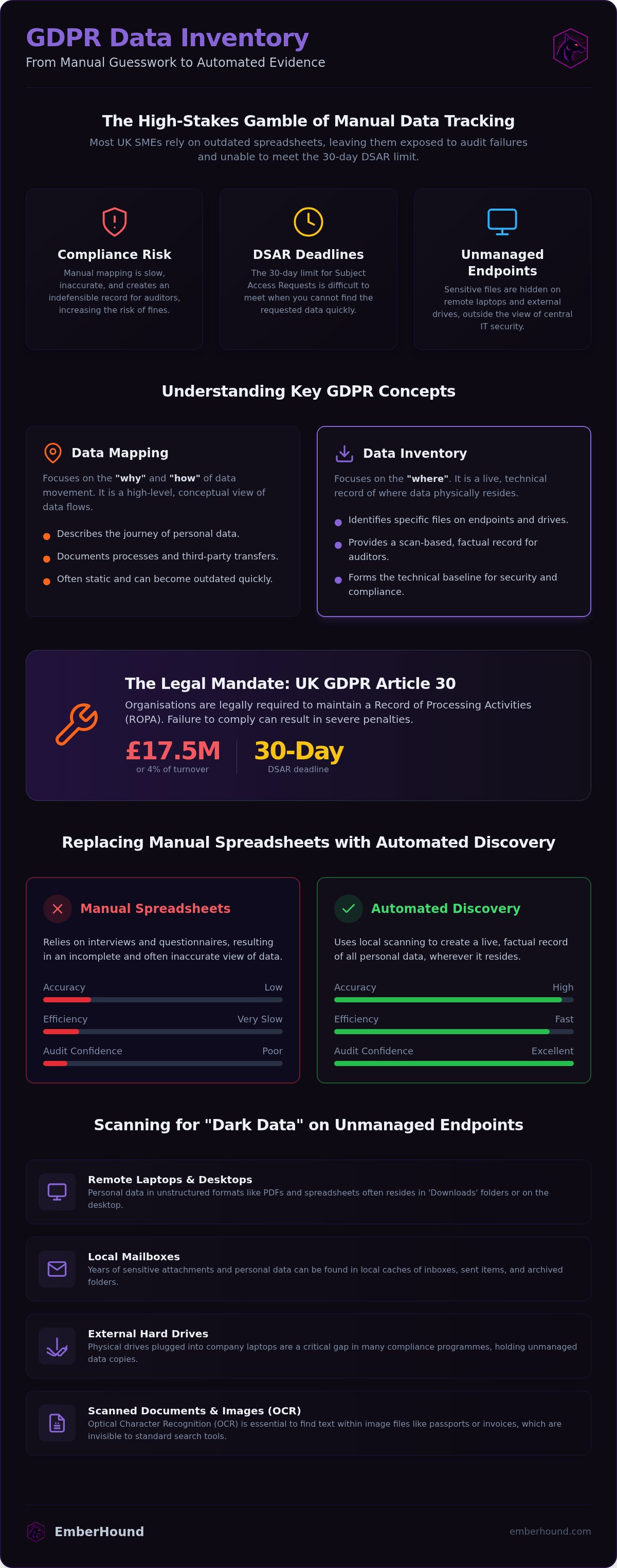
A data inventory is a live record of all personal data held by an organisation. It is not a static spreadsheet that sits in a folder gathering dust. It is a technical baseline. This record identifies what data you have, where it resides, and who has access to it. Without a factual inventory, your compliance strategy is based on guesswork. You cannot protect what you cannot see.
Building a data inventory for gdpr compliance is the first step toward a defensible security posture. It provides the visibility needed to handle data breaches and audit requests without panic. If you don't know that a sensitive file exists on a remote laptop, you cannot secure it. An inventory brings these "dark data" assets into the light.
Data inventory vs data mapping
Many businesses confuse data mapping with a data inventory. They are related but serve different purposes. Data mapping focuses on the "why" and "how" of data movement. It describes the journey of personal data from the moment it enters your business to the moment it is deleted. It looks at processes and third - party transfers. It is a high - level conceptual view.
In contrast, a data inventory focuses on the "where". It identifies specific endpoints, local mailboxes, and external hard drives. Whilst a map might say "customer data is stored in the CRM," an inventory will show that a copy of that data also exists in a stray CSV file on a marketing manager's desktop. Static maps are often out of date the moment they are finished. An inventory provides a factual, scan - based record of what is actually on the disk at this moment.
The legal requirement under UK GDPR
The legal pressure is real. Under the General Data Protection Regulation (GDPR) and the Data Protection Act 2018, UK organisations must maintain a Record of Processing Activities (ROPA). Article 30 specifically mandates this. The Information Commissioner's Office (ICO) requires you to document categories of data subjects, types of personal data, and retention schedules. You must also record your technical security measures.
Failure to maintain these records is a direct violation of the law. The stakes are high. The maximum fine for serious infringements under the UK GDPR is £17.5 million or 4% of total worldwide annual turnover. In May 2026, the ICO fined South Staffordshire Water £963,900 after a ransomware breach went undetected for 20 months. An accurate inventory is your primary evidence for auditors. It proves you understand your data estate and have taken active steps to manage it. It is also the only way to fulfil Subject Access Requests (DSARs) within the 30 - day limit. If you cannot find the data, you cannot disclose it.
Identifying personal data across your business network
UK SMEs often focus discovery efforts on central cloud storage. This leaves a massive blind spot. Personal data is rarely tidy. It lives in unstructured formats like PDFs, spreadsheets, and emails. Remote work has accelerated this sprawl. Sensitive files now reside on thousands of local hard drives outside the direct view of IT teams.
Identifying this data is essential for a data inventory for gdpr compliance that actually works. You cannot ignore the dark data lurking in downloads folders or on desktop backgrounds. These are the locations where temporary files become permanent liabilities. If an employee downloads a customer list to their laptop, your central audit log might miss it. You need endpoint - level visibility.
Scanning mailboxes and local drives
Email is the primary source of accidental data sprawl in UK businesses. Local mailboxes often contain years of sensitive attachments and personal data that should have been deleted. This isn't just an inbox problem. It includes sent items and archived folders stored locally on the device. Many employees keep local copies of their mailboxes for performance reasons, creating unmanaged caches of sensitive information.
External hard drives represent another critical gap. Many compliance programmes fail because they don't account for the physical drives employees plug into their laptops. A truly effective data inventory for gdpr compliance must include these peripherals. You must scan every local drive to ensure no scrap of data is left behind. You can start with a free scan to identify where these hidden files are currently residing on your network.
Using OCR to find data in scanned documents
Scanned documents are a common audit failure. Passports, driving licences, and invoices are often saved as images or non - searchable PDFs. Standard text search tools cannot see inside these files. This is where personal data goes to hide. If your discovery tool only looks for plain text, these files remain invisible and unrecorded.
Optical Character Recognition (OCR) is the solution. It allows you to identify text within image files across the network. Automated scanning with OCR ensures that a scanned ID on a remote desktop is just as visible as a row in a database. Without this capability, your inventory is incomplete. You must be able to prove to an auditor that you have identified text - based data even when it is trapped inside an image file.
Manual spreadsheets vs automated data discovery
Stop relying on employee memory. Manual spreadsheets are the weakest link in your compliance chain. Most UK SMEs start their journey with a shared document and a series of staff surveys. This approach is fundamentally flawed. It relies on the assumption that your team knows exactly where every file is stored. They don't.
Automation provides a factual, scan - based record of what is actually on the disk. It removes the human element from the equation. When you build a data inventory for gdpr compliance using technical discovery, you aren't asking for opinions. You are gathering hard evidence. The cost of manual discovery often exceeds the price of specialised software once you account for the hundreds of hours spent on internal meetings and follow - up emails. You can see the value comparison on our pricing page.
The inaccuracy of the survey - based approach
Employees often do not know they are storing personal data in temporary folders or local caches. A survey might capture what they remember, but it misses what they have forgotten. These snapshots in time become obsolete the moment they are saved. Technical discovery removes the guesswork. It identifies files in downloads folders, desktop backgrounds, and hidden directories that staff never think to report. This ensures your compliance reporting is based on reality, not recollection.
Building audit - ready evidence
Auditors require more than a list of names. They need proof that your discovery process is thorough and secure. Automated tools provide audit - ready evidence that manual lists cannot match. We use Salted SHA - 256 fingerprints to provide proof of discovery without ever exposing the raw data itself. This creates a permanent, verifiable record of the file's existence at a specific point in time.
Masked previews allow compliance officers to verify results securely. You can see enough of the data to confirm its type without violating privacy principles. Every mutation and access request is tracked in an audit log. This creates a transparent paper trail for the ICO or external auditors. Manual spreadsheets lack this integrity. They are easily edited, difficult to version, and offer no technical proof that the data actually exists where you say it does. Switching to automation is the only way to maintain a reliable data inventory for gdpr compliance as your business network grows.
How to build an audit-ready data inventory
Define your perimeter first. An audit - ready inventory starts by identifying every company - owned endpoint. This includes remote laptops, local mailboxes, and external storage. If you don't account for these devices, your scope is incomplete. You cannot claim compliance whilst ignoring the hardware your team uses daily. Once the scope is set, you must configure your scanning parameters to look for specific personal data patterns. This ensures your data inventory for gdpr compliance is built on technical facts rather than assumptions.
Scoping and pattern matching
Generic scans produce noise. You need precision. Customise your discovery to find industry - specific sensitive data that applies to your business. This might include health records, financial details, or specific customer identifiers. A clear technical roadmap is essential here. You should follow a GDPR data audit preparation checklist to ensure your scoping steps are airtight before the first scan runs. Common patterns to include in your scope are:
- Full names and residential addresses
- Email addresses and local mailbox content
- Financial information and payment card data
- Scanned identity documents identified via OCR
Execute the scan locally. This is a critical security step. Local - only processing ensures that no file exfiltration occurs. Your sensitive data never leaves the device it lives on. This approach maintains the highest level of security whilst building your record. After the scan, review the results to populate your Record of Processing Activities (ROPA). Categorise the data by subject type and retention period to satisfy ICO requirements.
Maintaining the inventory over time
Compliance is not a one - off event. It is a continuous obligation. Your data estate changes every time an employee saves a new file or plugs in a drive. You must establish a regular scanning cadence. Automate these scans to run on a weekly or monthly basis. This ensures that new endpoints and updated files are always captured in your record. Without regular updates, your inventory becomes a historical document rather than a live compliance asset.
An up - to - date inventory is your best defence against the 30 - day DSAR window. When a request arrives, you shouldn't be starting a search from scratch. You should already have the answers. Having a factual data inventory for gdpr compliance allows you to generate disclosure packs instantly. This reduces the risk of missing the deadline and proves to regulators that your data management is proactive. It turns a high - pressure legal requirement into a standard, manageable process.
Efficient data discovery with EmberHound
Lean IT teams cannot afford deployment drama. You need a solution that identifies every scrap of personal data without requiring a month of configuration. EmberHound Discover is built specifically for UK SMBs that require precise, endpoint - level visibility. It targets the unstructured files that central cloud tools often miss. By scanning the actual devices where your staff work, you build a data inventory for gdpr compliance that is based on technical reality rather than staff surveys.
We use a usage - based pricing model. This allows you to pay only for the endpoints you actually scan. There are no long - term contracts or complex licensing tiers. It is a transparent approach designed for agile businesses that need to scale their compliance efforts without unnecessary overhead.
Technical security and local processing
Security is the core of our discovery process. Traditional tools often require you to upload sensitive files to a central server for analysis. We reject this approach. All scanning occurs locally on the device. This local - only processing ensures that your files never leave the endpoint, eliminating the risk of data exfiltration during discovery. It is the most secure way to identify personal data across a remote workforce.
Your results are protected by industry - standard protocols. Data in transit uses TLS 1.3, whilst data at rest is secured with AES - 256 encryption. You can learn more about our security posture and specific encryption standards. To provide audit proof without exposing raw data, we generate salted SHA - 256 fingerprints. This creates a permanent, verifiable record of discovery that satisfies regulators whilst keeping the underlying personal data private. Masked previews further allow your compliance officer to verify results without viewing the full content of sensitive files.
Getting started with your first scan
Transitioning from manual spreadsheets to an automated data inventory for gdpr compliance takes minutes. The deployment is straightforward. You don't need to manage a complex on - premise dashboard or host a heavy database. You simply deploy the scanner to your endpoints and begin identifying risks immediately. It is designed to be lightweight and fast, ensuring no disruption to your team's daily workflow.
Don't wait for a Subject Access Request to discover your data gaps. You can start with a free GDPR scan to identify where sensitive files are currently hiding on your network. This initial scan provides the visibility you need to build a ROPA that actually reflects your data estate. It is the most efficient way to move from manual guesswork to a defensible, scan - based inventory that stands up to auditor scrutiny.
Secure your data estate today
Manual spreadsheets leave your business exposed to audit failure and missed DSAR deadlines. You simply cannot protect personal data you haven't identified. Transitioning to a scan - based data inventory for gdpr compliance replaces guesswork with technical evidence. It brings dark data from remote endpoints into the light whilst ensuring no file exfiltration occurs. This visibility is the foundation of a defensible security posture in a remote - first environment.
By using local - only processing, you maintain total control over your files. Salted SHA - 256 fingerprints provide the permanent proof auditors demand without compromising privacy. With usage - based pricing, you only pay for the devices you actually scan. It is a pragmatic, no - nonsense approach for lean teams who need results without deployment drama. You now have the framework to move beyond static maps and build a live record of your data.
Take the first step toward a defensible compliance posture. You can identify your risks and secure your perimeter in minutes. Total visibility is within reach.
Frequently Asked Questions
Do I need a data inventory for UK GDPR compliance?
Yes, you must maintain a record of your processing activities under Article 30 of the UK GDPR. This requirement applies to most organisations and is a foundational step for demonstrating accountability to the ICO. A data inventory for gdpr compliance provides the technical evidence needed to fill out your ROPA document accurately. Without it, you cannot prove you know where your data resides or how it is protected.
What is the difference between personal data and sensitive data in an inventory?
Personal data includes any information that can identify a living individual, such as names or email addresses. Sensitive data, often referred to as special category data, requires higher levels of protection. This includes information about health, ethnic origin, or religious beliefs. Your inventory must distinguish between these types because they carry different legal obligations. Identifying these categories is essential for meeting specific UK GDPR protection standards.
How often should I update my data inventory?
You should update your inventory whenever your data estate changes, but a weekly or monthly scanning cadence is best for most SMEs. Static records become obsolete quickly as employees create new files or move data to external drives. Regular discovery ensures your compliance record remains a live asset rather than a historical document. Automated tools can run these checks in the background to maintain accuracy without disrupting your daily IT operations.
Can a data inventory help with Subject Access Requests (DSARs)?
Yes, an accurate inventory is the only way to reliably fulfil DSARs within the mandatory 30 - day window. Instead of starting a manual search across every laptop and server, you can use your inventory to locate relevant files instantly. This reduces the risk of missing sensitive attachments or dark data in downloads folders. Having a pre - mapped record allows you to generate disclosure packs with confidence and speed.
Is a spreadsheet enough for a GDPR data inventory?
Spreadsheets are rarely sufficient because they rely on manual entry and human memory. They lack the technical integrity required for a defensible audit trail and cannot track files that employees forget to report. A spreadsheet is a snapshot of the past, whilst an automated inventory provides a factual record of the present. For a data inventory for gdpr compliance, you need a verifiable evidence trail that only technical discovery tools can provide.
How do I find personal data in scanned image files?
You must use Optical Character Recognition (OCR) technology to identify text trapped inside image files or non - searchable PDFs. Standard search tools ignore these formats, leaving passports, driving licences, and invoices invisible to your compliance team. OCR converts these images into machine - readable text, allowing your scanner to flag personal data patterns. This ensures that your inventory covers the unstructured image data that often causes audit failures.
Does data discovery software move my files to the cloud?
Not if you use a local endpoint scanner. Some enterprise tools exfiltrate data to a central cloud for analysis, but this increases your security risk. EmberHound performs all processing locally on the device, ensuring your sensitive files never leave the endpoint. This approach maintains privacy whilst building your record. All results are protected by TLS 1.3 and AES - 256 encryption, providing a secure way to map your data estate.
What happens if I do not have an accurate data inventory during an audit?
Failing to produce an accurate inventory during an ICO audit can lead to significant fines and enforcement action. You may be found in breach of Article 30 or Article 32 requirements for data security and record - keeping. Beyond financial penalties, a lack of visibility makes it impossible to manage data breaches or fulfil DSARs correctly. This creates a high - stakes liability that can damage your organisation's reputation and operational stability.


