

Why are you still paying senior legal consultants to manually map data that a machine could find in seconds? The most expensive part of GDPR isn't the potential fine. It's the thousands of pounds lost to manual labour. To stay lean, you must reduce GDPR compliance costs by cutting out human indecision. You've likely felt the sting of a single DSAR landing. You've watched your best people get buried in unmanaged mailboxes for weeks. It's an inefficient, exhausting drain on your resources. It makes budgeting for compliance feel like total guesswork.
It's time to stop the bleed. We're going to show you how to slash manual labour hours and audit fees by automating your data discovery and minimising your compliance scope. You don't need more corporate fluff or bloated consulting hours. You need speed. You need visibility. We've compiled the 2026 efficiency checklist to help you remove hidden PII, automate disclosure packs, and achieve predictable response times. Here is how you turn compliance from a variable burden into a fixed, manageable software expense that actually protects your bottom line.
Key Takeaways
- Identify the "Labour Trap" where manual data mapping and human indecision drain your annual budget.
- Minimise your compliance scope by purging redundant, obsolete, and trivial data that creates unnecessary liability.
- Discover how automated scanning and OCR technology can drastically reduce GDPR compliance costs compared to manual file indexing.
- Accelerate DSAR response times from weeks to hours by replacing manual collation with automated disclosure packs.
- Eliminate expensive audit blind spots by uncovering hidden PII in unmanaged mailboxes and legacy hard drives.
The Hidden Drains: Why Manual GDPR Compliance is Bleeding Your Budget
Compliance isn't inherently expensive. Your current methods are. Most businesses fall into the "Labour Trap" without even realising it. They treat data management as a manual task for their most expensive employees. When you pay a senior manager to spend twenty hours a week squinting at spreadsheets and digging through unmanaged mailboxes, you aren't just doing compliance. You're burning capital. If you want to reduce GDPR compliance costs, you must stop treating data mapping as a human-led activity.
Then there's the "Consultancy Loop". Traditional compliance relies on high-priced legal consultants who charge by the hour. They provide plenty of advice but very little action. You end up with a fifty-page PDF and the same data mess you started with. This is circular spending. It's a strategy that prioritises billable hours over technical resolution. You don't need another meeting; you need a tool that actually finds the data.
Calculating the Price of Human Error
Human eyes miss things. It's a fact of biology. A single spreadsheet containing PII left in a "Misc" folder can trigger a secondary audit or a costly legal dispute. These mistakes aren't just annoying; they're financial liabilities. In 2026, the Cost of Oversight is the total financial penalty and labour expense created by unmapped, unmanaged, and forgotten personal data. To stop this, you need to understand what is GDPR data discovery and how it replaces human guesswork with machine precision. Automation doesn't just find data; it removes the risk of the "second look" audit.
The DSAR Deadline Crisis
The thirty-day window is a budget killer. When a Data Subject Access Request (DSAR) lands, most teams enter a state of panic. They pull senior staff away from revenue-generating work to perform "Panic Searching" across unorganised local drives and archived emails. This emergency resource allocation is the most expensive way to handle data. You're paying for urgency because you lacked visibility. By the time you've manually collated every email and document, you've likely spent more on wages than the cost of a year's worth of automated scanning.
Finally, consider the price of data hoarding. Keeping everything "just in case" is no longer a safe bet. It's a liability that inflates your cyber insurance premiums and expands your audit scope. Insurers now look at your total data footprint to calculate risk. The more redundant, obsolete, or trivial (ROT) data you hold, the more you pay. To reduce GDPR compliance costs, you have to shrink the target. You need to identify what you have, delete what you don't need, and secure the rest with zero-trust discovery tools. Lightness is your best defence against rising costs.
Auditing Your Data Footprint to Minimise Compliance Scope
Every byte of Personal Identifiable Information (PII) you store is a liability. It's that simple. If you want to reduce GDPR compliance costs, you have to stop hoarding. Scope Minimisation is the act of aggressively reducing the volume of PII your business is legally responsible for. It's about thinning the herd. By identifying and deleting data you no longer need, you instantly shrink your legal exposure. You also lower the cost of your annual audits. Less data means fewer hours for an auditor to bill. It's the most direct path to a leaner budget.
"Zero-Trust" data discovery doesn't assume your servers are clean. It assumes they're cluttered. It hunts for Redundant, Obsolete, or Trivial (ROT) data that has been gathering dust for years. This isn't just about digital tidying. There is a direct link between your total data volume and your cyber insurance premiums. Insurers in 2026 are increasingly forensic. They calculate your risk based on the size of your attack surface. If you're holding onto ten years of customer data when you only need three, you're paying a premium for your own negligence. You're subsidising your own risk.
Identifying ROT Data Across the Network
Dark Data is your biggest enemy. It's the information hiding in unmanaged mailboxes, secondary backups, and neglected local drives. It serves no business purpose, yet it carries full GDPR weight. You need to spot duplicate records that have been copied across departments whilst ensuring the master record remains secure. This visibility is the first step in a "Clean-Up Sprint". You can audit your data footprint in days rather than months by using automated scanning tools that see what humans miss. Stop guessing where your PII lives and start seeing it.
Shrinking the Audit Surface Area
A smaller footprint makes life easier for your Data Protection Officer (DPO). It simplifies everything from subject access requests to impact assessments. For UK businesses handling payments, scope reduction has a double benefit. It slashes the complexity of combined PCI DSS and GDPR audits. When you reduce the number of systems that touch sensitive data, you reduce the number of systems you have to pay to protect. You're not just being compliant; you're being lean. You are turning a massive, sprawling obligation into a tight, manageable asset.
Organising a Clean-Up Sprint is the fastest way to reduce GDPR compliance costs before your next audit cycle. It involves a time-boxed effort to purge unnecessary records across the entire network. This isn't a vague suggestion; it's a survival tactic. By removing the "just in case" data, you remove the cost of protecting it. You move faster. You spend less. You stay protected without the bloat of unnecessary storage.
Automated vs Manual Discovery: A Direct Cost Comparison
Hiring more people to solve a data problem is like trying to empty the ocean with a bucket. It's expensive. It's slow. It's doomed to fail as your data grows. To reduce GDPR compliance costs, you have to look at the math. Manual file indexing relies on human speed. It's a linear expense. If your data volume doubles, your labour costs double. Automation breaks this cycle. It offers a scalable solution that processes terabytes as easily as gigabytes. The software cost stays flat whilst your data footprint expands, turning a variable liability into a predictable utility.
Then consider the hidden tax of false positives. When a human searches for PII, they often pull back thousands of irrelevant files. A staff member then has to spend hours filtering that noise to find actual personal data. This is wasted time. High-precision GDPR data discovery software UK uses pattern matching to eliminate this friction. It delivers clean, actionable results. It stops you from paying people to read documents that should never have been in the pile in the first place.
The ROI of Automated Scanning
Compare the cost per DSAR. A manual workflow involves searching, reviewing, and redacting across multiple platforms. This can easily consume forty hours of staff time. At a senior wage, that's a massive hit to your operational budget. Automation reduces this fulfilment process to a few clicks. You also avoid the "Sunk Cost" of employee training. Manual discovery requires constant upskilling of teams who eventually move on to other roles. Software doesn't quit. It retains the knowledge of your network permanently.
Eliminating the Need for MSSP Overheads
Many businesses pay Managed Security Service Providers (MSSPs) a heavy markup for basic visibility. You're effectively paying a middleman to look at your own data. In-house tools remove this layer of unnecessary expense. They give you "always-on" visibility without the periodic consulting fees. Instead of waiting for a quarterly report from an external team, you have the facts instantly. It's about taking control. It's about moving from reactive spending to proactive protection. You don't need a managed service; you need a tool that works.
The choice is simple. You can continue to throw expensive man-hours at a growing problem, or you can automate. Every hour spent on manual indexing is an hour stolen from revenue-generating work. To reduce GDPR compliance costs in 2026, you must decouple your compliance efforts from your headcount. Efficiency isn't just about doing things better. It's about doing fewer things manually. Automation is the only way to stay lean in a data-heavy world.
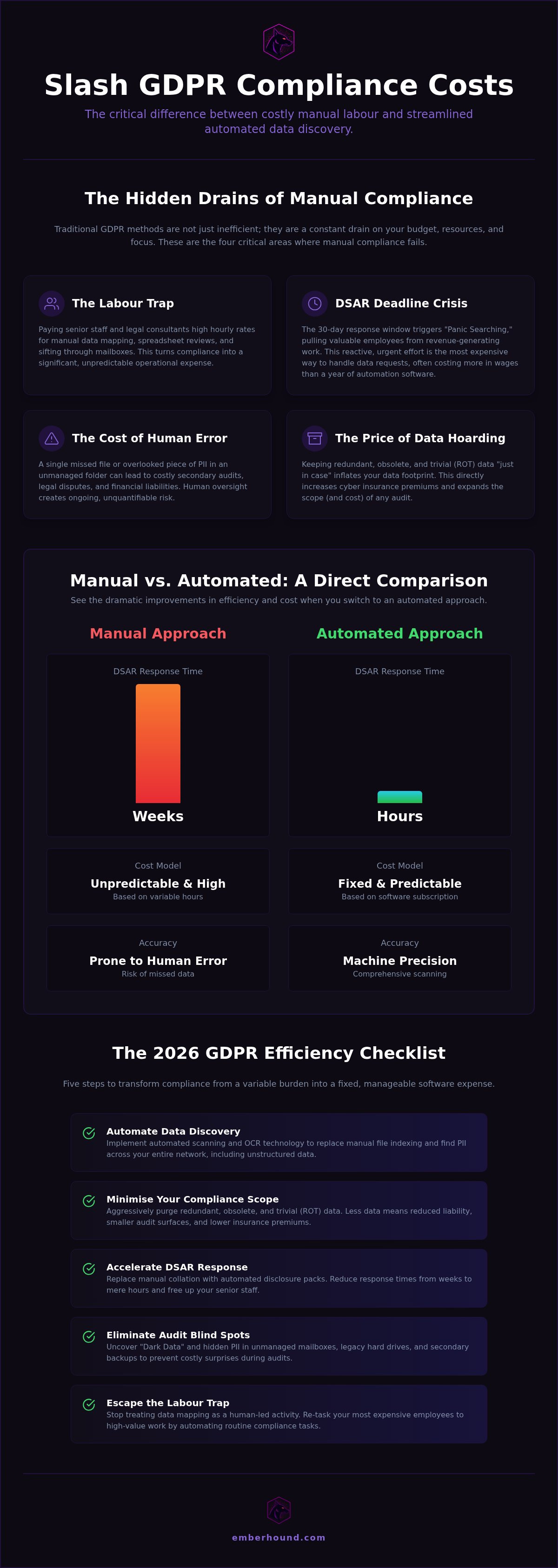
The GDPR Cost-Reduction Checklist: 5 Steps to Leaner Compliance
Theory is fine, but action saves money. To reduce GDPR compliance costs, you need a repeatable, technical framework that removes human error from the equation. Most businesses overspend because they lack a structured approach to data visibility. They react to requests instead of managing the environment. Follow this five-step checklist to strip the bloat from your compliance budget and reclaim your team's time.
- Step 1: Deploy automated scanning. Stop paying people to draw maps that are out of date by the time they're finished. Automated discovery provides a real-time inventory of your PII without the manual labour tax.
- Step 2: Implement OCR for legacy archives. Scanned PDFs and images are often ignored because they're "too hard" to search. This is a massive liability. Use OCR to index these files instantly.
- Step 3: Centralise DSAR fulfilment. Use a dedicated disclosure pack to collate and redact data. This turns a forty-hour task into a five-minute process.
- Step 4: Scan remote worker hard drives. Personal laptops and home office setups are breeding grounds for "Shadow PII". You must index these local drives to prevent unmanaged data from triggering a breach.
- Step 5: Consolidate your scanning platforms. If you're paying for separate GDPR and PCI tools, you're overpaying. Use a single platform to cover both.
OCR: Unlocking Hidden Data in Scanned Images
Scanned documents are compliance black holes. Most teams resort to manual review when a DSAR involves legacy files. This is a massive cost centre that drains your most valuable resources. It's slow. It's prone to oversight. Automated OCR technology identifies PII within images and scanned PDFs in seconds. It turns unsearchable pictures into actionable data. By digitising your archives, you remove the need for expensive "deep dives" into physical or scanned records. You stop paying for eyes and start paying for results.
Securing the Remote Perimeter
The office is no longer the boundary of your data risk. Remote workers often save sensitive files to local drives to "save time", creating dangerous pockets of Shadow PII. Physical audits are impossible and expensive. The cost-saving solution is remote hard drive scanning. By indexing local devices through a central tool, you maintain visibility without the travel costs or the disruption. You can automate your remote data discovery to ensure every device is indexed. This prevents breach costs before they happen by finding the data before a hacker does.
Consolidating your efforts is the final move. When you combine your GDPR and PCI card data scanning, you don't just save on subscription fees. You save on training and management time. One dashboard. One process. Total visibility. This is how you reduce GDPR compliance costs whilst actually improving your security posture. Don't let your compliance budget be a variable mystery. Turn it into a fixed, automated asset.
Future-Proofing Compliance with EmberHound
Compliance shouldn't be a boardroom crisis. It shouldn't be a never-ending manual journey led by expensive consultants. Most GRC platforms are bloated, enterprise-level monsters that take months to configure. They add complexity instead of removing it. EmberHound is the "No-Bloat" alternative. It's built for teams who need to reduce GDPR compliance costs instantly, not after six months of "onboarding". We focus on technical action over theoretical advice. It's about getting the job done.
For UK businesses, the advantage of combined GDPR and PCI coverage is unmatched. Why pay for two separate tools? Why manage two sets of credentials? You can scan for card data and personal identifiers in a single pass. This consolidation is a direct win for your budget. It simplifies your internal audits and cuts your software overheads in half. You get total visibility across your network without the enterprise price tag. It's lean. It's fast. It works.
The Agile Guardian Approach
We act as your Agile Guardian. EmberHound prioritises speed and immediate visibility. We find the data that humans miss. Our mailbox add-ons and hard drive add-ons ensure that "Shadow PII" has nowhere to hide. You don't need to hire more staff to manage your growing data mess. You just need a tool that sees everything. Being registered in England & Wales means we understand the local regulatory landscape. We don't hide behind layers of corporate fluff. We deliver results that protect your business and your budget.
Ready to Stop the Bleed?
You've seen the cost of human error. You know the price of manual searching. Every day you wait is another day of variable labour costs and hidden risks. Switching to automated scanning provides immediate savings. It turns your compliance effort into a background process that runs whilst you focus on growth. It's time to stop manual data discovery and start protecting your bottom line. You've done the hard work. Now let the software handle the search.
To reduce GDPR compliance costs, you must choose a partner that values your time. You need a solution that replaces guesswork with precision. Compliance doesn't have to be a burden. With the right tools, it becomes a silent, efficient asset. Stop the manual grind. Start the automation. Secure your future without the bloatware.
Secure Your Bottom Line with Automated Precision
Manual compliance is a relic. It's a variable expense that grows every time your data footprint expands. You've seen how human indecision and "panic searching" bleed your budget. By deploying automated scanning and aggressively shrinking your data scope, you turn a complex regulatory burden into a streamlined background process. You don't need a larger team; you need better visibility.
Automation is the only sustainable way to reduce GDPR compliance costs in 2026. Focus on the high-impact moves: replace manual mapping with machine precision, use OCR to unlock legacy archives, and consolidate your scanning tools. This isn't just about avoiding fines; it's about operational efficiency.
Ready to stop the bleed? Reduce your compliance overheads with EmberHound’s automated scanning tools today. Our platform includes DSAR disclosure packs for rapid fulfilment and OCR for scanned document discovery. You'll also benefit from UK-based support and expertise every step of the way. You've done the hard work of building your business. Let us handle the data discovery whilst you focus on the future.
Frequently Asked Questions
How much does GDPR compliance typically cost for a UK SME in 2026?
Compliance costs are highly variable for UK SMEs. Your total expense includes the mandatory ICO data protection fee, internal staff wages spent on audits, and the price of security tools. Whilst every business differs, the highest costs usually stem from inefficient manual processes and human error. Transitioning to a lean, tool-based approach is the only way to keep these overheads predictable as your company grows.
Can I really reduce my GDPR costs by using automated scanning software?
You can absolutely reduce GDPR compliance costs by switching to automated scanning. Machines process terabytes of data in the time it takes a human to read a single folder. By removing the need for manual file indexing, you cut the labour tax that makes traditional compliance so expensive. Automation turns a variable, staff-heavy burden into a fixed software expense that scales with your business.
What is the most expensive part of maintaining GDPR compliance?
Human labour is the most expensive component by a wide margin. Paying senior staff or external consultants to search through unmanaged mailboxes and local hard drives for PII is a massive drain on your budget. This "labour trap" often costs businesses more than the software that could solve the problem instantly. It's the hidden price of indecision and lack of visibility across your network.
How does data discovery software help with DSAR fulfilment costs?
Discovery software eliminates the "panic search" associated with the 30-day DSAR window. It indexes your entire network and collates relevant files into a disclosure pack automatically. This turns a forty-hour manual task into a five-minute automated process. You save thousands in internal wages and avoid the need for expensive emergency resource allocation that disrupts your revenue-generating departments whilst you struggle to meet deadlines.
Is it cheaper to hire a DPO or use compliance automation tools?
It's usually more cost-effective to use automation to support your DPO rather than relying on manual mapping. A DPO provides essential legal oversight, but they shouldn't be doing the manual legwork of finding data. Using software to handle the discovery work allows your DPO to focus on high-level strategy. This reduces the number of billable hours you pay to external consultants for routine tasks.
What happens if we ignore GDPR compliance to save money?
Ignoring compliance is a high-stakes gamble that usually ends in financial disaster. Beyond the risk of ICO fines, which can reach up to £17.5 million or 4% of global turnover, you face the cost of remedial audits and lost customer trust. The price of a single data breach far outweighs the cost of proactive automation. Saving money on compliance today often leads to total business failure tomorrow.
Can OCR scanning actually lower my data audit expenses?
OCR scanning directly lowers audit expenses by making "dark data" searchable. Manual review of scanned PDFs and images is a notorious cost centre that drains your team's time. OCR identifies PII in these files automatically, ensuring you don't miss hidden liabilities during a data audit. It turns unsearchable pictures into actionable data, removing the need for expensive, manual file-by-file inspections that lead to fatigue and error.
How often should I scan my network to keep compliance costs low?
Regular scanning is essential to reduce GDPR compliance costs over the long term. Monthly or quarterly scans catch "Shadow PII" before it becomes a deep-rooted liability. Consistent visibility prevents the need for expensive, emergency clean-up operations before an annual audit. By keeping your data footprint lean and well-mapped throughout the year, you avoid the seasonal spikes in compliance spending that hit unorganised businesses.


