

Your current vulnerability scanner is no longer enough to satisfy a QSA. PCI DSS 4.0 has turned what used to be a routine tick-box exercise into a rigorous technical hurdle. Requirement 11.3.1.2 now mandates authenticated internal scans, and for many UK IT teams, this means facing the uncomfortable reality that cardholder data is likely hiding in plain sight. Manual scope validation is a drain on resources and a primary cause of audit anxiety. You shouldn't have to spend weeks manually checking local drives whilst fearing a failed assessment due to one overlooked PDF.
Finding the right PCI DSS 4.0 scanning tool is about more than just flagging outdated software. It's about finding every instance of unencrypted Primary Account Number (PAN) data across your network, mailboxes, and even image-based files. This article identifies the specific technical requirements you must meet to stay compliant. You'll learn how to select tools that automate discovery and generate the precise reports your QSA requires. This approach saves your organisation time - and reduces assessment costs by thousands of pounds.
Key Takeaways
- Master the transition to authenticated scanning mandated by Requirement 11.3.1.2 to gain full visibility into internal system configurations.
- Use a specialised PCI DSS 4.0 scanning tool to locate hidden PAN data and effectively shrink your Cardholder Data Environment (CDE) scope.
- Implement automated discovery to satisfy Requirement 12.10.7, replacing manual checks with continuous monitoring for unexpected card data.
- Evaluate scanning software based on its ability to inspect remote hard drives and use OCR technology for identifying data in scanned receipts.
- Produce precise reports that satisfy QSA requirements and eliminate the need for manual data entry or spreadsheet tracking.
The Transition to PCI DSS 4.0 Authenticated Scanning
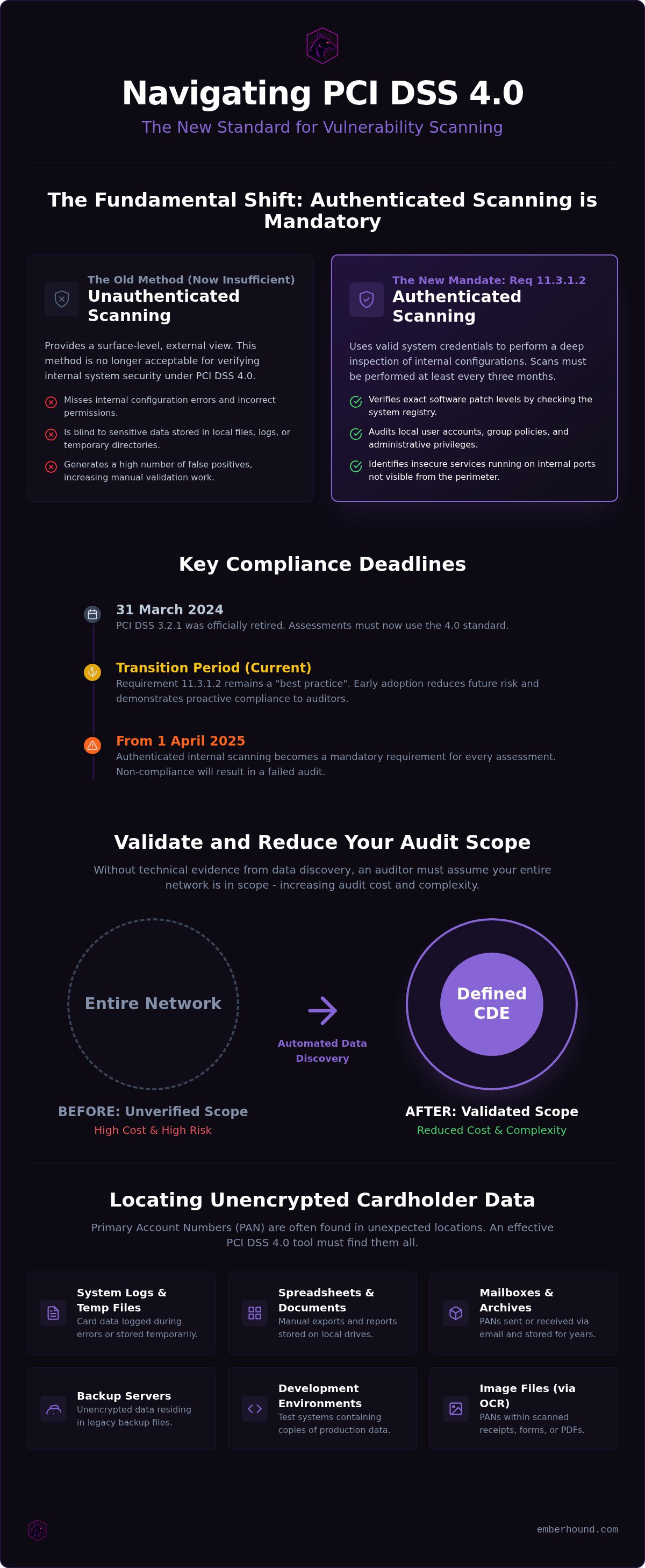
PCI DSS 4.0 has ended the era of surface-level scanning. Requirement 11.3.1.2 changes the fundamental approach to internal vulnerability assessments. It's no longer acceptable to ping a server from the perimeter and hope for the best. You must now provide your PCI DSS 4.0 scanning tool with the credentials needed to look inside the system. Standard 4.0 demands these authenticated scans at least once every three months. If you aren't doing this, you aren't compliant. It's that simple.
Unauthenticated scans are blind to internal realities. They see what a hacker sees from the outside, but they miss the configuration errors that lead to data breaches. Authenticated tools provide a complete view of user settings, permissions, and internal file structures. This visibility is the difference between a clean audit and a catastrophic oversight.
Why Credentials Matter for Compliance
Scan tools use valid credentials to access the operating system level. This is about checking the machine rather than just the network. This access allows the software to identify vulnerabilities hidden from the network perimeter. Authenticated scanning is more efficient at reducing false positives during audits. It provides the following technical benefits:
- Verification of patch levels at the registry level.
- Audit of local user accounts and administrative privileges.
- Detection of sensitive data in temporary directories or logs.
- Identification of insecure services running on internal ports.
Your QSA does not want a list of 500 "potential" issues. They want a verified report. Authenticated scanning provides that certainty and reduces the manual labour required to validate scan results.
Key Deadlines for UK Businesses
The clock is ticking for UK organisations. PCI DSS 3.2.1 officially reached its end of life on 31 March 2024. We are currently in a transition period that rewards early adopters and punishes the slow. Requirement 11.3.1.2 remains a best practice until 31 March 2025. After that date, it becomes a mandatory requirement for every assessment.
Implementing a PCI DSS 4.0 scanning tool now is a strategic necessity. 2026 assessments will require evidence of historical data and consistent scanning patterns. If you wait until April 2025 to start, you will lack the track record of compliance your auditor expects. Proactive implementation reduces the risk of last-minute technical hurdles that could delay your Attestation of Compliance (AoC).
Validating Audit Scope with Data Discovery Tools
The Cardholder Data Environment (CDE) is the primary driver of audit costs. If you cannot prove where card data is, your QSA will assume it is everywhere. This leads to an expensive audit scope that covers your entire network. A dedicated PCI DSS 4.0 scanning tool provides the technical evidence needed to exclude specific systems from the CDE. Without a verifiable inventory, scope reduction is just guesswork. You are essentially asking an auditor to trust your word. This is a high-risk strategy that usually ends in a wider assessment area and higher fees.
Manual file searching is a slow and unreliable process. It relies on staff knowing where they should save files. In reality, files often end up in different locations due to human error or automated system processes. Automated scanning eliminates this uncertainty. It provides a definitive list of every system that touches cardholder data. This clarity allows you to isolate the CDE and apply tighter controls only where they are needed. The result is a smaller audit footprint and lower compliance costs for your organisation.
Finding PAN Data Across the Network
Primary Account Numbers (PAN) are rarely confined to secure databases. They leak into system logs, temporary files, and forgotten spreadsheets. This data residue creates a significant compliance risk. You should use an unencrypted card data finder to locate these risks before an auditor arrives. Your scanning strategy must include all connected systems. This includes backup servers and development environments that IT teams often overlook.
Connected systems often include backup servers, development environments, and print spoolers. These are the locations where card data remains perfectly readable to an attacker. If a system is connected to the CDE, it is in scope until you prove it contains no card data. Scanning these secondary environments is the only way to satisfy the requirements of PCI 4.0. It is a binary choice: you either scan the system or you pay to audit it. Automated discovery ensures your inventory is accurate and defensible during a QSA assessment.
The Role of OCR in Modern PCI Discovery
PCI DSS 4.0 places a higher burden of proof on organisations to find data in non-traditional formats. Finance departments are often a major source of risk. They handle scanned receipts, PDF invoices, and email attachments. Standard text-based search tools cannot read these files. OCR technology is now a requirement for any effective discovery process. It identifies card numbers within image files that would otherwise remain hidden from your security team.
If your tool lacks OCR, your discovery process has a significant blind spot. A single scanned invoice containing a PAN can pull an entire file server into your audit scope. Automated OCR scanning finds these files in minutes. It is better to identify these files early and move them to secure storage. Waiting for a formal assessment to find these risks is a costly mistake. Using a specialised PCI DSS 4.0 scanning tool ensures that your finance department does not become the weak link in your compliance chain.
Addressing Requirement 12.10.7: Continuous Visibility
Requirement 12.10.7 is not a suggestion. It is a mandate for visibility. You must have established procedures to respond when PAN appears where it does not belong. This requirement implies a fundamental shift in compliance management. You need continuous visibility. An annual check is a snapshot of the past. It cannot protect you from scope creep that happens on a random Tuesday. Your PCI DSS 4.0 scanning tool must be active throughout the year to capture these anomalies.
Automated discovery prevents minor configuration errors from turning into major compliance failures. If you only scan once a quarter, exposed data could sit for months. That is a massive window of risk. Continuous scanning closes that window. It alerts your team the moment unencrypted data is detected in an unauthorised location. This proactive approach turns compliance from a stressful event into a standard operational process.
Incident Response and Data Discovery
Discovery tools are your early warning system. If a developer accidentally pushes a database dump to a public-facing segment, you need to know. Your incident response plan must include a specific technical step for scanning affected network segments. This is a technical component of a data privacy discovery software strategy. It allows you to contain the leak before it becomes a reportable breach for your organisation.
When an incident occurs, the first question from a QSA or the ICO is: "What was exposed?" Without a recent scan, you cannot answer. You are left guessing. A proactive scan provides a definitive log of what was present before the event. It turns a chaotic response into a methodical, evidence-based process. This level of detail is exactly what regulators expect to see when things go wrong.
Maintaining a Flat Network
Segmentation is the most effective way to reduce PCI audit costs. By isolating the CDE, you limit the number of systems that require testing. However, network segments are not static. Firewalls change. New routes are added. Automated scanners verify that card data has not migrated across these boundaries. They ensure your network remains properly segmented and that data stays where it is authorised.
Requirement 12.5.2 mandates scope validation at least every six months. Regular scans provide the technical evidence required to prove your segmentation remains effective. This removes the burden of manual network mapping and spreadsheet tracking. You don't just assume the network is secure; you produce the report that proves it. This level of automated oversight simplifies the audit process and provides a clear path to a successful v4.0 assessment.
Selection Criteria for PCI DSS 4.0 Scanning Software
Selecting the right software is a high-stakes decision. A failed audit costs significantly more than a licence fee. You need a tool that handles the technical heavy lifting without breaking your infrastructure. Authenticated scanning across Windows, Linux, and MacOS is the absolute baseline. If a vendor cannot support all three, they are leaving a gap in your compliance posture. Modern teams are distributed. Your scanner must reach remote hard drives and mailboxes where card data often migrates.
Your choice of a PCI DSS 4.0 scanning tool determines how much manual effort your team spends on audit preparation. Efficiency is key. The software should have a low impact on system performance. You cannot afford to crash a production server during business hours just to satisfy a requirement. Look for software that prioritises speed and visibility without the bloat of traditional enterprise suites.
Optical Character Recognition (OCR) is no longer optional. Requirement 12.10.7 demands procedures to find PAN where it is not expected. This includes image-based data like scanned receipts or PDF invoices. If your tool cannot read images, your finance department remains a massive compliance blind spot. Remote hard drives are another specific pain point for UK businesses with hybrid workforces. Data discovery must extend to the laptops of staff working from home. A tool that cannot scan these endpoints leaves your organisation exposed.
Technical Compatibility Requirements
Security is paramount. The tool must use modern encryption standards to store the credentials needed for authenticated scans. You should also decide between agent-based and agentless scanning. Agentless options often reduce the maintenance burden on your IT team. Crucially, ensure the software can find PAN data on network shares and NAS devices. These central storage hubs are common locations for unencrypted data leaks that auditors will check.
Reporting and Audit Readiness
Your QSA does not have time to decode vague reports. They want data mapped directly to PCI DSS 4.0 requirement codes. High-quality software distinguishes between encrypted and unencrypted PAN data automatically. This distinction is vital for accurate scope validation. It prevents you from wasting time on data that is already secured. It also helps you justify why certain systems are excluded from the CDE.
Audit readiness requires a clear trail. The software must log every scan activity, including dates, targets, and findings. This creates a defensible history of compliance that spans the entire year. Specialist tools often include PCI 4.0 compliance packs that pre-format these reports for immediate submission. This reduces the manual effort required to prepare for your annual assessment. To streamline your next audit, explore how EmberHound automates card data discovery.
EmberHound: Reducing Audit Complexity through Automated Scanning
EmberHound is a specialised PCI DSS 4.0 scanning tool built to eliminate the manual labour of audit preparation. It handles both PCI card data scanning and GDPR discovery within a single interface. The platform identifies sensitive data in locations other tools miss. This includes the deep layers of local file systems and network shares. We provide the tools to manage your own compliance without the need for expensive managed service contracts or outside consultants.
Clarity is a priority for our reporting. We use a spaced - hyphen format to ensure every finding is clear and professional for your QSA. This avoids the cluttered, jargon-heavy outputs produced by traditional enterprise scanners. You get a direct list of what needs fixing, where it is, and why it is a risk. This approach allows your internal team to take control of the data discovery process. You don't need a managed security service provider to run these scans for you. You have the technical capability to find and remediate risks instantly.
Specialised OCR and Mailbox Add-ons
Our OCR engine is a technical requirement for modern compliance. It extracts text from images to find hidden card data in scanned invoices and receipts. This capability is required for meeting the strict v4.0 visibility requirements. Standard text searches cannot see these files. If they remain in your environment, they represent an unmanaged risk. We offer specific modules to address these blind spots:
- OCR Scanning: Identifies PAN within images and PDFs.
- Mailbox Add on: Scans email history for unencrypted card data.
- Hard Drive Add on: Inspects the local storage of remote workstations.
The mailbox add-on scans every inbox to ensure no PAN is stored in email history. We also offer a hard drive add-on to reach the laptops of remote workers. These features close the gaps that often lead to failed assessments. You can identify unencrypted data on a specific workstation and remove it before the audit begins. This level of automated oversight replaces the need for manual sampling or staff interviews.
Direct Support for UK Compliance Teams
EmberHound is a UK-based technology company registered in England & Wales. We understand the specific regulatory pressure on UK organisations. Our software is built for lean teams who need immediate, actionable results. You don't have to wait for an overseas support desk to answer a technical question. We provide direct access to UK-based technical support to help you configure your scans effectively.
Our focus is on precision. We don't provide a long list of irrelevant security insights. We provide a tool that finds card data. This allows you to validate your CDE scope and reduce your audit costs. Learn more about PCI DSS card data scanning to see how automated discovery simplifies the path to v4.0 compliance. By identifying unencrypted PAN data across your network, you can ensure your organisation stays within the boundaries of its security policy.
Secure Your Audit Path Before the Deadline
PCI DSS 4.0 has changed the rules of the game. Authenticated scanning is a technical necessity for Requirement 11.3.1.2. By implementing a dedicated PCI DSS 4.0 scanning tool now, you eliminate the guesswork from scope validation. You move from assuming your network is flat to proving it. This proactive approach saves your team from the high costs of manual data discovery and the risk of hidden PAN data.
You deserve a solution that matches your pace. EmberHound provides a no-nonsense technical interface designed for speed. Our platform includes OCR data detection to find card numbers in scanned images and is backed by UK-based expert support. Don't let your next audit be a source of anxiety. Take control of your data environment today. Start your PCI DSS 4.0 scan with EmberHound.
Compliance is a process, not a crisis. You have the tools to stay ahead.
Frequently Asked Questions
Is authenticated scanning mandatory for PCI DSS 4.0?
Yes, authenticated scanning is mandatory under Requirement 11.3.1.2 for internal vulnerability scans. Whilst it is a best practice today, it becomes a strict requirement after 31 March 2025. Providing credentials allows the scanner to inspect the operating system registry and local file structures. This level of access is necessary to identify configuration risks that unauthenticated scans cannot detect from the network perimeter.
How often should I run a PCI DSS 4.0 scanning tool?
You must run scans at least once every three months to meet the basic requirement. However, Requirement 12.10.7 suggests that discovery should be an ongoing process. Regular use of a PCI DSS 4.0 scanning tool identifies data leaks as they happen rather than months later. This continuous visibility prevents scope creep and ensures you are always ready for an unannounced audit or assessment.
What is the difference between a vulnerability scan and a discovery scan?
Vulnerability scans find security bugs; discovery scans find the data itself. A vulnerability scan checks for missing patches or insecure ports. A discovery scan uses a PCI DSS 4.0 scanning tool to locate unencrypted cardholder data across your network. You cannot prove your audit scope is correct without discovery. Both processes are required to satisfy the technical standards of a v4.0 assessment and protect your organisation.
Can I use the same tool for GDPR and PCI DSS 4.0 scanning?
Yes, it is possible to use one platform for both regulations. EmberHound offers combined coverage for GDPR data discovery and PCI card data scanning. This efficiency allows lean IT teams to manage data privacy risks without switching between different tools. You can identify unencrypted PAN and PII in the same scan, which simplifies your internal reporting and reduces the software overhead for your security department.
Does PCI DSS 4.0 require scanning of remote worker laptops?
Yes, if those laptops are used to process or store cardholder data, they are in scope. PCI DSS 4.0 requires you to validate that no unencrypted PAN is stored where it isn't expected. This includes the local drives of remote staff. Using a tool with a hard drive add - on allows you to scan these endpoints and maintain compliance for your distributed workforce without requiring devices to be physically in the office.
What happens if the scanning tool finds unencrypted card data?
If your tool finds unencrypted data, you must trigger your incident response procedures as per Requirement 12.10.7. This involves identifying the source of the leak and securely removing the data. You should then document the remediation for your QSA. Finding and fixing these issues internally is always better than having an auditor discover them during a formal assessment, which could lead to a failed audit.
Does EmberHound support OCR for scanned documents?
Yes, EmberHound includes OCR technology as a core capability. This engine extracts text from images to find cardholder data in scanned receipts and PDF invoices. Standard search tools are blind to these file types. Without OCR, your finance department remains a major compliance risk. This feature ensures you find data in locations that auditors specifically target during a v4.0 assessment to ensure full visibility of all PAN.
How does a scanning tool help reduce my audit scope?
A scanning tool provides the technical proof required to exclude systems from the Cardholder Data Environment (CDE). If you can demonstrate that a network segment contains no unencrypted PAN, you can remove it from your audit scope. This results in fewer systems to test and lower fees from your QSA. Discovery is the only defensible way to shrink your assessment area and focus your security controls where they matter.


