

Your current data inventory is almost certainly a compliance liability. Most UK organisations still rely on manual spreadsheets that are outdated the moment the save button is pressed. It is a fragile system that leaves sensitive personal data hidden in forgotten mailboxes or buried within scanned images. Implementing a dedicated automated data inventory tool is the only way to move from guesswork to a defensible, live record of your data estate.
You likely feel the pressure of looming DSAR deadlines and the constant fear of an ICO audit. It is exhausting to manage complex regulations whilst operating with a lean IT team. This guide shows you how to replace manual labour with automated discovery to generate audit - ready evidence for stakeholders. We will examine how to identify data across local endpoints, use OCR to find text in images, and build a sustainable compliance framework that reduces your daily workload. You will discover how to gain total visibility over your sensitive data without the friction of traditional enterprise software.
Key Takeaways
- Stop relying on manual spreadsheets that expire the moment they are saved. Use an automated data inventory tool to maintain a live, audit - ready record of where sensitive data lives across your network.
- Identify hidden risks by scanning local mailboxes, external hard drives, and scanned documents using OCR technology to find data that manual checks miss.
- Protect data privacy during the discovery process by using salted fingerprints and masked previews rather than exfiltrating raw files from your endpoints.
- Avoid the friction of enterprise bloatware by selecting a focused platform that prioritises speed and visibility for lean UK compliance teams.
- Start your implementation by defining a clear scope for all remote worker devices to ensure no sensitive data remains unrecorded during your next audit.
What is an automated data inventory tool?
An automated data inventory tool is software that identifies, categorises, and records sensitive data across a business network. It is a mechanism for continuous visibility rather than a static snapshot. This software provides a real-time view of where your sensitive information resides. It replaces the traditional spreadsheet approach, which fails to reflect the speed of modern data movements. For UK organisations, these tools are essential for meeting the strict record-keeping requirements of UK GDPR and PCI DSS.
Moving your compliance strategy from a reactive posture to a proactive one requires technical certainty. By scanning your entire estate, an automated data inventory tool ensures that no file, mailbox, or external drive remains unmonitored. It creates a defensible record of your data processing activities that stands up to scrutiny from auditors and stakeholders alike.
The shift from manual to automated inventories
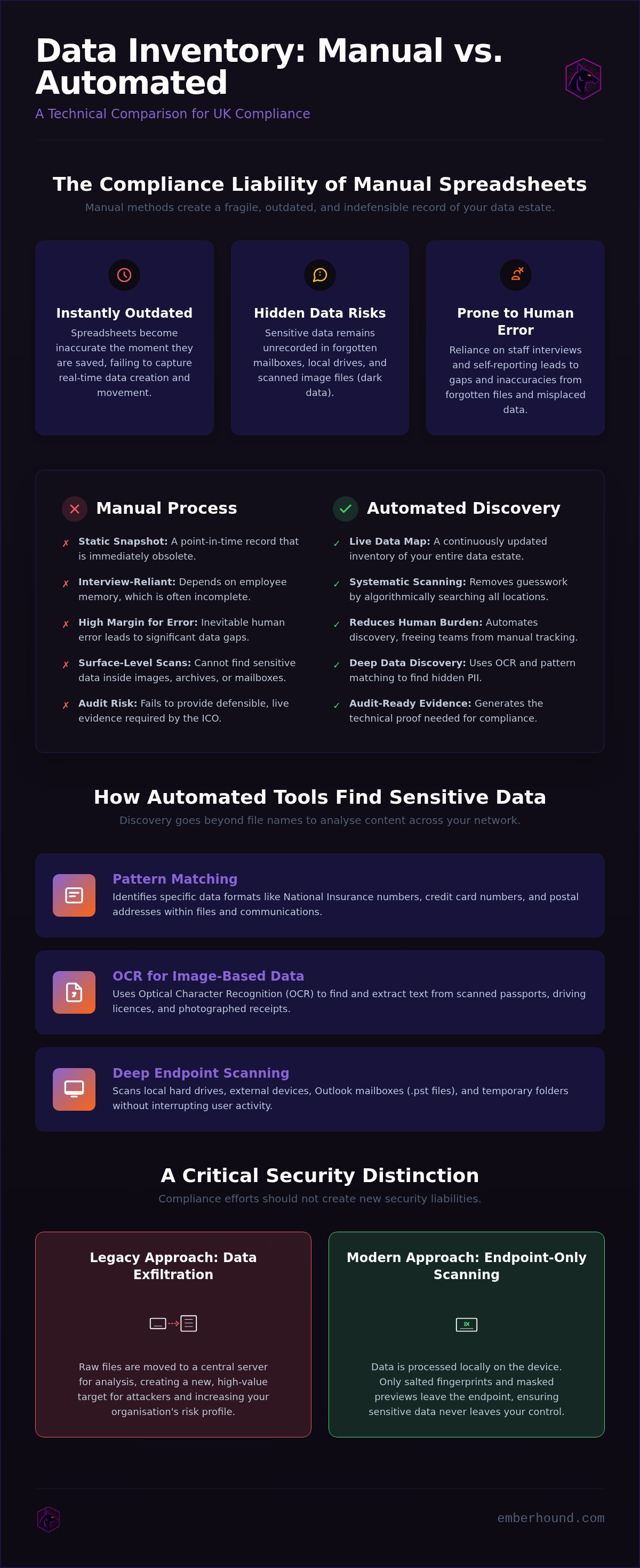
Manual inventories rely on staff interviews and self-reporting. This method is inherently flawed because employees often forget where they save files. They are frequently unaware of the sensitive data buried in their download folders or temporary directories. Human error is the primary driver of inaccuracy in manual records. When you rely on memory, you create gaps in your security posture.
Automation changes the dynamic. Scanning algorithms systematically search your network to find files that staff have misplaced. This process removes the burden from your team - it eliminates guesswork. The primary benefit is the creation of a live data map. This record updates as new data is created or moved. This ensures your inventory stays accurate without manual intervention or constant follow-up emails to department heads.
Why UK businesses require automated discovery in 2026
Regulatory pressure from the ICO is intensifying. Organisations are expected to demonstrate precise knowledge of where personal data resides at all times. Simply having a policy is no longer enough; you need technical evidence. Automated tools provide this evidence. They are a cornerstone of effective GDPR data audit preparation.
The volume of unstructured data is also accelerating. Sensitive information is no longer confined to neat databases. It is scattered across emails, chat logs, and temporary downloads. Manual tracking is impossible in this environment. Without automation, your compliance team is blind to a significant portion of your data estate. Using a dedicated tool ensures you can meet DSAR deadlines with confidence. You can provide audit-ready records that reflect the actual state of your network instead of an aspirational guess.
How automated data inventory tools find sensitive data
An effective automated data inventory tool scans for patterns, not just file names. It identifies specific strings within the content of files across endpoints, servers, and cloud storage. This involves scanning for sequences that match credit card formats, National Insurance numbers, or home addresses. To maintain security, the tool uses pattern matching and salted fingerprints. This allows it to recognise sensitive data without ever storing the raw, unmasked information on a central server.
Security is a primary concern during the discovery process. Many legacy tools exfiltrate data to a central database for analysis, which creates a new attack surface for your organisation. A more secure approach is endpoint - only scanning. In this model, all processing occurs locally on the device. Data never leaves your network. For any data that must be transmitted or stored at rest, the system employs TLS 1.3 with AES - 256 encryption. This ensures that your compliance efforts do not accidentally become a security liability.
Scanning mailboxes and local hard drives
Personal data is rarely where it is supposed to be. It is frequently hidden in Outlook mailboxes, PST files, or local 'Downloads' folders. These are the common blind spots of manual inventories. An automated data inventory tool scans these locations silently. It works in the background without interrupting the user's daily tasks. This depth of discovery is critical for identifying what is personal data in unexpected directories or forgotten email attachments.
OCR and image-based data discovery
One of the most significant risks to UK compliance is 'dark data' held in images. Passport scans, driving licences, and photographed receipts often contain high - risk sensitive data. Manual spreadsheets cannot track this information. Optical Character Recognition (OCR) technology allows the software to 'read' the text inside these images and scanned PDFs. It treats a JPG or a PNG with the same scrutiny as a Word document.
This capability ensures that your inventory includes every piece of sensitive information, regardless of format. You can identify risks that were previously invisible to your IT team. If you want to see exactly what is hiding on your network, you can start a free local scan to test the accuracy of your current records. By automating this process, you eliminate the possibility of missing data that could lead to an ICO fine or a failed audit.
Comparing inventory tools: Manual vs. Automated vs. Enterprise
Choosing the right approach to data discovery is a balance between risk and resource. Manual inventories are a common starting point, but they quickly become a liability. Enterprise platforms represent the other extreme. They often introduce more complexity than they solve. A focused automated data inventory tool provides the middle ground. It delivers the technical certainty you need without the administrative overhead of a large - scale software project.
The high cost of 'free' manual spreadsheets
Manual spreadsheets are deceptive. They appear cost - effective because they don't require a software licence. The reality is different. Populating these records requires hundreds of man - hours from staff who have better things to do. You are paying for your team's time to perform a task that is flawed by design. These records provide no proof of discovery. During an ICO audit, a static list of what you think you have is weak evidence. It lacks the salted fingerprints and masked previews that prove you actually checked the files. Static records are also useless for rapid DSAR fulfilment. You cannot search a spreadsheet to find every instance of a person's data across a thousand local hard drives.
Avoiding enterprise software bloat
Enterprise platforms are built for global corporations with dedicated governance departments. They include features that most UK SMBs simply never use. You don't need complex multi - stage approval workflows or integrated risk heatmaps to meet GDPR standards. These platforms are expensive and often require months of implementation. They become a new project for your IT team to manage instead of a tool that solves a problem.
Lean teams should prioritise speed and visibility. Look for a solution with a usage - based pricing model and a 'no deployment drama' philosophy. Your automated data inventory tool is a utility. It should run locally, scan quickly, and provide audit - ready evidence immediately. This approach ensures you spend your budget on actual discovery. You avoid paying for features that sit idle. The choice of tool depends on the scale of your data and the specific compliance frameworks you need to satisfy. You need a specialised tool that fits your team's capacity and provides immediate results.
Implementing an automated data inventory in your business
Successful implementation begins with a clear definition of your discovery scope. You must include all endpoints, especially the laptops of remote workers and any external storage devices. An automated data inventory tool is only as effective as the ground it covers. Selecting a tool that permits a free initial scan allows you to verify the accuracy of its discovery algorithms before committing to a full deployment.
Configuration is the next priority. You must instruct the software to search for specific data types that match your industry requirements. If you handle payments, card data discovery is essential. For general UK GDPR compliance, you should focus on personal identifiers such as National Insurance numbers, home addresses, and date of birth records. Once configured, you must establish a recurring scanning schedule. Data estates change daily. A monthly or weekly scan ensures your inventory remains a live record rather than a stale document.
Preparing for a data audit
Auditors require technical proof, not just policy documents. Use your inventory tool to generate evidence that demonstrates active monitoring. This includes masked previews and salted fingerprints that prove you have identified sensitive files without creating new security risks. All discovery actions and data movements should be recorded in a centralised audit log. This methodical approach to record - keeping is a fundamental component of modern GDPR data mapping software strategies. It provides the transparency needed to satisfy the ICO during a formal enquiry.
Using your inventory for DSAR fulfilment
A Data Subject Access Request (DSAR) is a significant administrative burden for lean teams. An accurate, automated inventory allows you to locate a specific individual's information in minutes. You no longer need to manually search through thousands of folders or mailboxes. Automated discovery is the first step in building a disclosure pack. It ensures you find every relevant file, including 'dark data' hidden in images or deep directories. This speed is vital for meeting the strict 30 - day statutory deadline. It reduces the risk of missing data, which is a primary cause of compliance failure and subsequent fines.
Why EmberHound is the efficient choice for UK compliance
EmberHound is an automated data inventory tool built specifically for the constraints of UK organisations. We understand that lean IT and compliance teams don't have the time for lengthy software deployments or complex governance workflows. Our platform prioritises speed and visibility. It provides the technical certainty required for UK GDPR and PCI DSS without the administrative burden associated with enterprise - scale platforms. You get a direct, precise record of your data estate that is ready for any audit.
Our commercial model matches our technical philosophy. We offer a usage - based pricing structure. This allows you to pay only for the discovery you perform. There are no mandatory long - term contracts. This flexibility enables you to start small and scale your discovery efforts as your requirements change. You aren't paying for idle features or seats you don't use. It is a no - nonsense approach to compliance that respects your budget and your time.
Local processing for maximum security
Security is the foundation of our 'Discover' track. Unlike traditional scanners that move data to a central server for analysis, EmberHound performs all scanning locally on the endpoint. The platform never accesses your file system directly. This architecture is a deliberate choice to eliminate the risk of data exfiltration. Your sensitive files never leave your network during the discovery process. It is a fact - based approach to security that provides immediate reassurance to your stakeholders.
By keeping processing at the edge, we ensure that your compliance activities don't create new vulnerabilities. We use TLS 1.3 with AES - 256 encryption for any metadata that needs protection. This ensures that your audit - ready evidence, including masked previews and salted fingerprints, is handled with technical rigour. It is the smarter, faster alternative to the slow - moving enterprise giants that often struggle with modern, distributed workforces.
Start your journey to accurate compliance
You don't need a six - month project to fix your data inventory. The onboarding process for EmberHound is designed to be friction - free. You can start a free GDPR scan today to identify the immediate risks hiding on your network. This allows you to test the accuracy of our OCR technology and mailbox scanning without any upfront cost. If you are tired of the complexity found in traditional scanners, visit our why us page to see how we provide a more efficient path to compliance. We provide the tools you need to build a defensible record of your sensitive data instantly.
Secure your data estate for the long term
Manual tracking is no longer a viable strategy for UK organisations facing strict ICO oversight. A dedicated automated data inventory tool shifts your compliance from a reactive burden to a proactive, defensible asset. By focusing on local endpoint discovery and OCR technology, you eliminate the blind spots that lead to failed audits and DSAR delays.
You deserve a solution that prioritises security through endpoint - only scanning. This architecture ensures your sensitive files never leave your network. With audit - ready evidence like salted fingerprints and a flexible, usage - based model, you can maintain high standards without the weight of enterprise contracts or long - term commitments.
Take control of your data visibility today. Build a compliance framework that works for your team instead of against it.
Frequently Asked Questions
What does an automated data inventory tool actually do?
An automated data inventory tool identifies, categorises, and records sensitive data across your business network. It replaces static spreadsheets by scanning endpoints, servers, and cloud storage for patterns like credit card numbers or home addresses. The tool builds a live map of your data estate, providing continuous visibility into where personal information resides. This ensures your records of processing activities are accurate and audit - ready without the need for manual staff interviews.
How does a data inventory tool help with GDPR compliance?
These tools provide the technical evidence required to satisfy the UK GDPR principle of accountability. By maintaining an accurate record of personal data locations, you can demonstrate to the ICO that you have control over your data processing activities. It simplifies the creation of Records of Processing Activities (ROPA). Having a clear inventory also allows you to respond faster to data breaches or subject access requests, reducing the risk of regulatory fines.
Is an automated data inventory better than a manual spreadsheet?
Yes, because manual spreadsheets are outdated the moment they are saved. They rely on human memory and self - reporting, which are prone to significant error. An automated data inventory tool uses scanning algorithms to find hidden files that staff have forgotten or misplaced. It provides a live, verified record of your data estate. This removes the administrative burden of manual updates and ensures your compliance evidence is based on technical facts rather than staff guesses.
Can a data inventory tool find sensitive information in images?
Yes, provided the tool includes Optical Character Recognition (OCR) technology. This capability allows the software to 'read' text inside scanned PDFs, passport scans, driving licences, and photographed receipts. Most manual inventories and basic scanners overlook this 'dark data'. By using OCR, an automated data inventory tool identifies sensitive information buried in image files, ensuring that your compliance records include all formats of personal data stored across your network devices and external drives.
Does the scanning process slow down employee computers?
Efficient tools are designed to have a negligible impact on system performance. They typically run as background processes with low CPU priority, ensuring that employees can continue their work without interruption. Some platforms allow you to schedule scans during quiet periods or set resource limits to prevent any noticeable slowdown. This no - drama approach ensures that compliance discovery doesn't come at the cost of your team's productivity or your hardware's performance during the working day.
Will my sensitive data be uploaded to the cloud during a scan?
Not if you use a tool that prioritises endpoint - only scanning. Some enterprise platforms exfiltrate data to a central server, but more secure architectures perform all processing locally on the device. In this model, only metadata or salted fingerprints are sent to the management console. Your actual sensitive files never leave your network. This architecture eliminates the risk of data exfiltration during the discovery process and provides a much higher level of security for your organisation.
How often should I run an automated data scan?
You should establish a regular scanning schedule based on how frequently your data estate changes. For most UK organisations, a weekly or monthly scan is sufficient to maintain an accurate inventory. This ensures that new files, downloads, or email attachments are captured in your records promptly. Regular scanning prevents your inventory from becoming a static snapshot, keeping your compliance evidence live and ready for an unexpected audit or a data subject request.
Can these tools help with Subject Access Requests (DSARs)?
Yes, they are essential for meeting the 30 - day statutory deadline for DSARs. An accurate inventory allows your team to locate a data subject's information across all endpoints and mailboxes in minutes rather than days. It identifies every instance of their personal data, including information hidden in images or forgotten directories. This reduces the risk of missing relevant files and ensures you can provide a complete disclosure pack to the requester with minimal manual effort.


