

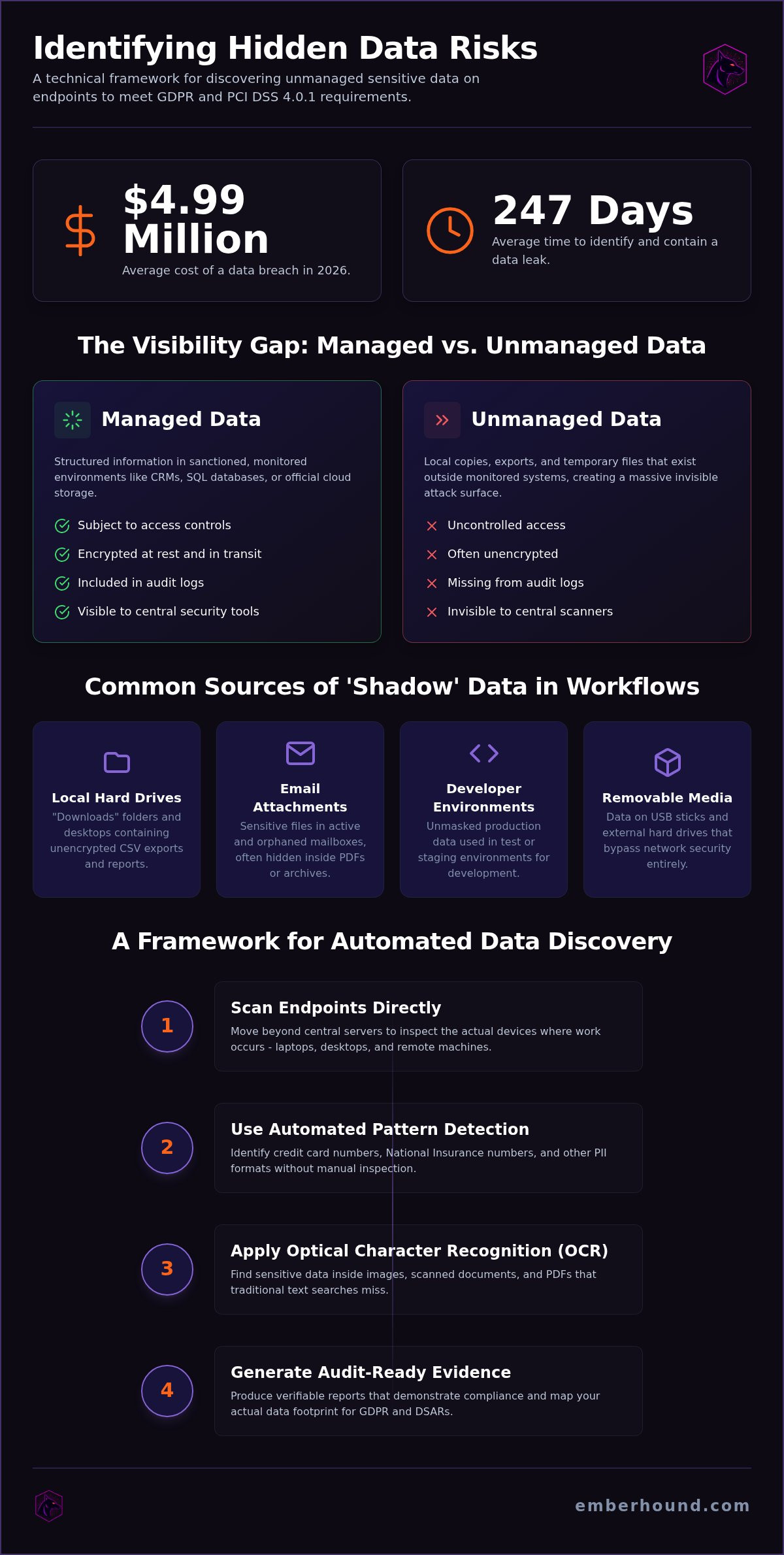
Global data breaches in 2026 now cost an average of $4.99 million. Even more critical is the 247 - day window it takes the average organisation to identify and contain a leak. If you cannot identify hidden data risks within hours, you are essentially flying blind through a storm of mandatory PCI DSS 4.0.1 and GDPR requirements. You already know that manual discovery is a failed strategy. It is slow, expensive, and leaves sensitive personal data rotting on employee laptops where it does not belong.
The fear of an oversight is real, but it is manageable with the right approach. This article provides a factual, technical framework to locate unmanaged sensitive data without the friction of manual auditing. We will outline a clear method to find hidden files and generate the audit - ready evidence needed to secure your compliance posture. You will learn how to replace regulatory anxiety with absolute visibility. There is no corporate fluff here. This is a direct path to a reduced risk profile and a stronger security stance.
Key Takeaways
- Learn to distinguish between managed databases and the unmanaged flat files stored on employee desktops and in orphaned mailboxes.
- Establish a technical framework to identify hidden data risks by scanning all organisation endpoints instead of relying on central servers.
- Understand the financial impact of invisible data during a Data Subject Access Request (DSAR) and how it affects GDPR Article 30 compliance.
- Use automated pattern detection to find credit card and National Insurance numbers without the delays of manual auditing.
- Discover how local - only endpoint scanning and OCR technology provide audit - ready evidence whilst maintaining data privacy.
Defining Hidden Data Risks and Their Origins
Visibility is the primary requirement for any compliance framework. You cannot defend what you cannot see. To identify hidden data risks, you must first accept that your official data map is likely incomplete. These risks are sensitive records - such as personal data or cardholder information - that exist outside your sanctioned, monitored storage environments. They are the "dark matter" of your IT estate. They don't appear on your central dashboard, but they still carry the full weight of regulatory liability.
The Difference Between Managed and Unmanaged Data
Managed data is structured. It lives in your CRM, your SQL databases, or your official cloud storage. It's subject to access controls, encryption, and audit logs. Unmanaged data is the opposite. It consists of local copies, exports, and temporary files. When an employee downloads a customer list to their desktop to work faster, that data becomes unmanaged. Over time, these flat files accumulate on laptops and external drives. This creates a massive, invisible attack surface that central security tools often ignore. Unmanaged data is the primary source of drift between your security policy and your actual risk profile.
Why Official Governance Fails to Capture Every File
Most compliance programmes rely on manual data mapping. This is a snapshot of where data should be, not where it actually is. It fails because it ignores human behaviour. Employees often bypass official channels for convenience, leading to the growth of Shadow IT across the organisation. Manual auditing is too slow for the velocity of modern file creation. By the time a spreadsheet is logged in a registry, it has already been copied, edited, and shared amongst multiple departments.
Every file mutation - a copy, a rename, or an email attachment - creates a new instance of risk. In remote work environments, this problem is amplified. Data silos form on home office laptops where central governance cannot reach. If your framework does not start with automated visibility, your compliance posture is built on guesswork. To effectively identify hidden data risks, you must move beyond the server and look at the actual endpoints where your team handles sensitive information every day. Real - time visibility is the only way to close the gap between your official records and your actual data footprint.
Common Sources of Shadow Data in Modern Workflows
The cloud gets all the attention. But the real risk is often sitting on the desk in front of you. To identify hidden data risks, you must look at where work actually happens. Most organisations have a shadow data problem caused by convenience. Employees download reports. They save local copies. They forget those files exist. This is not a malicious act. It is a byproduct of high - speed workflows that prioritise immediate results over long - term data hygiene.
Local Hard Drives and Desktop Downloads
The "Downloads" folder is a compliance graveyard. It is the default destination for every CSV export from your CRM or billing system. These files often contain unencrypted sensitive data. They sit on local disks, bypassed by central server backups and cloud - only security scanners. You need to know what is personal data under UK GDPR to understand the scale of this risk. A single spreadsheet with 500 rows of customer names and addresses is a significant liability if that laptop is lost or stolen. Desktop folders are equally problematic, as they often house "temporary" files that become permanent fixtures of the local environment.
Email Attachments and Orphaned Mailboxes
Email is the primary tool for internal data sharing. It is also a massive repository for unmanaged files. Sensitive data is frequently sent as attachments. These files remain in the "Sent Items" and "Inbox" folders indefinitely. The risk is even higher with orphaned mailboxes. When an employee leaves, their mailbox often stays active or archived without being scanned for sensitive content. Standard search tools are insufficient for this task. They can find keywords, but they cannot find patterns like credit card numbers or National Insurance numbers hidden inside a PDF attachment.
There are other blind spots that frequently escape notice. Developers often use production data in test environments to ensure accuracy. This data is frequently unmasked and unmanaged, creating a vulnerability in your software development lifecycle. Then there is physical media. USB sticks and external hard drives bypass the network entirely. They are portable, easily lost, and rarely encrypted. If you want to map these risks without the drama of a manual audit, you can start scanning local endpoints for free to see what is actually hiding on your network. Visibility is the only way to stop shadow data from becoming a breach headline.
Evaluating the Financial and Regulatory Impact of Invisible Data
What you don't know can hurt you. In 2026, the global average cost of a data breach reached a record high of $4.99 million. This is a 12% increase from the previous year. Most of this cost stems from detection and escalation. If you cannot identify hidden data risks, your response time lags. You cannot protect or delete data you don't know exists. Sensitive cardholder data often ends up in unencrypted application logs. These logs sit on local drives, invisible to your security team until an auditor finds them. By then, it is too late to prevent the penalty.
GDPR Penalties for Unknown Personal Data
UK GDPR is clear. You have a legal duty to know where all personal data resides. GDPR Article 30 requires accurate record - keeping of all processing activities. Hidden data makes this impossible. If you suffer a breach and the Information Commissioner's Office (ICO) finds unmanaged files you didn't know about, your technical measures look weak. This increases the likelihood of a maximum fine. For severe violations in 2026, this remains up to €20 million or 4% of total worldwide annual turnover. Use a GDPR Data Audit Preparation guide to close these gaps before the regulator calls.
The Cost of Manual Data Discovery
Manual discovery is a resource drain. Searching every server and laptop manually takes hundreds of man - hours. Using basic file explorers is inefficient. They miss hidden directories and cannot parse the contents of complex file types. A Data Subject Access Request (DSAR) has a strict 30 - day deadline. If your team spends 20 of those days just trying to find the data, you have already lost. Automation reduces the total cost of compliance by removing the human bottleneck. It turns a weeks - long search into a minutes - long scan. This speed saves money and prevents the cost of slow response. Breaches that take longer than 200 days to contain cost an average of $5.65 million, compared to $4.32 million for those contained faster. That is a $1.33 million penalty for being slow. To identify hidden data risks quickly is to protect your bottom line. Accuracy is not just a compliance requirement; it is a financial necessity.
A Technical Framework to Identify Hidden Data Risks
Compliance starts at the endpoint. Server - side scanning is only half the solution. To truly identify hidden data risks, your framework must start at the edge of the network. Centralised scanning misses the local copies and "temporary" exports stored on individual laptops. You need a baseline that accounts for every device. This requires moving beyond the data centre and deploying discovery directly to the source of file creation.
Automating the Discovery Process
Manual spot - checks are a statistical gamble. They rely on luck rather than logic. Automated scanning is superior because it operates at a scale no human team can match. These tools use regular expressions and pattern matching to find specific data types. Whether it is a 16 - digit credit card number or a UK National Insurance number, automation finds it in seconds. Implementing automated data inventory tools ensures that your records are based on technical fact, not employee self - reporting.
Using OCR to Scan Non - Textual Data
Standard file discovery often stops at the text layer. If sensitive data is trapped inside a JPG, a PNG, or a flattened PDF, most scanners remain blind to it. OCR (Optical Character Recognition) technology parses the pixels of an image to extract text strings. This is vital for identifying data in scanned receipts, passport photos, or screenshots of customer records. OCR bridges the gap in traditional discovery by treating images with the same level of scrutiny as spreadsheets. Without it, your visibility is incomplete.
Visibility must not compromise privacy. When reviewing findings, your framework should use masked previews. This allows your team to verify a match - such as seeing the last four digits of a card number - without exposing the full sensitive record. For audit purposes, generate salted SHA - 256 fingerprints. These act as immutable evidence that you have identified the risk without actually storing the sensitive data itself. This methodology provides a clear, audit - ready trail that satisfies both internal security and external regulators.
Securing Your Environment with EmberHound
If you need to identify hidden data risks without the administrative burden of traditional enterprise software, EmberHound is the definitive solution. Most security tools are heavy, intrusive, and require complex server configurations that small teams don't have time to manage. EmberHound is a specialist platform built for speed and privacy. It is designed specifically to find unmanaged personal data and cardholder information on the endpoints where it actually resides. There is no deployment drama or "bloatware" to contend with. It is an agile tool for professionals who value time and clarity above corporate fluff.
Local - Only Scanning for Privacy Assurance
The platform never accesses your file system directly. Instead, all processing occurs locally on the endpoint. This is a critical distinction for privacy assurance. Sensitive files are not uploaded to a central server or cloud dashboard for analysis. Your data stays exactly where it is. We use TLS 1.3 with AES - 256 encryption for all communications, ensuring that only metadata and salted results are transmitted. This architecture ensures that even if a network intercept occurred, the underlying sensitive data remains unreachable. It gives IT managers total confidence that they are not creating a new risk whilst trying to solve an old one. You can identify hidden data risks across your entire estate whilst maintaining a zero - trust posture regarding the data itself.
Generating Audit - Ready Evidence
Compliance requires verifiable proof. EmberHound provides masked previews that allow you to verify sensitive data matches without exposing the full record to the administrator. This maintains the principle of least privilege and keeps you within the boundaries of GDPR and PCI DSS requirements. To satisfy external auditors, the system generates salted SHA - 256 fingerprints. These act as immutable evidence of your discovery process. If you face a regulatory inquiry or a Data Subject Access Request, the DSAR disclosure pack provides a rapid response mechanism. It offers several key advantages for overworked teams:
- Collates findings into a structured, professional format.
- Reduces the time spent on manual data verification.
- Provides audit - ready documentation for legal deadlines.
You can start a free scan today to find your first risk and see the evidence for yourself. It is the fastest way to move from technical uncertainty to an audit - ready compliance posture.
Secure Your Compliance Posture Today
The gap between your official data map and your actual risk profile is where breaches happen. You've seen how unmanaged files on local hard drives and orphaned mailboxes create invisible liabilities that manual audits simply cannot catch. By shifting to a technical framework that prioritises endpoint - only scanning and OCR, you can identify hidden data risks before they trigger a regulatory penalty or a failed DSAR.
Visibility is no longer a luxury; it is a baseline requirement for GDPR and PCI DSS 4.0.1 compliance. You need a solution that provides audit - ready evidence without the friction of long - term contracts or complex deployment schedules. Modern security requires a direct, local approach that keeps sensitive data where it belongs whilst giving you the salted fingerprints you need for technical proof.
Take the first step toward a cleaner, more transparent IT estate. You can secure your organisation's future with absolute clarity starting right now.
Frequently Asked Questions
What is a hidden data risk in a business context?
A hidden data risk is sensitive information stored outside of approved, managed systems. Examples include customer spreadsheets on desktops, unencrypted exports in downloads, or cardholder data in log files. These files are invisible to central governance and bypass standard security controls. They represent a significant compliance gap because you cannot protect or delete data if its existence is unknown. Identifying these files is the first step toward securing your organisation.
How do I identify personal data across my network?
You identify personal data by scanning all organisational endpoints, including laptops, external hard drives, and local mailboxes. Automated tools use pattern matching to find identifiers like National Insurance numbers or contact details. This process must go beyond central servers to capture the local copies and "temporary" files created by employees. Using a technical framework ensures that your data inventory is based on actual file contents rather than manual self - reporting.
Why is shadow data a problem for GDPR compliance?
Shadow data is a problem because it violates the GDPR principle of accountability and the requirement to maintain accurate records of processing. If you don't know where personal data resides, you cannot fulfil a Data Subject Access Request (DSAR) or ensure the right to erasure. Hidden files increase the risk of a reportable breach. Under GDPR, failing to secure unmanaged data can lead to fines of up to €20 million or 4% of global turnover.
Can I find credit card data hidden in image files?
Yes, you can use OCR (Optical Character Recognition) technology to detect cardholder information within images. This is essential for finding sensitive data in scanned receipts, passport photos, or screenshots of payment screens. Traditional scanners often miss non - textual files, leaving a significant blind spot in your PCI DSS compliance. OCR parses the pixels to extract text, allowing you to identify hidden data risks that would otherwise remain invisible.
How does local scanning differ from cloud-based data discovery?
Local scanning performs all data processing directly on the endpoint rather than uploading files to a central cloud server. This "endpoint - only" approach ensures that sensitive files never leave the device, which is a more secure way to identify hidden data risks. It eliminates the need for massive data exfiltration and reduces the burden on network bandwidth. Security measures like TLS 1.3 and AES - 256 encryption protect any metadata transmitted during the process.
What is the fastest way to respond to a DSAR?
The fastest way is to use an automated discovery tool that generates a dedicated DSAR disclosure pack. Manual searching is too slow for the 30 - day legal deadline and often misses files on local hard drives. Automation locates every instance of an individual's personal data across all endpoints in minutes. This provides your team with structured findings and audit - ready evidence, allowing you to meet compliance deadlines without the stress of manual auditing.
How often should an organisation scan for hidden data risks?
Scanning should be a regular, ongoing part of your security posture rather than a one - off event. File creation happens daily, and new risks appear every time an employee downloads a report or saves an email attachment. Many organisations perform weekly or monthly scans to maintain an accurate data inventory. Regular discovery ensures that your compliance evidence is always current and that any unmanaged sensitive data is identified and secured before a breach occurs.
Is it possible to automate the creation of a data inventory?
Yes, automation is the only reliable way to maintain a comprehensive data inventory. Manual mapping is a snapshot that becomes obsolete the moment a file is copied or moved. Automated tools scan your entire estate to find sensitive data patterns and create an immutable record of where information lives. This process generates salted SHA - 256 fingerprints as proof of discovery, providing a factual baseline that satisfies auditors and regulators without manual intervention.


