

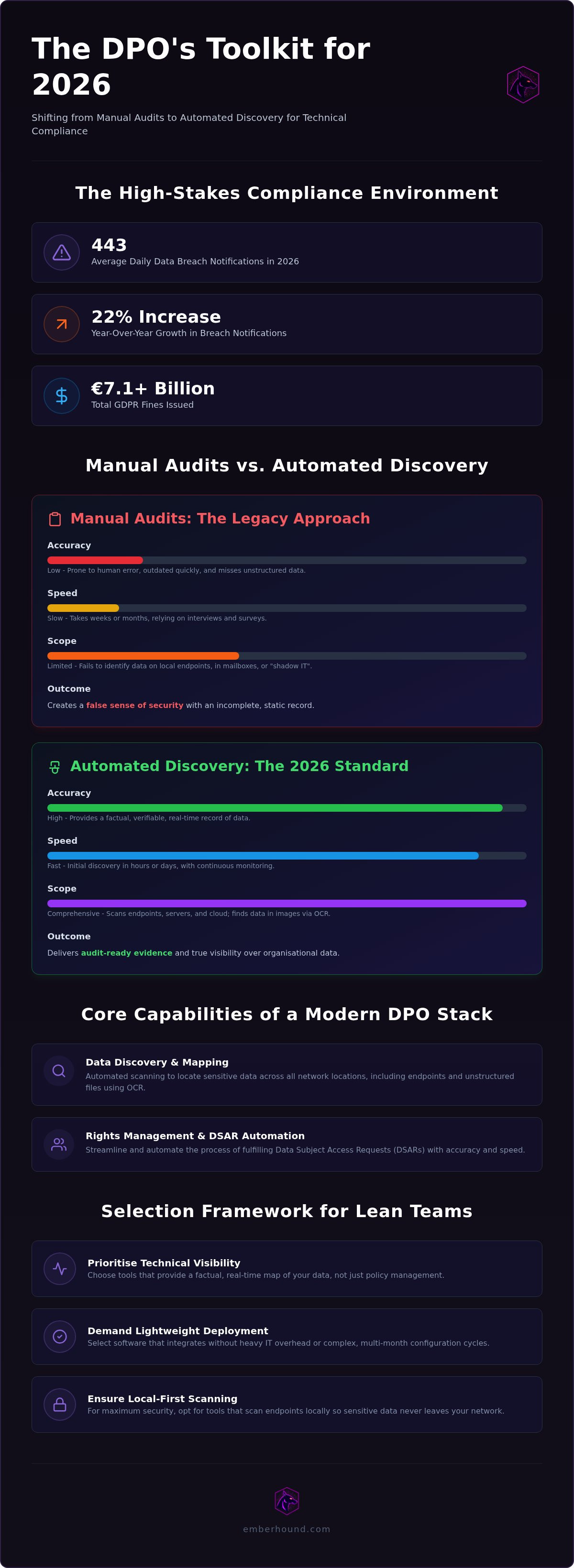
In 2026, the average number of daily data breach notifications hit 443. That is a 22% increase year - over - year. For the modern DPO, the margin for error has vanished. You are likely tired of manual data mapping that takes months and still ends up riddled with mistakes. DSAR deadlines shouldn't feel like a weekly crisis, yet without automated discovery, they usually do.
Legacy software is often too complex for lean teams to deploy effectively. You need Data Protection Officer tools that provide immediate visibility across your network rather than just adding to your paperwork. We understand the pressure of high - stakes oversight. You need a stack that works without massive IT overhead or months of configuration. This guide identifies the essential software categories and technical capabilities required to build a functional, agile data protection environment.
We will provide a clear list of necessary tool categories and a selection framework designed for speed and accuracy. By the end, you will have a roadmap to reduce audit anxiety and meet regulatory requirements with technical precision.
Key Takeaways
- Shift focus from administrative paperwork to direct technical visibility to meet 2026 regulatory standards.
- Identify the core categories of Data Protection Officer tools required to automate data mapping and Subject Access Request (DSAR) workflows.
- Evaluate the risks of manual audits versus the accuracy of automated discovery for maintaining a factual record of sensitive data.
- Use a selection framework to find lightweight software that integrates without heavy IT overhead or complex deployment cycles.
- Prioritise security by choosing tools that perform local endpoint scanning to ensure sensitive data never leaves your internal network.
Why Data Protection Officer Tools Must Focus on Data Visibility
Compliance in 2026 is not a paperwork exercise. It is a technical reality. You can have the most detailed privacy policy in the world, but if you cannot locate your data, that policy is a liability. Knowing the law is easy. Knowing where your sensitive data resides across a fragmented network is the actual challenge. Manual record - keeping relies on human memory and static spreadsheets. Both fail during a formal audit.
The stakes are high. Total GDPR fines have now surpassed €7.1 billion. With the average number of daily data breach notifications rising to 443 - a 22% increase year - over - year - the margin for error has disappeared. Relying on administrative tools alone leaves you blind to technical risks. Effective Data Protection Officer tools must prioritise direct visibility over policy management to ensure you are actually protected.
The Limitations of Policy - Only Platforms
A Record of Processing Activities (RoPA) is often treated as a compliance checkbox. In reality, a RoPA is only as good as the data that feeds it. Most administrative platforms rely on manual input from department heads. This creates a dangerous gap between your documentation and your network reality. If your RoPA says customer data is in your CRM, but a marketing intern has saved a CSV on a local drive, your policy is a fiction.
Outdated spreadsheets create a false sense of security. They are static snapshots of a dynamic environment. As your team grows, data drifts. It ends up in local mailboxes, external hard drives, and forgotten downloads folders. Administrative tools cannot see this drift. Without technical discovery, you are managing a ghost map of your organisation. This lack of visibility is why manual audits fail. They are slow, prone to error, and provide no factual evidence of where data actually sits.
Meeting the 2026 Regulatory Standard
The Information Commissioner's Office (ICO) has moved beyond reviewing binders. In 2026, regulators expect DPOs to have direct, verifiable oversight. You are expected to know exactly what data you hold and where it is stored at any given moment. This is a technical requirement, not a legal one. The growth of data volume makes manual compliance impossible for lean teams. You cannot interview every employee every week to find out where they saved a file.
Selecting the right Data Protection Officer tools is about closing the visibility gap. You need software that identifies data locally and provides audit - ready evidence without massive IT overhead. For a deeper look at these requirements, see our GDPR guide. By moving from policy - first to data - first, you reduce organisational risk. You stop guessing and start knowing. Technical tools provide the factual record required to survive an audit and manage DSARs with confidence.
Essential Categories of Data Protection Officer Tools for Technical Compliance
Building a functional compliance stack requires shifting focus from administration to technical capability. Administrative platforms handle the "what" of compliance, but they often fail at the "where". To meet 2026 standards, your toolkit must provide direct access to the data itself. A modern Data Protection Officer tools stack consists of four core pillars: discovery, rights management, consent, and risk assessment. Each category serves a specific purpose in reducing organisational risk and eliminating manual bottlenecks.
Data Discovery and Mapping
You cannot protect data you haven't found. Manual data mapping relies on surveys and interviews, which are notoriously inaccurate. Automated scanning is the only way to maintain a factual record of sensitive data across your network. This includes identifying files on endpoints, local mailboxes, and external hard drives. Using GDPR data discovery software UK allows you to replace guesswork with technical certainty.
OCR (Optical Character Recognition) is a critical feature in this category. Sensitive data is frequently trapped in non - searchable formats like scanned invoices, ID photos, or PDF screenshots. Without OCR, these files remain invisible to standard search tools. High - performance discovery software scans these images locally, ensuring that no pocket of data remains unmapped. You can start a free GDPR scan to identify these hidden risks on your endpoints today.
Rights Management and DSAR Automation
Subject Access Requests (DSARs) are a significant drain on resources. The 30 - day deadline is non - negotiable, and manual file searches rarely capture everything. DSAR automation tools find relevant data across all connected devices and compile it into a disclosure pack. This removes the need for IT teams to spend hours manually searching directories. Accuracy is vital here. Missing a single file can lead to a regulatory complaint, whilst failing to redact third - party information can cause a secondary breach.
Consent and Risk Assessment
Consent management platforms (CMPs) are necessary for web - based data collection. They ensure that user preferences are recorded and respected in real time. For new projects, Data Protection Impact Assessment (DPIA) tools provide a structured framework for risk analysis. These tools help you identify potential privacy harms before they become active problems. When these categories work together, they create a transparent environment where compliance is a byproduct of your technical architecture rather than a separate, manual chore.
Comparing Manual Audits and Automated Data Protection Officer Tools
Manual audits are an exercise in memory, not a technical check. They rely on interviews, surveys, and the hope that employees remember every file they have ever saved. This approach is fundamentally flawed. People forget. They save sensitive data in "temporary" folders that become permanent. They move files to external drives for convenience. A manual audit only captures what employees think they have, not what is actually on your network.
Automated Data Protection Officer tools replace these subjective interviews with a factual record. Instead of asking where data is, you see exactly where it sits. The cost - benefit analysis is clear. Human - led mapping takes weeks of billable hours and causes significant internal disruption. Software does the same work in hours with zero employee downtime. More importantly, it eliminates the error rate inherent in human reporting.
The Risk of Human Error in Manual Mapping
Your employees are your biggest source of "dark data". This is information that exists outside of your official, governed systems. A marketing manager might download a list of leads to a local drive to format it. A recruiter might save a CV to their desktop for a quick call. During an interview, they won't mention these files because they don't view them as "data processing".
- Forgotten Backups: Old versions of databases left in local folders.
- Convenience Copies: Sensitive data moved to unencrypted USB sticks or external drives.
- Shadow IT: Personal cloud storage used to bypass file size limits.
Automated scanning identifies these risks by looking at the actual file headers, not just the file names or locations. It finds what the interviews miss. It provides a level of technical accuracy that manual processes cannot replicate.
Efficiency Gains Through Local Endpoint Scanning
The traditional way to audit is to drag everything to a central server for analysis. This is slow, expensive, and creates a security risk. Modern Data Protection Officer tools scan data exactly where it lives. This local endpoint scanning keeps your files on your hardware, ensuring they never leave your network during the discovery process. It's a cleaner, faster approach that respects your existing security boundaries.
This method reduces the burden on your IT team. There are no massive data transfers to manage and no central databases to secure. To ensure your findings are legally defensible, you need audit - ready evidence. Using salted SHA - 256 fingerprints allows you to prove the existence and location of data without needing to store the actual sensitive content in your audit log. It's a faster, safer, and more accurate way to build your compliance record.
Selection Framework: Identifying Practical Tools for Lean Teams
Lean teams don't have time for software drama. Legacy platforms often require weeks of configuration and mandatory training sessions that pull your team away from their core work. When you are evaluating Data Protection Officer tools, the primary goal is technical utility without the "enterprise" overhead. You need tools that deliver immediate results with low deployment friction. Complexity is not a feature; it is a cost that small teams cannot afford to pay.
Your framework should focus on three pillars: security, simplicity, and scalability. Selecting the right software means looking past marketing fluff to find tools that solve the specific pain points of data discovery and Subject Access Request (DSAR) management. High - performance tools are lightweight, decisive, and transparent about their technical capabilities.
Data Security and Encryption Standards
The security of the tool itself is as important as the data it protects. Any software that scans your network must meet modern encryption standards to prevent it from becoming a new vulnerability. This means requiring TLS 1.3 for data in transit and AES - 256 encryption for any data at rest. You should also ensure the software provides masked previews. This allows you to confirm the presence of sensitive data without exposing the full content to the user, maintaining privacy even during the audit process.
Local - only processing is a critical privacy feature that separates agile tools from bloated cloud platforms. By scanning data locally on the endpoint, you ensure that sensitive files never leave your internal network. This architecture eliminates the risk of data exfiltration during the discovery phase. For a detailed breakdown of these technical safeguards, refer to the EmberHound trust page.
Avoiding Deployment Complexity
Hidden costs are a frequent trap in the compliance sector. Long - term contracts and mandatory implementation fees often lock lean teams into tools that are too difficult to use. Instead, look for pricing models that are usage - based. This "pay for what you use" approach allows you to scale your compliance efforts as your organisation grows without overcommitting your budget.
- Deployment Speed: Choose software that installs in minutes, not days.
- Add - on Flexibility: Ensure you can add mailbox scanning or external drive discovery as needed.
- IT Overhead: Prioritise tools that run without requiring dedicated server infrastructure.
A practical tool should be an "Agile Guardian" that works in the background. It should provide audit - ready evidence and clear visibility into your data landscape without requiring a massive IT project to maintain. By prioritising these technical requirements, you build a compliance stack that is efficient, secure, and ready for 2026 standards.
EmberHound: Data Protection Officer Tools for Precise Discovery
EmberHound is the technical answer to the visibility problem. It is built for the DPO who values speed and technical accuracy over administrative bloat. Most Data Protection Officer tools add to your workload by requiring manual data entry. EmberHound reduces it by identifying sensitive data directly on the endpoint. This is a local - only approach. Your files never leave your network. There is no exfiltration risk during the scan, and no central database to secure.
The software provides combined coverage for GDPR and PCI DSS v4.0. Since the new PCI requirements became mandatory on 31 March 2025, organisations must maintain continuous security processes. EmberHound supports this by scanning for both personal data and cardholder data in a single pass. You get a unified view of your risk without the need to deploy multiple agents. This is the "Agile Guardian" approach: finding what you need without the bureaucracy.
Precise Discovery and Audit - Ready Evidence
Verification is the core of credible compliance. EmberHound uses masked previews to allow you to confirm the presence of sensitive data without exposing the full content to unauthorised eyes. This maintains privacy whilst providing the DPO with the proof they need. To prove your results to external auditors, the system generates salted SHA - 256 fingerprints. These act as immutable evidence of your data locations without storing the sensitive data itself in your audit logs.
This technical precision is essential for meeting the 2026 regulatory standard. For organisations handling payments, reducing the audit scope is a priority. You can learn more in our guide to PCI DSS card data scanning. When a DSAR arrives, the software generates automated disclosure packs. This allows you to meet the 30 - day deadline with verified evidence and reduced manual effort.
Starting Your Compliance Journey
Deployment should not be a project. EmberHound is designed for "no drama" implementation in small - to - medium businesses. There are no mandatory contracts or heavy IT overheads. You install the software and start finding data immediately. This pragmatism allows lean teams to build a credible security posture based on technical facts rather than policy aspirations. It is a tool for professionals who are tired of unnecessary complexity.
You can replace manual guesswork with technical certainty today. It is a straight choice between administrative anxiety and technical visibility. If you are ready to identify the sensitive data residing on your endpoints, mailboxes, and external drives, you can start a free GDPR scan right now. Stop managing paperwork and start managing your data with the tool built for the 2026 compliance reality.
Modernise Your Data Oversight for 2026
Administrative compliance is no longer a shield against regulatory scrutiny. As data volumes grow and breach risks accelerate, your reliance on manual mapping and employee interviews must end. You need a technical stack that provides factual visibility across every endpoint. By prioritising Data Protection Officer tools that focus on direct discovery, you replace organisational guesswork with verifiable evidence.
EmberHound secures this process with TLS 1.3 and AES - 256 encryption. Our endpoint - only scanning ensures your files never leave your hardware, whilst salted SHA - 256 fingerprints provide the audit - ready proof you need without the risk of exfiltration. You can move from managing policy to managing data with technical precision.
Building a credible security posture doesn't require a massive IT project. It starts with choosing the right tools for a lean, efficient team. Take control of your network visibility and meet your compliance obligations with confidence.
Frequently Asked Questions
What are the most important tools for a Data Protection Officer?
The most important Data Protection Officer tools focus on technical discovery, rights management, and risk assessment. You need software that identifies personal data across your network, automates Subject Access Request (DSAR) evidence gathering, and manages consent records. Whilst administrative platforms help with policy, technical tools provide the direct visibility required for 2026 compliance. Prioritise software that offers local endpoint scanning to ensure your data remains within your existing security boundaries during the mapping process.
Can software automate the entire GDPR compliance process?
No software can automate the entire GDPR compliance process, as it involves legal judgement and organisational policy. However, tools can automate the most time - consuming technical tasks. This includes finding sensitive data, mapping its location, and generating audit logs. By using Data Protection Officer tools for technical discovery, you remove the burden of manual file searches. This allows your team to focus on high - level strategy whilst the software maintains a factual record of your network reality.
How do data discovery tools help with DSAR fulfilment?
Data discovery tools assist with DSAR fulfilment by identifying every instance of an individual's personal data across your organisation's endpoints. Instead of manual file searches that take hours, these tools scan local mailboxes, hard drives, and servers to find relevant matches instantly. They then compile this evidence into a disclosure pack. This ensures you meet the 30 - day deadline with accuracy. This reduces the risk of regulatory complaints or secondary breaches caused by missed information.
Is cloud - based DPO software secure for sensitive data?
Cloud - based software is secure if it uses modern encryption, but endpoint - only scanning is the gold standard for privacy. EmberHound uses TLS 1.3 and AES - 256 encryption to protect data in transit and at rest. Crucially, all scanning occurs locally on the endpoint. This means your files are never exfiltrated to a central server or cloud dashboard. You maintain complete control over your sensitive data whilst still benefiting from the speed of automated discovery.
What is the difference between data mapping and data discovery?
Data mapping is the process of creating a high - level record of your processing activities, often for a RoPA. Data discovery is the technical scan that identifies where sensitive data actually resides. Mapping is often based on employee interviews and can be inaccurate. Discovery provides the factual evidence that validates or corrects your map. Using technical discovery tools ensures your compliance records reflect your network's reality rather than just your documented policies.
Do Data Protection Officer tools require complex IT deployment?
Modern Data Protection Officer tools do not require complex IT deployment or long - term implementation projects. Legacy enterprise software often demands significant server infrastructure, but agile platforms focus on low - friction onboarding. You can install discovery software on endpoints in minutes without mandatory training or implementation fees. This approach is specifically designed for lean teams and SMBs that need to build a credible security posture without massive IT overhead or dedicated on - premise hosting.
How does OCR technology assist in data protection?
OCR (Optical Character Recognition) technology identifies personal data trapped in non - searchable formats like scanned documents, ID photos, and PDF screenshots. Standard search tools cannot read the text inside these images. This leaves significant pockets of sensitive data unmapped. OCR scanning allows your discovery software to read and categorise this information locally. This ensures your data mapping covers all file types. It provides a more accurate record of the sensitive data held across your organisation.
Why is local - only scanning preferred for compliance audits?
Local - only scanning is preferred because it eliminates the risk of data exfiltration during the discovery process. Traditional tools often move files to a central server for analysis, which creates new security vulnerabilities and increases costs. By processing data on the endpoint, your sensitive files never leave your network. This architecture provides audit - ready evidence, such as salted SHA - 256 fingerprints. It respects your existing security boundaries and reduces the overall burden on your IT infrastructure.


