

Unidentified cardholder data is a ticking audit bomb. In 2026, the grace period for PCI DSS 4.0 is a memory, and the 51 requirements that became mandatory in March 2025 are now the baseline for every assessment. You know the pressure of finding every Primary Account Number (PAN) hidden in local mailboxes or external drives. It's a heavy manual burden that keeps security teams awake, fearing the oversight that leads to a five - figure monthly fine from an acquiring bank.
We agree that manual spreadsheets and "best guess" scoping are no longer viable strategies for modern compliance. This guide explains how to identify cardholder data and reduce your audit scope without the traditional administrative grind. You will learn to use local endpoint scanning to find sensitive data, generate audit - ready evidence with salted SHA - 256 fingerprints, and satisfy PCI DSS 4.0 standards. We cover technical discovery methods that keep your data on - site. This ensures visibility and prevents file exfiltration.
Key Takeaways
- PCI DSS 4.0 requires organisations to protect account data and perform regular scans to identify all instances of cardholder data.
- Identify and remove Primary Account Number (PAN) data from unnecessary systems to reduce your audit scope.
- Establish a scanning workflow that targets laptops, servers, and cloud storage using pattern matching like the Luhn algorithm.
- Generate audit - ready evidence using salted SHA - 256 fingerprints to ensure no sensitive files leave your local system.
- Automate card data discovery to meet compliance standards without the administrative burden of manual spreadsheets.
What is PCI DSS and why is card data discovery necessary?
The Payment Card Industry Data Security Standard (PCI DSS) is a set of security requirements established to protect the global payment ecosystem. It regulates how organisations store, process, and transmit cardholder data (CHD) to prevent fraud and reduce the frequency of data breaches. For any entity handling credit or debit cards, compliance is a contractual obligation. It is enforced by payment brands and acquiring banks to ensure a baseline of security across the network.
Card data discovery is the process of finding every instance of this data across your environment. Primary Account Numbers (PAN) are the most common targets. These 16 - digit numbers are the primary keys for fraudulent transactions. Data often leaks into unmanaged locations. Helpdesk logs might capture a full card number during a troubleshooting session. Internal emails often contain card details sent by customers or staff. Temporary scratch files or database backups also harbour "ghost" data. If you don't know it exists, you cannot protect it.
Defining cardholder data and sensitive authentication data
The standard distinguishes between data that can be stored and data that must never be kept after authorisation. Cardholder data (CHD) includes the full PAN, the cardholder name, and the expiry date. Sensitive authentication data (SAD) is more volatile. It includes magnetic stripe data, CVV codes, and PINs. Storing SAD after authorisation is a direct violation of the standard. According to the PCI SSC Glossary, cardholder data is defined as the full Primary Account Number (PAN) or the full PAN plus any of the following: cardholder name, expiration date, and/or service code.
The risk of unmanaged sensitive data
Unencrypted card data sitting on a forgotten server is a liability. It increases the risk of a breach. According to the 2026 Verizon Data Breach Investigations Report, the global average cost of a data breach reached $4.99 million. Beyond the threat of theft, hidden data expands your audit scope. The scope includes every person, process, and technology that touches CHD. If a single laptop contains a stray spreadsheet with PAN data, that device and its network segment fall under PCI DSS requirements. This expansion adds unnecessary costs and complexity to your annual assessment.
Locating this data is the first step in any scope reduction strategy. You cannot secure what you cannot see. By identifying and removing data from unnecessary locations, you shrink the attack surface. This process simplifies the audit and reduces the technical burden on your team.
The 12 requirements of PCI DSS 4.0
The latest version of the standard represents a fundamental shift in how compliance is measured. It moves away from rigid checklists toward outcome - based security. Organisations are now required to provide evidence that controls are functioning continuously. You can no longer rely on a single annual audit to prove you are secure. You must demonstrate a constant grip on your data environment. Review the official PCI DSS v4.0 documents to understand the full scope of these 51 new requirements that are now mandatory as of 2026.
Knowing the location of every scrap of personal data is a primary requirement. If you cannot prove where cardholder data (CHD) is stored, you cannot prove it is protected. This level of visibility is the difference between a successful assessment and a costly failure. Auditors expect you to have a defined process for discovery. It is not enough to say the data is in the database. You must prove it is not anywhere else on your network.
Protecting stored account data (Requirement 3)
Requirement 3 focuses on the technical protection of account data. If your business must store Primary Account Numbers (PAN), they must be rendered unreadable. Strong cryptography is the standard. AES - 256 encryption is the industry benchmark for data at rest. However, encryption is only effective if it covers every instance of the data. Many teams struggle with 'data sprawl' where clear text PANs reside in swap files, temporary directories, or memory dumps.
You need unencrypted card data finder tools to verify that no clear text exists in your environment. These tools act as a final check against misconfigured applications or accidental storage. If you find clear text data where it shouldn't be, your encryption strategy has a gap that needs immediate remediation.
Maintaining a vulnerability management programme
Security is not static. You must regularly scan your systems for weaknesses. This includes every endpoint that could impact the cardholder data environment (CDE). Laptops, servers, and cloud storage accounts are all in scope if they interact with payment flows. A robust programme uses PCI DSS card data scanning to identify risks before an auditor arrives.
Requirement 12 now explicitly demands regular scanning to identify all instances of CHD. This is no longer a best practice. It is a mandatory operational task. Failure to identify hidden data leads to an expanded audit scope and increased compliance costs. You can start a free scan to identify these risks without adding to your team's manual workload.
Scope reduction: How to find PAN data on your network
Audit scope is the definitive boundary of your PCI DSS assessment. It encompasses every person, process, and technology that touches cardholder data (CHD). If you cannot define this boundary with precision, your audit costs will spiral. Reducing scope is a strategic necessity. It involves finding and removing data from locations where it serves no business purpose. Manual searches for card numbers are a gamble. They are prone to human error and oversight. You cannot expect a lean IT team to manually inspect every temporary directory or local mailbox across hundreds of endpoints.
Automated scanning provides the audit - ready evidence required by Qualified Security Assessors (QSAs). It replaces guesswork with a repeatable, technical process. This is the only way to ensure that your CDE remains as small as possible. You can find detailed guidance on scope validation in the PCI Security Standards Council Document Library.
The difference between segmentation and discovery
Segmentation is a defensive wall. It isolates the CDE from the rest of the corporate network using firewalls and access controls. However, walls are useless if the data is already on the other side. Discovery is the verification layer. It proves that no CHD has leaked outside that isolated zone. You need both to maintain a credible security posture. Segmentation keeps data in; discovery ensures it hasn't already outgrown its boundaries.
Generating audit-ready evidence
QSAs require proof of your discovery efforts. However, providing this proof must not create a new security risk. You need to show you found a card number without actually revealing the card number to the auditor. Masked previews solve this. They show only the first six and last four digits of a card. This allows compliance teams to verify findings without increasing risk or violating privacy standards.
To provide a verifiable record without file exfiltration, use salted SHA - 256 fingerprints. These fingerprints provide a unique ID for files without revealing their content. This technical approach ensures that no sensitive data leaves the local system during the audit process. It builds a bridge of transparency between your team and the auditor. You can see how we maintain this level of security on our trust page.
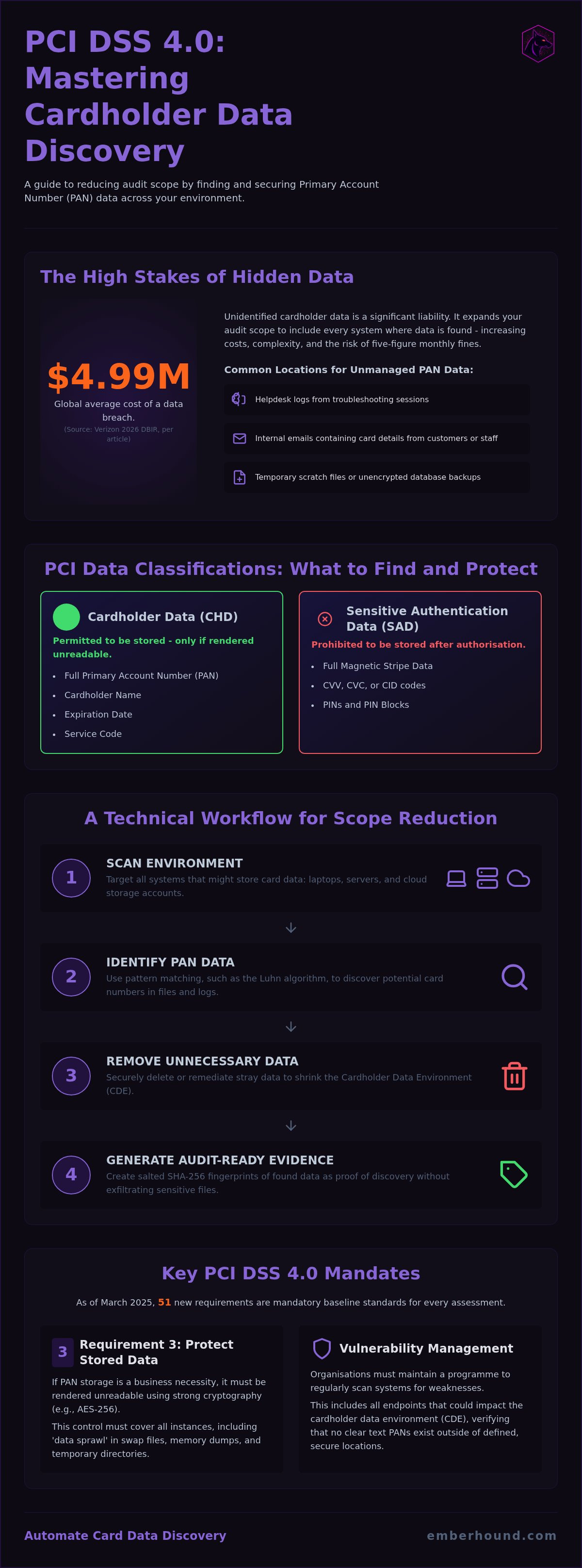
A technical workflow for PCI card data scanning
Implementing a successful scan requires a methodical approach to your network architecture. First, you must define every target endpoint. This includes employee laptops, on - premise servers, and cloud storage accounts. These locations are the primary sites where cardholder data (CHD) accumulates through shadow IT and local backups. You cannot secure what you haven't mapped. A lean IT team must prioritise these high - risk areas to prevent data sprawl before it triggers an audit failure.
Configuration is the next step in the workflow. You must set scanning parameters to identify specific data patterns. The Luhn algorithm is the standard checksum for validating Primary Account Numbers. By using this algorithm alongside specific BIN ranges, you filter out false positives whilst ensuring no actual card data is missed. This technical precision is what separates an efficient discovery process from a manual administrative nightmare.
Execution must focus on data residency. Once the scan identifies a file, you must review the findings and remediate the risk. This involves either deleting the file or encrypting it with AES - 256. Documenting this entire process is essential for your annual PCI DSS assessment. Auditors don't just want to see that you found data; they want to see the "who, what, and when" of your remediation cycle. This documentation serves as your primary evidence of continuous compliance.
Local-only processing vs cloud exfiltration
Security professionals often worry about the tool itself becoming a liability. Traditional cloud scanners move your files to a third - party server for analysis. This creates a massive data residency risk. Endpoint - only scanning keeps the data where it lives. The platform never accesses the file system directly. It processes the scan locally, which is significantly faster. It avoids the heavy network traffic associated with uploading terabytes of data to a cloud dashboard. This approach keeps your sensitive data within your own security perimeter.
Scanning beyond text: OCR and mailboxes
CHD doesn't always live in simple text files. Scanned receipts, invoices, and PDFs are common hiding spots that many tools miss. You must use OCR for data discovery to detect card data within these images. Local mailboxes are another critical target. Employees often receive or send card details via email without realising the compliance risk. Scanning these repositories ensures you find the "ghost" data that policy alone cannot stop.
Automating PCI compliance with EmberHound
Manual audits are a snapshot in time. They are slow. They are expensive. Most importantly, they fail to catch data that leaks between audit cycles. EmberHound provides a data discovery platform specifically for IT and compliance teams who need a continuous grip on their environment. It is designed for lean groups needing to meet SOC 2 and PCI DSS requirements without the administrative bloat of traditional enterprise software. You don't need a dedicated team to manage the tool. It works alongside your existing processes to provide immediate visibility.
Transparency is built into the core of the platform. Audit logging tracks every access and mutation. This ensures you have a complete, tamper - proof record of your discovery activities for your QSA. Usage - based pricing removes the barrier of entry. You only pay for what you use. There are no mandatory contracts or hidden fees. This model respects the budget constraints of modern, agile organisations whilst providing the same level of security as high - cost legacy systems.
Friction - reduced onboarding
Traditional security tools often come with significant deployment drama. They require complex configurations and lengthy implementation phases that can stall a compliance project for months. EmberHound is an agile alternative to these slow - moving giants. You can start a free scan to identify immediate risks without disrupting your existing workflows. This allows you to address high - priority vulnerabilities before an official assessment begins. This speed is essential for teams facing tight deadlines. To see the platform in action, you can Book a demo and witness how quickly you can achieve visibility across your endpoints.
Security by design
Data residency and protection are non - negotiable. EmberHound uses TLS 1.3 for data in transit and AES - 256 encryption at rest. These are standard features, not optional extras. The platform generates salted fingerprints for every file it scans. This allows you to demonstrate compliance to QSAs without moving sensitive card data to the cloud. By keeping processing local, you maintain a credible security posture that satisfies the most stringent regulatory demands. This architecture ensures that your PCI DSS efforts do not create new security holes or violate data residency requirements. It provides the evidence you need without the risk you fear.
Secure your cardholder data environment today
PCI DSS 4.0 has transformed compliance from an annual event into a continuous operational requirement. You must maintain visibility over every Primary Account Number across your network to avoid compounding monthly fines that can reach $100,000. Local - only scanning is the most effective way to identify hidden cardholder data without the risk of file exfiltration. This approach ensures your sensitive information stays within your own security perimeter whilst satisfying the strict demands of your annual assessment.
By adopting usage - based pricing and generating audit - ready evidence through salted fingerprints, you can satisfy auditors without the traditional manual burden or deployment drama. You no longer need to rely on slow, manual searches that are prone to human error. Automation provides the technical precision required for a modern security posture. You can protect your organisation and simplify your compliance journey right now.
It's time to replace outdated spreadsheets with a technical workflow that actually works for your team. You have the tools to achieve total visibility and reduce your audit scope today.
Frequently Asked Questions
What is the Luhn algorithm and how is it used in PCI DSS?
It's a checksum formula used to validate identification numbers, specifically credit card numbers. In the context of the standard, it serves as a primary filtering mechanism during data discovery. Scanning tools use it to distinguish between random strings of digits and potential Primary Account Numbers (PAN). This reduces false positives, allowing security teams to focus on actual sensitive data rather than non-payment numerical strings found in logs or system files.
Can I store cardholder data if it is encrypted?
Yes, you can store cardholder data (CHD) such as the PAN, provided it is rendered unreadable through strong cryptography. Industry standards like AES-256 are required for data at rest. However, you must never store sensitive authentication data (SAD) after authorisation, even if it is encrypted. This includes CVV codes and magnetic stripe data. Regular scanning ensures that encrypted CHD is only located in authorised, documented systems and hasn't leaked elsewhere.
How often should I scan my network for card data?
PCI DSS 4.0 requires organisations to perform regular scans to identify all instances of cardholder data. Whilst the standard sets a minimum frequency, many professionals recommend a continuous monitoring approach. This is because data sprawl can occur daily through accidental logs or employee emails. Monthly or quarterly scans are common baselines, but the goal is to provide evidence that security controls are consistently maintained throughout the year, rather than just during an audit.
What happens if card data is found in an unauthorised location?
You must immediately initiate your incident response and remediation plan. This typically involves identifying the source of the leak, deleting the unauthorised files, or moving them to a secure, encrypted environment. You must also document the discovery and your corrective actions for your annual assessment. Failing to remediate these findings expands your audit scope and increases the risk of monthly non-compliance fines from acquiring banks, which can reach $100,000.
Does PCI DSS apply to small businesses in the UK?
Yes, PCI DSS applies to every entity that stores, processes, or transmits cardholder data, regardless of size or location. UK businesses must comply if they accept card payments. Small businesses often fall into different Levels based on transaction volume, which dictates the type of assessment required, such as a Self-Assessment Questionnaire (SAQ). Regardless of the level, the technical requirement to protect sensitive data and perform discovery remains a mandatory contractual obligation.
Is local-only scanning better than cloud-based discovery?
Local-only scanning is often preferred by security teams because it maintains strict data residency. It processes files directly on the endpoint, ensuring no sensitive data is exfiltrated to a third-party server. This approach uses TLS 1.3 and AES-256 to protect information locally. Cloud-based discovery often involves moving raw files over the network, which increases latency and introduces new security risks. Local processing is typically faster and avoids the drama of complex cloud deployments.
How does PCI DSS 4.0 differ from version 3.2.1?
Version 4.0 replaces the rigid checklists of v3.2.1 with an outcome-based approach. It introduces 51 new requirements that became mandatory in March 2025. The standard now emphasises continuous compliance rather than point-in-time audits. It also allows for a customised approach, permitting organisations to implement specific security controls tailored to their environment, provided they meet the standard's objectives. There is now much greater scrutiny on the security of online payment pages and third-party scripts.
Can EmberHound help with DSAR requests as well?
Yes, EmberHound provides dedicated DSAR disclosure packs to help organisations handle subject access requests efficiently. The platform's discovery tools identify personal data across endpoints, mailboxes, and external drives. This allows compliance teams to locate every scrap of a person's information within the legal 30-day window. By using the same scanning engine for both GDPR and PCI card data discovery, you can consolidate your compliance workflow and reduce the technical burden on your IT group.


