

What if the 30-day statutory deadline wasn't a source of panic, but just another routine task? You've felt the pressure. A request arrives. The clock starts. Suddenly, your team is buried in fragmented mailboxes and remote worker laptops. Without the right DSAR disclosure pack software, you're left squinting at scanned documents, terrified of the PII hidden in images that standard search tools miss. It's a manual, high-stakes grind that drains your resources and risks your reputation.
You can end the hunt today. Discover how to eliminate manual data retrieval and build audit-ready disclosure packs in hours, not weeks. This guide explores how to centralise your discovery, use OCR to find every hidden detail, and gain total certainty that no data was missed. We'll walk through the automated workflows that replace manual searching with a centralised, audit-ready system that keeps you compliant and in control.
Key Takeaways
- Stop the 30-day countdown from becoming a crisis by understanding the hidden costs and compliance risks of manual data retrieval.
- Discover how DSAR disclosure pack software slashes processing time from weeks to hours by automating PII discovery across fragmented data sources.
- Master the anatomy of a compliant disclosure pack, ensuring you include all mandatory supplementary information alongside requested data.
- Eliminate the risk of data leakage with OCR technology that finds personal information buried in scanned documents and images.
- Build audit-ready responses that protect your organisation's reputation and reduce the burden of manual redaction on overworked teams.
The DSAR Deadline Pressure: Why Manual Disclosure is a Compliance Risk
The clock starts the moment an email hits your inbox. You have 30 days. No excuses. For many UK SMEs, a Data Subject Access Request triggers a frantic scramble across servers and desktops. Relying on manual retrieval isn't just slow; it's a gamble with your regulatory standing. The Information Commissioner's Office (ICO) expects a thorough response. "We couldn't find the files in time" is not a valid legal defence. It's a confession of poor data governance.
Every citizen holds a fundamental right of access to personal data. When you fail to provide a complete disclosure pack, you aren't just being unorganised. You're infringing on a statutory right. The ICO looks for evidence of a "reasonable search." If your process involves one person clicking through folders and hoping for the best, you've already failed that test. Manual processes are fragile, slow, and inevitably leave data behind.
The Reality of Data Fragmentation
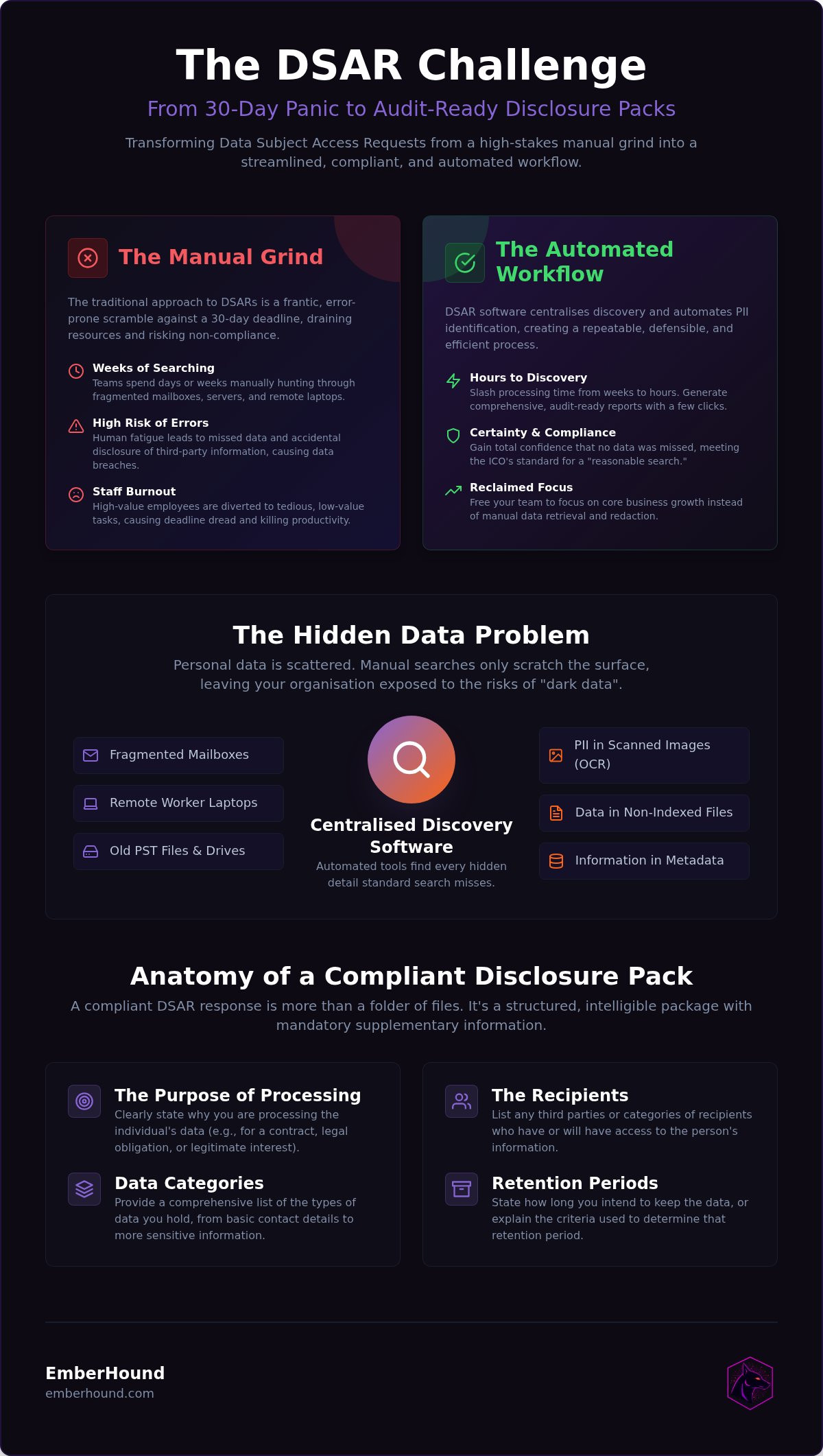
Personal data doesn't sit in one neat, centralised database. It's scattered. It's in a remote worker's "Downloads" folder. It's buried in an old PST file on a disconnected hard drive. It's hidden in a scanned PDF from three years ago. Manual keyword searches in Windows Explorer are notoriously shallow. They miss metadata. They ignore non-indexed locations. They can't see inside images.
This "dark data" is exactly where the most sensitive information hides. Without dedicated DSAR disclosure pack software, you're searching a dark room with a dying torch. You'll miss something. When that missed data surfaces later, the regulatory consequences are severe. In 2026, the standard for a "reasonable search" has shifted. If the technology exists to find the data, the ICO expects you to use it.
Staff Burnout and the Opportunity Cost
Manual DSAR processing is a productivity killer. You're taking high-value IT professionals or Data Protection Officers and turning them into digital archaeologists. They spend days, sometimes weeks, manually exporting mailboxes and de-duplicating files. The hidden costs are staggering:
- Diverted Resources: Every hour spent hunting for data is an hour not spent on core business growth.
- Redaction Fatigue: Human eyes get tired. Tired eyes miss third-party names, leading to data breaches.
- Deadline Dread: The psychological toll of a looming 30-day cutoff leads to rushed, error-prone work.
Investing in DSAR disclosure pack software isn't just about avoiding fines. It's about reclaiming your team's focus. Automation turns a week-long headache into a few hours of verified, audit-ready work. It replaces panic with a repeatable, defensible process.
Anatomy of a Compliant DSAR Disclosure Pack
A DSAR response is not a digital shoebox of raw files. Sending a disorganised folder of documents doesn't just frustrate the requester; it risks non-compliance. Under the UK GDPR, you must provide data in a "concise, transparent, intelligible and easily accessible form." If a requester has to hunt through hundreds of unlabelled files to find their information, you haven't fulfilled your obligations. A professional DSAR disclosure pack software solution transforms this chaotic data dump into a structured, audit-ready package.
The UK's Information Commissioner's Office is clear: you must provide more than just the personal data itself. You are legally required to include "supplementary information" that explains how and why you are processing that data. This is often handled through a formal cover letter or a summary document that acts as the roadmap for the entire pack. Without this context, the data you provide is incomplete.
What Information Must Be Included?
Your disclosure pack must be comprehensive. It should answer the requester's questions before they even ask them. To stay compliant, ensure every pack contains:
- The Purpose: Why are you processing this person's data? Is it for a contract, legal obligation, or legitimate interest?
- Data Categories: A clear list of the types of data you hold, from basic contact details to sensitive health or financial records.
- The Recipients: Who else has seen this data? You must list any third parties or categories of recipients who have access to their information.
- Retention Periods: How long do you intend to keep this data? If you don't have a fixed date, you must explain the criteria used to determine that period.
Structuring the Pack for the Requester
Intelligibility is the standard. This means grouping data logically rather than chronologically or by file type. For example, group all payroll records together and all internal communications in another section. A clear index or summary sheet is essential. It tells the requester exactly what is in the pack and where to find it. This level of organisation demonstrates that you take data rights seriously and have conducted a thorough search.
Format matters too. You should provide the data in a "commonly used electronic format" like a PDF or a structured CSV. Security is the final, non-negotiable step. Never send a disclosure pack via standard email without protection. Use encrypted links or password-protected archives to ensure the data only reaches the intended recipient. If you're struggling to pull these elements together, using a tool like the EmberHound disclosure pack creator can automate the formatting and indexing for you, ensuring every response is consistent and secure.
Key Features to Seek in DSAR Disclosure Pack Software
Most compliance platforms are just glorified task managers. They track the deadline but leave the heavy lifting to you. If your team is still manually opening every PDF and searching every subfolder, your software has failed you. Effective DSAR disclosure pack software must do more than organise. It must hunt. It needs to be a discovery engine first and a management tool second. This is the only way to meet the 30-day deadline without sacrificing accuracy or staff sanity.
Speed is your greatest asset. You need a solution that scans across your entire digital footprint. This includes cloud mailboxes, local hard drives, and network servers. If your search stops at the office door, you're missing the data on your remote team's laptops. Look for features that centralise this search, pulling fragmented PII into a single, audit-ready view. This visibility is what transforms a stressful request into a routine administrative task.
Deep Discovery vs. Surface Search
Filenames are deceptive. A document named "Invoice_2023" might contain sensitive employee details or private home addresses in the footer. Surface-level search tools miss this entirely. You need a platform that looks inside the files. It must penetrate zip folders and scan every single email attachment. This level of granularity is what separates a "best effort" from a "reasonable search" in the eyes of the ICO.
This isn't just about DSARs; it's about your broader data hygiene. Using dedicated GDPR data discovery software UK ensures you aren't just reacting to requests but proactively managing your risk. When you can see every instance of PII across your network, the disclosure pack almost builds itself. You gain a level of control that manual searching can never provide.
The OCR Advantage
Scanned documents are often the graveyard of compliance. A photo of a passport or a scanned contract is just an image to most search tools. Without Optical Character Recognition (OCR), this data remains invisible. This is a massive liability. If a requester knows you have a specific document and you fail to include it, your credibility vanishes instantly.
Optical Character Recognition is the technology that converts text within images and scanned documents into searchable, machine-readable data. It acts as a critical safety net for your DSAR responses. By flagging names and addresses inside JPEGs and PDFs, OCR ensures you never leave "hidden" data behind. It turns an unsearchable image into a compliant data point in seconds.
Finally, look for intelligent redaction tools. It isn't enough to find the requester's data. You must protect everyone else's. Your DSAR disclosure pack software should automatically flag third-party names and contact details for review. This reduces the manual burden on your staff and prevents accidental data breaches that could lead to further ICO scrutiny.
Reducing Redaction Fatigue and Retrieval Errors
Redaction is the bottleneck. It's where the 30-day deadline often hits a wall. You've gathered the data, but now you have to scrub it. Over-redacting makes the response useless. Under-redacting causes a data breach. It's a high-wire act that most teams perform manually. Using DSAR disclosure pack software changes the dynamic. It moves the burden from human eyes to intelligent algorithms. Automation doesn't replace your judgement. It informs it.
The software doesn't just find the requester's name. It flags everyone else's. It identifies the "mixed data" scenarios where a single document contains PII for multiple people. This isn't just about speed. It's about defensibility. If the ICO asks why you withheld a specific paragraph, you need an audit trail. You need to show that you applied a specific exemption whilst remaining as transparent as possible. A manual spreadsheet of redactions isn't enough in 2026. You need a system that logs every decision in real time.
Protecting Third-Party Privacy
Identifying third parties in a sea of data is exhausting. Human error is inevitable after the tenth hour of reviewing emails. Automated discovery tools highlight these risks instantly. They ensure consistency across the entire pack. If a name is redacted on page three, it must be redacted on page fifty. Software maintains this logic across thousands of files. This prevents the "leaky redaction" where a name is hidden in the body of an email but left visible in the CC line.
Transparency is the goal. You must balance the requester's rights against the privacy of others. This is where "mixed data" becomes a legal minefield. By using a centralised platform, you can apply exemptions consistently. You aren't just guessing. You're following a repeatable process that protects your organisation from future litigation. It turns a subjective, stressful task into a methodical workflow.
Ensuring Accuracy in High-Volume Requests
Handling one DSAR is a project. Handling five at once is a crisis. Batch processing is essential for staying afloat. You need to index data once and search it multiple times. This reduces the retrieval errors that plague manual workflows. It ensures that no attachment is left unsearched and no hard drive is ignored. Automated indexing within your DSAR disclosure pack software creates a searchable map of your data, allowing you to respond to multiple requests without doubling your workload.
Accuracy is even more critical when financial data is involved. If your disclosure includes billing records or payment history, you need absolute certainty. Integrating PCI DSS card data scanning ensures that sensitive cardholder information is identified and handled correctly within your compliance framework. This level of precision provides the peace of mind that manual "eyeballing" simply cannot match. You avoid the catastrophic error of disclosing a full credit card number in a standard subject access response.
Stop the manual hunt and start building audit-ready packs today. Explore EmberHound’s automated DSAR tools to see how we simplify the most complex compliance tasks.
EmberHound: Rapid Data Discovery for Audit-Ready Disclosure Packs
Compliance shouldn't feel like a hostage situation. Large enterprise tools are often too heavy, too expensive, and too complex for lean UK teams. You don't need a multi-month implementation phase when the 30-day clock is already ticking. EmberHound is built for speed. We provide the "Efficient Specialist" approach to data management. Our DSAR disclosure pack software strips away the bureaucracy, giving you exactly what you need to find, verify, and package data instantly.
Our dedicated Disclosure Pack add-on is the final piece of the puzzle. It takes the results of your discovery and organises them into the structured, intelligible format the ICO demands. No more manual indexing. No more wrestling with file structures. It creates a professional, audit-ready response that shows regulators you are in total control of your data landscape. We offer enterprise-grade discovery without the enterprise-grade price tag or complexity.
Scanning Every Corner of Your Network
Data doesn't stay in one place. Your search shouldn't either. EmberHound provides native support for mailbox scanning and remote hard drives. We find the PII that others miss. Whether it's a forgotten PST file or a folder on a remote worker's laptop, our tool reaches into every corner of your network. We include OCR technology as standard. This ensures that scanned IDs, handwritten notes, and image-based contracts are searchable from day one. You can go from installation to your first scan in minutes, not days.
We are a business registered in England & Wales. We understand the specific pressures of the UK regulatory environment. You aren't just buying software; you're partnering with specialists who know the local market. It's no-nonsense, high-velocity discovery designed for the way modern teams actually work. It's about visibility, not just checkboxes. We help you find the data so you can focus on running your business.
Your Path to Stress-Free Compliance
The real value of automation is the shift in your team's mindset. You move from "panic mode" to "process mode." A DSAR stops being a crisis that halts your business. It becomes a repeatable workflow. Over time, this creates a permanent inventory of your data. You'll know exactly where PII lives, who has access to it, and how long it's been there. This is proactive governance that protects your reputation and your bottom line. Long-term compliance is built on visibility, not guesswork.
Stop the manual grind. Reclaim your team's time and ensure you never miss a deadline again. Organise your DSAR response today with EmberHound and build your next disclosure pack with absolute certainty.
Take Control of Your Compliance Timeline
The 30-day deadline doesn't have to be a recurring crisis. You've seen how fragmented data and manual redaction create a dangerous bottleneck for lean teams. By implementing professional DSAR disclosure pack software, you replace frantic searching with a defensible, automated process. You protect third-party privacy without the staff burnout. You meet your statutory obligations with absolute certainty.
EmberHound provides the total visibility you need through dedicated mailbox and hard drive add-ons. Our built-in OCR scanning ensures no personal information stays hidden in images or scanned PDFs. With our registered UK-based support and expertise, you aren't just buying a tool; you're gaining a protective partner. It's time to move from "panic mode" to a streamlined, audit-ready workflow.
Stop the DSAR panic: Discover how EmberHound automates your disclosure packs
Compliance is a marathon, but your response process should be a sprint. Start automating today and reclaim your team's focus for what matters most.
Frequently Asked Questions
What is DSAR disclosure pack software?
DSAR disclosure pack software is a specialised tool that automates the discovery, extraction, and formatting of personal data into a compliant response package. It replaces manual folder-browsing with a centralised engine that scans mailboxes and hard drives. This software ensures that all mandatory supplementary information, such as retention periods and processing purposes, is included alongside the raw data. It transforms a chaotic data hunt into a structured, audit-ready workflow for your team.
How long do I have to respond to a DSAR in the UK?
You must respond to a subject access request within one calendar month of receipt. While the UK GDPR allows for an extension of a further two months for complex or numerous requests, you must notify the requester within the initial month. Failure to meet this 30-day window without a valid, documented reason is a direct breach of regulation. It signals poor data governance to the ICO and increases your risk of formal investigation.
Can software automate the redaction of third-party data?
Modern DSAR disclosure pack software uses intelligent discovery to flag names, addresses, and contact details belonging to third parties. It doesn't just find the requester's data; it identifies "mixed data" risks within documents. This allows your team to review and apply redactions consistently across thousands of files in a fraction of the usual time. Automation ensures that you protect the privacy of others whilst fulfilling the requester's statutory rights.
Does DSAR software scan email attachments?
Effective discovery tools scan inside every email attachment, including PDFs, Word documents, and zip folders. Surface-level searches that only look at filenames or email headers are insufficient for compliance. You need deep discovery that penetrates the content of every file to ensure no personal information is left behind. This level of granularity is essential for meeting the "reasonable search" standard expected by the Information Commissioner's Office in 2026.
Is a DSAR disclosure pack the same as a data map?
A data map is a high-level overview of where data lives, whilst a disclosure pack is the specific collection of records provided to a requester. The pack contains the actual personal information and the required supplementary explanations. Think of the data map as your library catalogue and the disclosure pack as the specific books requested. You use the map to find the information, but the pack is the final, compliant output you deliver.
What happens if I miss the 30-day DSAR deadline?
Missing the deadline exposes your organisation to ICO investigations and potential fines. Under current UK regulations, serious violations can result in penalties of up to £17.5 million or 4% of global turnover. Beyond the financial risk, it damages your reputation and often leads to the requester escalating their complaint to the regulator. In a climate of increased scrutiny, a late response is often viewed as a failure of basic accountability.
Can I charge a fee for providing a DSAR disclosure pack?
You cannot charge a fee for providing a DSAR disclosure pack in the vast majority of cases. The information must be provided free of charge under the UK GDPR. You can only charge a "reasonable fee" based on administrative costs if the request is "manifestly unfounded or excessive." However, the threshold for this is exceptionally high. Most businesses should assume every request must be handled without cost to the individual making it.
Does DSAR software work for remote employee laptops?
Specialist DSAR disclosure pack software includes hard drive add-ons specifically designed to scan local machines and remote worker laptops. This ensures that personal data stored outside the centralised server or cloud mailbox is still discovered and indexed. It provides total visibility across your entire network, regardless of where your staff are physically located. This is critical for organisations with a hybrid workforce where data is often fragmented across multiple remote devices.


