

Paying £50,000 for an enterprise data discovery suite might be the most expensive way to fail your next audit. You already know the burden of legacy compliance software. Deployment takes months. It drains your IT team. This comparison of EmberHound Vs competitors shows why traditional tools fail lean teams. Most legacy systems require you to exfiltrate sensitive files to a third-party cloud just to see what is inside them. This creates a new security gap while you are trying to close an old one.
It is time for a different approach. We help you cut through marketing noise to find a solution that fits your specific compliance needs and your budget. You deserve a tool that is lean and effective. You don't need another piece of expensive bloatware that sits idle on your servers.
We examine how local endpoint scanning provides the visibility you need for GDPR and PCI DSS v4.0 without the high costs of the industry giants. You will see exactly how to keep your data local and generate audit-ready reports. Here is how the market looks in 2026.
Key Takeaways
- Understand why local endpoint scanning is the standard for maintaining data privacy whilst meeting audit requirements.
- Evaluate the total cost of ownership when reviewing Ember Hound Vs competitors to keep your budget within your compliance goals.
- Discover a practical framework for selecting tools that provide immediate visibility without the deployment drama of legacy software.
- Learn how to generate salted SHA-256 fingerprints for audit evidence to satisfy GDPR and PCI DSS v4.0 standards.
The Data Discovery Gap for Lean Compliance Teams
Data discovery is the process of locating sensitive information across an organisation. It is the foundation of data security and compliance principles. Without it, you cannot protect what you cannot see. For UK businesses, this visibility is a legal necessity. GDPR and PCI DSS v4.0 require regular, accurate scanning of all endpoints. If you wait for an audit to find your data gaps, it is already too late.
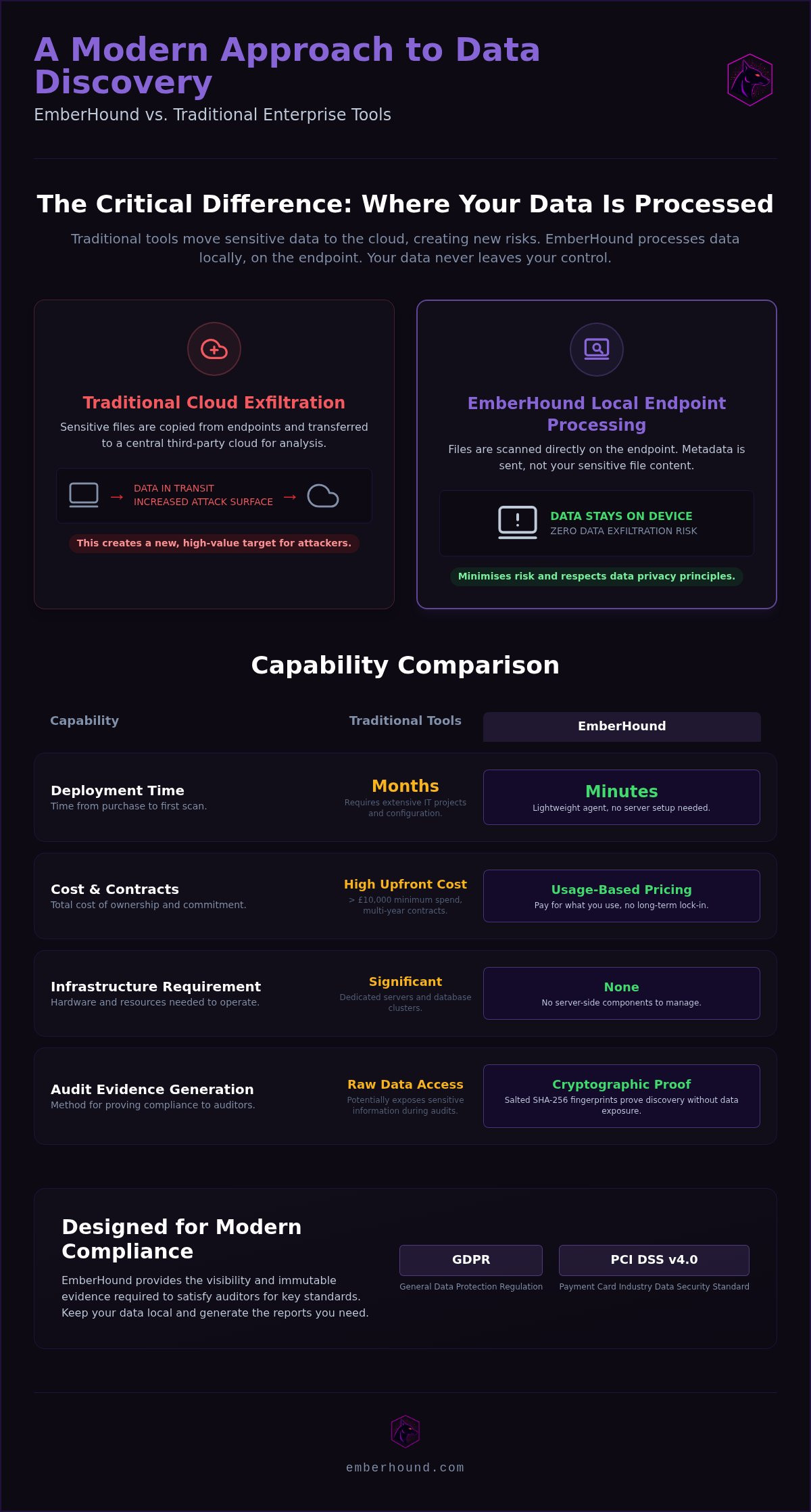
Lean IT teams face a specific problem. Most tools on the market are built for massive enterprises with unlimited budgets. When comparing Ember Hound Vs competitors, the difference in infrastructure requirements is immediate. Traditional tools often require significant infrastructure and long-term financial commitments. They demand dedicated servers and complex configurations that drain internal resources. Small teams don't have the time or the hardware to spare for a six-month implementation project.
Common Challenges with Legacy Compliance Tools
Legacy software often comes with high minimum spend requirements that exceed £10,000 for entry-level access. You are often forced into mandatory multi-year contracts before you even run your first scan. The user interfaces are equally punishing. They are complex and require specialist training or expensive consultancy just to operate basic features. Then there is the performance hit. Active scans from traditional agents can drain employee device resources. This often results in significant lag during the working day. It is a heavy price to pay for basic visibility.
Why EmberHound is Different for UK Businesses
EmberHound is a dedicated platform for data discovery and compliance scanning. It is built for speed and clarity. We stripped away the enterprise bloat to focus on immediate utility for DPOs and IT managers. You can see why our approach works for teams that need results, not more management overhead. Deployment happens in minutes, not months. There is no need for complex server side-loading or database clusters.
The pricing reflects this agility. Our usage-based model allows businesses to scale their scanning as they grow. You pay for what you use. No multi-year lock-ins. No massive upfront capital expenditure. In the matchup of Ember Hound Vs competitors, EmberHound is the choice for organisations that value efficiency over complexity. It provides the audit-ready evidence you need without the deployment drama of traditional software.
Local Endpoint Scanning vs Traditional Cloud Exfiltration
Traditional data discovery tools operate on a "collect and analyse" model. They pull sensitive files from your endpoints and exfiltrate them to a central cloud server for processing. This creates a massive security risk. You are essentially creating a second, vulnerable repository of your most sensitive information. When evaluating Ember Hound Vs competitors, the most critical technical divide is where this processing happens. EmberHound processes all files locally on the endpoint. The platform never accesses the file system directly from a central server. Your data stays exactly where it belongs: on your device.
Security is baked into the architecture. We use TLS 1.3 for data in transit and AES-256 encryption at rest. This ensures that even the metadata generated during a scan is protected to the highest industry standards. Following a practical framework for data protection means minimising data movement. EmberHound makes this the default behaviour, not an optional configuration.
The Security Benefits of Endpoint-Only Processing
Moving data is dangerous. Every time a file leaves an endpoint, the attack surface expands. Local scanning eliminates this risk entirely. It allows your organisation to comply with strict internal security policies that often forbid the movement of personal data across the network. There is no need for complex firewall exceptions or VPN tunnels. You don't have to punch holes in your perimeter security just to see if you are compliant. It is a cleaner, safer way to manage discovery without compromising your network integrity.
Generating Audit-Ready Evidence Without Raw Data
Auditors don't need to see your raw data; they need proof that you have found it and are managing it correctly. EmberHound provides this through masked previews. You see enough to confirm the presence of personal data, but the sensitive details remain hidden. We use Salted SHA-256 fingerprints to provide immutable proof of discovery for your audit trail. These fingerprints act as a unique digital signature for every finding. Detailed audit logs track all mutations and access to these findings, giving you a complete history of your compliance status. You get the evidence you need for GDPR or PCI DSS v4.0 without ever exposing the underlying data to the cloud. You can test our local scanning approach today with a free trial.
Comparing EmberHound with Legacy Enterprise Software
Many enterprise suites bundle data discovery with unrelated tools, forcing you to pay for features you will never use. This "bloatware" approach is the standard when looking at Ember Hound Vs competitors in the legacy space. EmberHound is a specialised tool for GDPR and PCI card data discovery. It does one job with high precision. Deployment occurs without the "drama" associated with enterprise-scale software. You won't spend weeks configuring database permissions or server roles. The platform includes specific add-ons for local mailbox scanning and external hard drive discovery. These are areas where legacy agents often fail or require additional, expensive modules.
Local mailbox scanning covers Outlook and other common clients without needing to grant global administrator access to your entire email tenant. Scanning external hard drives identifies files moved to portable storage that would otherwise bypass network-level discovery. These features provide visibility where it is most needed, without the complexity of a full-scale security operations centre deployment.
Pricing Models and Contractual Flexibility
Enterprise competitors often require upfront annual payments and set-up fees that can run into thousands of pounds. This creates a barrier for teams that need to prove compliance quickly. EmberHound offers a usage-based model with no mandatory contracts. You pay for the data you scan, not the number of seats in your office. A free scan option is available to help teams assess their data posture immediately. It allows you to see the problem before you commit to a solution. This transparent approach is designed for businesses that need to manage costs whilst maintaining strict compliance standards.
OCR and Specialised Scanning Capabilities
Discovery is more than just reading text files. EmberHound includes OCR technology to find data within images and scanned documents. This is vital for finding personal data hidden in passport scans or PDF invoices. Dedicated DSAR disclosure packs help teams fulfil subject access requests faster. These packs package findings into a ready-to-send format. You can also run combined GDPR and PCI coverage in a single unified scan. This reduces the time spent on repetitive tasks. When comparing Ember Hound Vs competitors, this level of specialised utility often beats the generic features of larger platforms. You get exactly what you need to satisfy an auditor without the unnecessary extras.
Choosing Your Compliance Tool: A Practical Framework
Selecting a data discovery tool requires a clear-eyed look at your actual requirements. Don't get distracted by vague promises of digital transformation or marketing fluff about data tapestries. You need a tool that works for your specific compliance frameworks. If you are handling card payments, PCI DSS v4.0 is your baseline. If you store customer records, UK GDPR is the priority. When evaluating Ember Hound Vs competitors, look beyond the feature list. You must verify the privacy posture of the software. Specifically, ask where the data is processed. If the tool moves raw files to the cloud, it is a liability. You need audit-ready evidence that proves discovery without introducing new risks. Handing over a tamper-proof report is the only way to satisfy a rigorous audit.
A practical framework isn't a suggestion; it's a survival guide for lean teams. You don't have the luxury of trial and error. Every hour spent on a failed deployment is an hour your data remains exposed. Focus on tools that offer immediate visibility. You need to know exactly where your exposure lies before the next regulatory update arrives. If a vendor cannot explain their data processing flow in plain English, walk away.
Assessing Technical Requirements and Performance
Does the tool require a dedicated on-premise server or a complex dashboard? Many enterprise options do. This adds maintenance tasks to your already busy IT team. You should also check the impact on employee endpoints. A scanner that consumes 50% of CPU cycles will lead to complaints and disabled agents. In 2026, your workforce is likely hybrid. Your tool must handle remote workers and external hard drives without requiring a VPN tunnel back to a central server. If the deployment drains your resources before you've even found a single file, the tool isn't fit for purpose.
Verifying Compliance with UK Data Protection Laws
Ensure the software supports personal data discovery as defined by the UK GDPR. This isn't just about finding names; it's about identifying the full scope of sensitive information you hold. Speed matters here. Check for features that simplify the Subject Access Request (DSAR) process. A manual search across hundreds of endpoints is not a viable strategy. Finally, confirm the provider offers a clear data processing agreement (DPA). This document is your legal safety net. It defines how the vendor handles your metadata and ensures they meet their own obligations under the law. Without a clear DPA, you're taking an unnecessary risk with your organisation's reputation. When you compare Ember Hound Vs competitors, the strength of the DPA should be a primary deciding factor.
Frictionless Onboarding with EmberHound
Most software vendors hide their product behind a "Book a Demo" button. They want to qualify your budget before they show you a single screen. This friction slows down teams that need to start scanning today. In the battle of Ember Hound Vs competitors, we choose transparency. You can start a free scan without a lengthy sales cycle. The platform is built for immediate use by IT professionals and DPOs who value their time. You get audit-ready reports as soon as the first scan completes. There is no waiting period for data processing or manual report generation.
Setting Up Your First GDPR or PCI Scan
Onboarding is a matter of minutes. Download the scanner and configure your discovery parameters based on your specific audit goals. You select the endpoints, mailboxes, or external drives you need to analyse. The software works quietly in the background. Once the process is finished, you review the findings in a secure, masked interface. This allows you to confirm the presence of personal data without exposing the raw values to unauthorised eyes. If you hit a technical snag, support is available through our technical knowledge base and expert team. We focus on getting you to your first report with zero unnecessary steps.
Scaling Compliance as Your Business Grows
Your data footprint will expand. Compliance is a continuous process. It is never a one-off event. EmberHound allows you to add more endpoints or scanning capabilities as your organisation evolves. You can use the DSAR disclosure pack to manage increasing request volumes without hiring more staff. This pack automates the gathering of evidence. It solves a major pain point found when comparing Ember Hound Vs competitors. You can also link your results to your broader PCI DSS card data scanning strategy. This unified approach handles your GDPR and PCI obligations through a single, efficient workflow. You need a platform that scales with your requirements.
Secure Your Compliance Future
Compliance in 2026 demands speed and privacy. You cannot afford to wait months for a deployment or risk moving sensitive files to a third-party cloud. Local endpoint scanning is the smarter choice for teams that value their time. It keeps your data exactly where it belongs. You generate audit-ready evidence without the risk of data exfiltration. Legacy tools are too heavy for lean organisations.
When you weigh up Ember Hound Vs competitors, the choice is between legacy bloat and modern efficiency. You get masked previews to protect privacy and salted SHA-256 fingerprints to satisfy auditors. There are no long-term contracts to sign. You pay for what you use and start scanning immediately. It is time to stop managing complex infrastructure and start finding your data. Your compliance posture should provide confidence. It should stop being a drain on your IT resources.
Take the first step toward a simpler audit process today. Your team deserves a tool that works as hard as they do.
Frequently Asked Questions
Is EmberHound a managed security service provider (MSSP)?
EmberHound is not a managed security service provider (MSSP) or a legal consultancy. We are a technology company providing automated data discovery software. Our platform allows your internal IT or compliance team to run scans independently. This avoids the high costs and scheduling delays associated with third-party service providers. You maintain full control over your scanning schedule and results whilst using our tools to meet your specific regulatory obligations.
Does EmberHound exfiltrate my files to the cloud during a scan?
Your files never leave your local device during a scan. EmberHound uses endpoint-only processing to ensure that sensitive information is analysed locally on the hardware where it resides. The platform does not exfiltrate raw file content to the cloud. This architecture is a major differentiator in the Ember Hound Vs competitors landscape. It minimises your attack surface and ensures you remain in compliance with strict internal data movement policies.
Can I use EmberHound to find credit card data on employee laptops?
You can use EmberHound to identify credit card data on any connected employee laptop or desktop. The platform is designed for PCI Card Data Discovery and helps you locate primary account numbers (PAN) across your entire endpoint fleet. By finding this data on local machines, you can significantly reduce your PCI DSS audit scope. It's a practical tool for ensuring that cardholder data hasn't accidentally leaked into unsecure local folders.
How does EmberHound handle subject access requests (DSARs)?
We provide dedicated DSAR disclosure packs to automate the subject access request process. When a request arrives, you can run a scan to locate every instance of that individual's personal data across your organisation. The software then packages these findings into an audit-ready format. This saves your DPO hours of manual searching and ensures that you meet the strict one-month deadline required under UK GDPR regulations without the typical administrative burden.
Does the software support OCR for scanned PDF documents?
The platform includes OCR scanning technology to detect information within images and scanned PDF documents. This is a critical feature because personal data often hides in passport scans, driving licences, or digitised invoices that standard text-based tools cannot read. Our OCR engine analyses these files locally on the endpoint. This ensures you have a complete view of your data exposure, including the contents of your non-searchable document archives.
Is there a mandatory long-term contract for EmberHound?
There are no mandatory long-term contracts when you choose EmberHound. We operate on a usage-based pricing model where you pay for what you scan. This flexibility is a key advantage when comparing Ember Hound Vs competitors who often demand upfront annual payments or multi-year commitments. You can start with a free scan to assess your needs and then scale your usage as your business grows or your audit requirements change.
Can I scan external hard drives and mailboxes with EmberHound?
You can scan both external hard drives and local mailboxes using our specialised add-ons. The software identifies sensitive information stored on portable storage devices that might otherwise bypass your network security controls. Our local mailbox scanning feature covers common clients like Outlook, allowing you to find personal data hidden in email attachments or message bodies. These capabilities ensure that your discovery process is thorough and covers all potential data repositories.


