

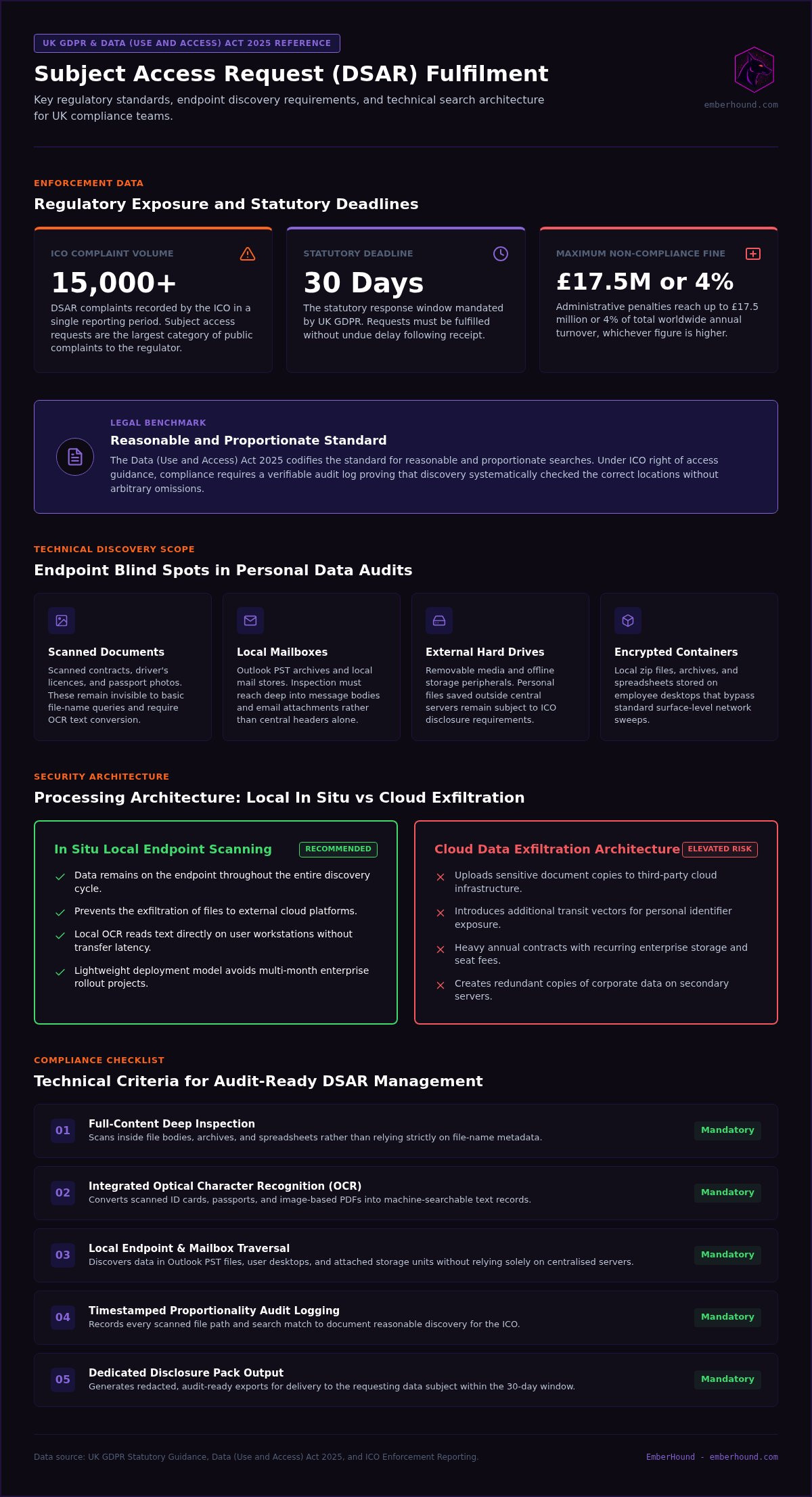
The Information Commissioner's Office recorded over 15,000 complaints regarding subject access requests in a single reporting period. This makes DSARs the largest category of public complaints to the regulator. If you manage a lean IT team, this volume is a constant threat to your schedule. You know the routine. A request arrives. The 30-day clock starts. You spend hundreds of hours searching email attachments and scanned images. The fear of missing personal data is exhausting. Most subject access request software is either too expensive or too complex for your actual needs.
You need to meet your legal obligations without the burden of enterprise bloatware. This article identifies the essential features and privacy standards required to fulfil DSARs accurately. We explain how the Data (Use and Access) Act 2025 codifies the standard for reasonable and proportionate searches. You will learn how to locate data across every endpoint and generate audit-ready evidence for the ICO. We focus on lightweight tools that deliver visibility without the friction of a massive annual contract or unnecessary exfiltration.
Key Takeaways
- Use automated data discovery to fulfil UK GDPR obligations within the 30-day statutory deadline.
- Effective subject access request software must reach beyond file names to scan local mailboxes and external hard drives.
- Maintain privacy by processing data in situ on the endpoint. This prevents the exfiltration of files to external cloud platforms.
- Minimise total cost of ownership by opting for usage-based pricing models. These tools eliminate the need for complex enterprise contracts.
- Use a dedicated disclosure pack to generate audit-ready evidence for the ICO.
What is Subject Access Request Software?
Subject access request software is a tool that automates the discovery of personal data across your digital network. It is the technical solution to a high-stakes legal requirement. These tools scan mailboxes, hard drives, and servers to identify every file linked to a specific individual. The primary goal is to produce a redacted disclosure pack for the data subject. For small teams, this software is the difference between compliance and a regulatory crisis. It allows you to meet the UK GDPR 30-day response deadline without halting your entire IT operation.
The Legal Context of DSARs in the UK
The Information Commissioner's Office (ICO) enforces strict timelines for data access. Under the UK GDPR, every individual has a right of access to personal data held by your organisation. This right is absolute. You must provide a copy of the data without undue delay. The Data (Use and Access) Act 2025 has updated some mechanisms, but the core duty remains. Failure to comply invites administrative fines of up to £17.5 million or 4% of global turnover. According to analysis of ICO enforcement reporting, the regulator recorded over 15,000 complaints regarding access requests in a single period. It is the single most common grievance reported by the UK public. It is a risk that requires a professional response.
Why Manual Processing is no Longer Sustainable
Manual searching is a recipe for failure. It takes hundreds of hours. It relies on human intuition, which is often flawed. You will miss hidden data in local PST files or forgotten external drives. Data volumes in modern businesses grow faster than any manual team can process. If you rely on basic keyword searches, you will overlook personal data inside scanned images or PDF attachments. Effective subject access request software uses OCR scanning to find this information. Manual teams cannot scale to meet these demands. They simply run out of time. Using a dedicated discovery platform ensures you locate every scrap of data across all endpoints. This automation protects your team from the burden of repetitive, low-value searching.
Essential Features for Effective DSAR Management
Effective subject access request software looks beyond file names. Metadata is a starting point. The real risk lives inside the files. You need to inspect the actual content of every document on your network. Manual inspection is impossible at scale. Automated scanning should reach across local mailboxes and external hard drives. This ensures you capture data that exists outside of central servers.
According to ICO right of access guidance, searches must be reasonable and proportionate. You cannot prove proportionality without a detailed audit log. Your software should record every path scanned and every match found. This creates a paper trail for the regulator. It proves you conducted a systematic search. It confirms you looked in the right places. An audit log is your primary defence against claims of negligence. It documents the scope of your discovery. It timestamps your actions.
The Role of OCR in Data Discovery
Many organisations store sensitive information in formats that traditional search tools ignore. Scanned contracts, driver's licences, and passport photos are invisible to basic scanners. OCR for data discovery is a requirement for modern compliance. It converts these images into searchable text. This ensures no personal data is missed. Without it, your search is incomplete. You leave yourself exposed to complaints if a data subject discovers you missed a scanned record. Detection must be deep. It must be accurate. If a document is a picture of a text file, your software must read it.
Mailbox and Endpoint Scanning Capabilities
Personal data is frequently buried in Outlook mailboxes or local employee laptops. These are the dark corners of your infrastructure. Scanning must cover both the body of emails and their attachments. Many tools stop at the server. This is a mistake. You need email data discovery software that inspects local PST files and external hard drives. These endpoints are where the most sensitive correspondence often lives. Attachments are a major blind spot. If an employee has saved a copy of a spreadsheet to their desktop, you have to find it. You must scan zip files. You must scan encrypted containers.
Automation should be light. You don't need a six-month implementation project. You need a tool that runs on the endpoint and reports back. This keeps your data secure. It keeps your team focused on higher-value tasks. If you want to test your own environment for hidden data, you can start a free scan to see what lives on your endpoints.
Local Endpoint Scanning vs Cloud Data Exfiltration
Traditional subject access request software often requires you to move data to find data. This is a significant security risk. Moving sensitive files to a third-party cloud for analysis creates a secondary vulnerability. If the vendor suffers a breach, your compliance data is exposed. Local endpoint scanning processes data in situ. The files stay where they are. This approach is consistent with NCSC device security guidance regarding the protection of local architecture. It limits the exposure of personal data during the discovery process. It also avoids the network congestion caused by bulk file uploads.
Maintaining Data Sovereignty
UK organisations operate under strict rules regarding where personal data is processed. Local scanning ensures sensitive files remain under your direct control. You avoid the "black box" risk associated with cloud-based discovery platforms. When you upload data to a vendor's server, you lose visibility. You don't know which administrators have access to those files. Keeping the search on the endpoint maintains your data sovereignty. It is a more secure method for handling high-risk datasets. It keeps your compliance team in charge of the data lifecycle. This is a defensive necessity for organisations handling sensitive citizen information.
Encryption and Security Standards
Security standards are the foundation of trust in compliance tools. Any discovery tool must use TLS 1.3 for transit and AES-256 for data at rest. These are the baseline requirements for GDPR data discovery software UK professionals should demand. EmberHound uses salted SHA-256 fingerprints to identify files. This technique allows the system to verify data without storing the raw content. The use of unique salts prevents rainbow table attacks. You get audit-ready evidence for the ICO. You don't have to build a central repository of sensitive files. This architecture protects the privacy of the data subject and satisfies the regulator.
EmberHound is a data discovery platform built for the endpoint. It uses masked previews to show you the matches. The raw file content stays on the local machine. This architecture removes the risk of bulk data exfiltration. It is a pragmatic solution for lean IT teams. You get the results you need without the friction of an enterprise-scale cloud migration. It is the smarter way to manage the 30-day deadline without compromising your security posture.
A Buyer’s Checklist for SME Compliance Teams
SMEs are often priced out of the compliance market. Enterprise subject access request software frequently carries high minimum contract values - often exceeding £18,000 per instance. This is prohibitive for a lean team managing a handful of requests. You need a tool that fits your budget and your timeline. A checklist ensures you don't buy bloatware that sits unused on your server. You need to identify the total cost of ownership before you sign a contract. This includes implementation time and staff training requirements.
Pricing Models that Scale with You
Usage-based pricing is ideal for SMEs with fluctuating DSAR volumes. You shouldn't pay for capacity you don't use. Many vendors force you into mandatory long-term contracts just to access basic discovery features. This locks you into a fixed cost regardless of how many requests you receive. Check the EmberHound pricing page for transparent costs that align with your actual activity. Pay for the scans you run. Avoid the annual commitment trap. Transparent pricing is a marker of a tool built for the "lean" professional.
Ease of Deployment and Use
Compliance teams often lack the IT resources for complex software installations. You cannot afford a six-month rollout when you have a 30-day statutory deadline looming. Look for "no deployment drama" tools. These are applications that start working immediately without requiring a dedicated database or on-premise dashboard hosting. Request a video demo to see the interface in action. If the software requires a week of training, it is too complex for a small team. It should be intuitive enough for a compliance officer to run a scan without calling the IT helpdesk.
The SME Buyer's Checklist
- Total Cost of Ownership: Calculate implementation, training, and support fees. Avoid tools with hidden "consulting" requirements.
- Contract Flexibility: Prioritise usage-based models over annual subscriptions.
- Image Detection: Verify the software handles image-based data via OCR. As established, missing a scan of a passport or contract is a compliance failure.
- Deployment Speed: Ensure the tool is operational within hours, not weeks.
- Data Sovereignty: Confirm the tool uses local endpoint scanning to avoid the risks of cloud exfiltration.
Simplifying DSAR Fulfilment with EmberHound
EmberHound is a data discovery platform designed for lean compliance teams. It is built to solve the discovery problem at the source. It doesn't require a massive infrastructure change. It doesn't demand an enterprise budget. It is a technically robust solution for GDPR and PCI DSS compliance. The platform uses endpoint-only scanning. This ensures that your files never leave your network. It uses TLS 1.3 and AES-256 encryption at rest to protect your findings. You get the visibility you need without the security risks of cloud exfiltration. It is the specialist tool for professionals who value time.
Masked previews provide the proof you need. You can see a snippet of the match found by the scanner without revealing raw file content to the central dashboard. This is a critical privacy feature. It protects the data subject while giving you the confidence to proceed. You identify the data. You verify the location. You act. This methodology reduces the surface area for a breach during the compliance check itself. It is a pragmatic balance between transparency and security. You don't have to move sensitive files to a central server to know they exist.
The DSAR Disclosure Pack
The final step of a subject access request is often the most stressful. You have found the data. Now you must prove it. Our tool generates audit-ready evidence for every subject access request. The DSAR disclosure pack helps you locate and export evidence in minutes. It removes the manual burden of compiling spreadsheets and reports. You can focus on responding to the data subject rather than fighting with your file system.
Salted fingerprints provide a permanent record of the discovery process. These salted SHA-256 fingerprints are unique to each file and scan. They allow you to prove to the ICO exactly what was searched and when. This pack simplifies the final step of responding to the data subject. It creates a verifiable trail of your actions. It documents your "reasonable and proportionate" search as required by the Data (Use and Access) Act 2025. You get a clear, timestamped log of every endpoint inspected. This evidence is ready for review by your legal team or the regulator.
Start Your Compliance Journey Today
Compliance shouldn't be a drain on your IT resources. EmberHound is a credible partner for UK businesses managing GDPR. We focus on speed. We focus on accuracy. We focus on the constraints of small, overworked teams. Our usage-based pricing model ensures you only pay for what you need. Our platform is registered in England & Wales (Company No. 17113470). We understand the local regulatory environment. We provide the tools you need to stay compliant without the burden of enterprise bloatware.
You can begin with a free scan to see the platform in action. Test it on a single laptop. Scan a local mailbox. Check an external drive. You will see how quickly the subject access request software identifies personal data. You will see the clarity of the audit logs. There is no long-term contract required to start. There is no complex setup. It is time to replace manual searching with a professional discovery tool. Take control of your data discovery process before the next deadline arrives.
Secure Your Compliance Pipeline
Subject access request software should solve problems, not create new ones. You now have the checklist required to avoid enterprise bloatware and hidden costs. Prioritise local endpoint scanning to maintain data sovereignty. Ensure your chosen tool uses OCR to find personal data hidden in scanned images and PDF attachments. These technical standards protect your team from the risk of oversight and the heavy burden of manual searching. You don't need a complex suite to meet a 30-day deadline.
EmberHound is the agile guardian for UK compliance teams. We are registered in England & Wales (Company No. 17113470). Our platform offers local-only processing to ensure your sensitive files never leave your network. With usage-based pricing and no long-term contracts, you get a professional discovery tool that scales with your actual needs. You can generate audit-ready evidence for the ICO without the friction of a massive annual commitment. It is time to simplify your fulfilment process and meet every deadline with total confidence.
Frequently Asked Questions
How long does it take to implement subject access request software?
Deployment takes minutes rather than weeks. You don't need a complex server setup or on-premise dashboard hosting. Most subject access request software for SMEs is designed to run immediately on the endpoint. This allows your team to start scanning mailboxes and hard drives without a long-term implementation project. You can be operational in time to meet an urgent 30-day deadline. It removes the technical friction from your compliance workflow.
Does DSAR software store a copy of our personal data in the cloud?
Professional tools perform endpoint-only scanning. This means all processing occurs locally on the device. No raw file content is exfiltrated to the cloud for analysis. Instead, the system uses masked previews and salted SHA-256 fingerprints to provide audit-ready evidence. This architecture ensures your sensitive files remain under your direct control. It eliminates the risk of a secondary data breach during the discovery process. It keeps your data sovereignty intact.
Can software find personal data in scanned PDF documents?
Yes, provided the tool includes OCR technology. Optical Character Recognition converts images and scanned PDFs into searchable text. This is a requirement for modern discovery because many organisations hold sensitive data in scanned contracts or ID photos. Without OCR, these files are invisible to basic keyword searches. Automated scanning ensures you don't miss hidden data in your archives. It protects you from incomplete disclosures and potential regulatory complaints.
Is there a free version of DSAR management software for small businesses?
You can start with a free scan to evaluate your endpoints. Most lean platforms use a usage-based pricing model. This allows you to pay for what you use without committing to an expensive annual contract. It is an ideal solution for SMEs with fluctuating request volumes. You get access to professional discovery features without the burden of enterprise-scale costs. You scale your compliance efforts as your business grows without deployment drama.
What is the difference between data mapping and automated scanning?
Data mapping is a high-level overview of where data should be. It is often a theoretical exercise. Automated scanning is a deep inspection of where data actually is. Scanning tools look inside files, mailboxes, and attachments to identify specific personal data. Mapping helps you understand the landscape. Scanning provides the specific evidence required for a DSAR disclosure pack. You need both for a thorough and accurate compliance posture.
How does the software handle data across remote employee laptops?
The software uses local endpoint processing to scan laptops wherever they are located. It doesn't require the device to be on a central office network. The scan runs locally and reports findings back to a central dashboard via TLS 1.3 encryption. This is vital for managing a hybrid workforce. You can identify sensitive data on remote machines without the need for bulk file transfers or intrusive remote access tools.
Can I use this tool for PCI DSS compliance as well as GDPR?
EmberHound offers combined coverage for both GDPR and PCI DSS frameworks. You can use the same discovery engine to find personal data and cardholder information. This unified approach reduces the number of tools your team needs to manage. It ensures that you meet multiple regulatory standards through a single, efficient platform. You can scan for salted fingerprints of card numbers alongside names and addresses in one pass.
What happens if we miss the 30-day deadline for a DSAR?
Missing the deadline invites complaints to the Information Commissioner's Office. Access requests are the single largest category of public complaints to the UK regulator. Failure to respond can lead to administrative fines of up to £17.5 million or 4% of global turnover. You also face significant reputational damage and potential legal action from the data subject. Using automated tools is the most reliable way to prevent these costly delays.


