

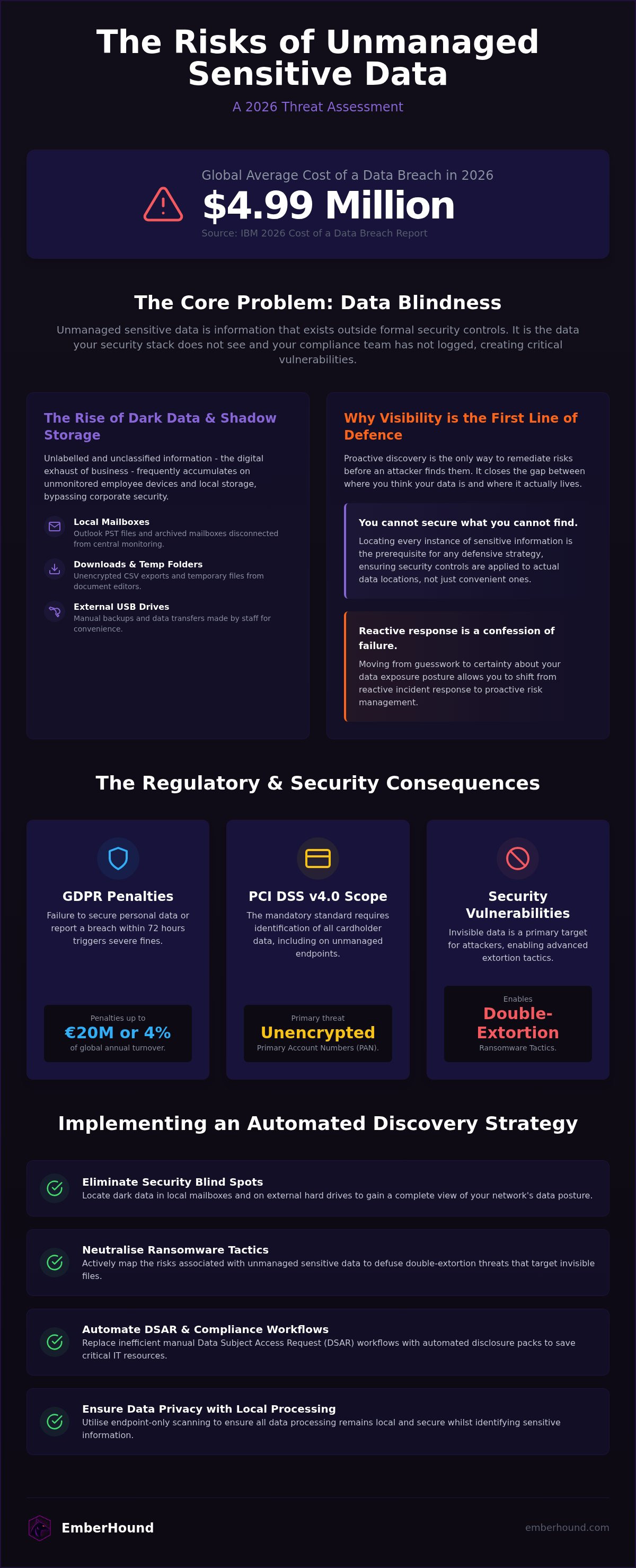
In 2026, the global average cost of a data breach has climbed to $4.99 million, according to the IBM 2026 Cost of a Data Breach Report. For many security teams, the primary driver of this financial impact is visibility. The risks of unmanaged sensitive data are no longer just theoretical; they represent a direct threat to your balance sheet. You already know that tracking personal data across hundreds of remote worker laptops is an impossible manual task. The sheer volume of information is too high, and the threat of ICO fines is too severe to rely on spreadsheets.
This technical assessment identifies the specific security, regulatory, and operational vulnerabilities created by invisible data. We provide a clear map of these risks and a defensible strategy for maintaining GDPR and PCI DSS v4.0 compliance through automated discovery. We will examine how to reduce your breach surface by finding what you cannot see. This approach helps you move from the inefficiency of manual DSAR processing to a state of calm, automated control.
Key Takeaways
- Locate dark data in local mailboxes and external hard drives to eliminate security blind spots across your network.
- Evaluate the 2026 enforcement landscape for personal data under GDPR and cardholder data under PCI DSS 4.0.
- Map the risks of unmanaged sensitive data to neutralise double-extortion ransomware tactics that target invisible files.
- Replace manual Subject Access Request (DSAR) workflows with automated disclosure packs to save critical IT resources.
- Use endpoint-only scanning to ensure all data processing remains local and secure whilst identifying sensitive information.
Defining the Scope of Unmanaged Sensitive Data
Unmanaged sensitive data is information that exists outside your formal data inventory or security controls. It is the data your security stack does not see. It is the data your compliance team has not logged. Whilst most organisations focus their budget on central servers and cloud environments, they often overlook the edge of their network. This includes local mailboxes, external hard drives, and scanned PDF documents. These disconnected islands of information are the primary drivers for the risks of unmanaged sensitive data in 2026.
The transition to remote and hybrid working models has fundamentally changed the geography of your data. Data sprawl is no longer a server-side issue. It is a laptop issue. Employees frequently move files to local folders to bypass slow connections or to work offline. This creates a fragmented landscape where sensitive information is siloed on thousands of individual machines. You must maintain a clear distinction between broad sensitive data - such as intellectual property - and personal data governed by GDPR. Both require data security, but the latter carries specific legal obligations and notification requirements if exposed.
The Rise of Dark Data and Shadow Storage
Dark data is unlabelled and unclassified information sitting in your archives. It is the digital exhaust of your business. It often contains old customer lists, expired contracts, or legacy financial reports. Employee habits contribute significantly to this problem through shadow storage. Staff often create local work-in-progress folders that never sync back to the corporate cloud. These locations are rarely backed up or monitored. A critical risk emerges from sensitive data stored in image formats. Without OCR scanning, a scanned ID card or a photographed invoice remains invisible to your security tools. These files sit in the shadows. They wait for a breach to bring them to light.
Common locations for this shadow storage include:
- Local Outlook PST files and archived mailboxes.
- Downloads folders containing unencrypted CSV exports.
- Temporary folders used by PDF viewers and document editors.
- External USB drives used for manual backups by staff.
Why Visibility is the First Line of Defence
You cannot secure what you cannot find. Locating every instance of sensitive information is the prerequisite for any defensive strategy. Proactive discovery allows you to find and remediate risks before an attacker does. Reactive incident response is a confession of failure. It is the difference between preventative maintenance and a catastrophic engine blowout. By mapping your data exposure posture, you move from guesswork to certainty. You identify exactly where your risks of unmanaged sensitive data lie. This visibility ensures your security controls apply to actual data locations rather than only the most convenient ones. It is about closing the gap between where you think your data is and where it actually lives.
The Regulatory and Financial Consequences of Data Blindness
Blindness is expensive. In 2026, the financial risks of unmanaged sensitive data have moved from abstract warnings to hard balance-sheet liabilities. If you cannot see your data, you cannot defend your compliance status during a SOC 2 audit or a CIS v8.1 framework review. This lack of visibility creates a significant security risk that regulators no longer ignore. The ICO and other European bodies have shifted focus. They are increasingly penalising mid-market organisations that fail to maintain basic data hygiene. A single unmanaged database export on a remote laptop can trigger a full regulatory investigation.
GDPR Penalties and the Cost of Personal Data Breaches
The current GDPR fine structure remains an existential threat to smaller firms. Upper-tier violations reach up to €20 million or 4% of global annual turnover. Failure to secure personal data is not the only trigger for these penalties. You have a legal duty to notify the ICO of a breach within 72 hours of discovery. If your data is unmanaged, you will waste those 72 hours just trying to identify what was stolen. You cannot report what you haven't mapped. This delay is a secondary violation that often leads to higher fines. Use our GDPR Guide to align your technical discovery with these strict reporting timelines.
PCI DSS Scope and Unencrypted Card Data
PCI DSS v4.0 is now the mandatory standard. It requires the identification of all cardholder data across your entire environment, including unmanaged endpoints. Unencrypted Primary Account Numbers (PAN) sitting in forgotten text files or local mailboxes are high-priority targets for attackers. Finding this information allows you to delete or move it. This action directly reduces the scope of your PCI audit. A smaller scope means lower QSA costs and fewer technical controls to maintain. It is the most efficient way to lower your compliance burden. Read our guide on PCI DSS Card Data Scanning to see how scope reduction works in practice.
Beyond the immediate fines, reputational damage often outlasts the initial penalty. Customers in 2026 are highly sensitive to data mishandling. A single exposure event can lead to a permanent loss of trust and a sharp decline in contract renewals. It takes an average of 247 days to identify and contain a breach. This lifecycle is too long. Shortening this window starts with visibility. You can start a free scan to identify your exposure before it becomes a public record.
Security Vulnerabilities Created by Invisible Data
Unmanaged data acts as a silent multiplier for cyber attack impact. In 2026, ransomware actors prioritise exfiltration over simple encryption. They use automated scripts to hunt for high-value file patterns, such as "invoice" or "passport", to fuel double-extortion tactics. Attackers steal this information before locking your systems, then threaten a public leak to force payment. If you don't know where your files live, you cannot assess the damage or negotiate from a position of strength. This lack of control is one of the most critical risks of unmanaged sensitive data.
Shadow AI presents a new technical vulnerability. Many employees now use local AI tools to summarise large datasets or generate reports. If these tools ingest unmanaged local files, that sensitive information becomes part of the model's context window or training set. This creates a permanent risk of data leakage through subsequent AI prompts. Without visibility into what these models are "reading" on local machines, you cannot prevent the accidental exposure of personal data through internal AI outputs.
The Breach Surface of Endpoint Data
Local hard drives are the weakest link in your security chain. Whilst your cloud storage has logs and access controls, local desktops are often a "black box" for security teams. Sensitive data frequently remains on retired or lost hardware because it was never indexed or properly wiped. You must implement local mailbox scanning to find sensitive information buried in email archives. Many users store years of attachments in local Outlook PST files. These archives sit outside the reach of standard cloud security tools but are easily harvested during an endpoint compromise. A lost laptop containing unmanaged personal data is not just a hardware loss; it is a mandatory ICO reporting trigger.
OCR and the Risk of Scanned Documents
Sensitive data frequently hides in scanned PDFs and image files. A photograph of a credit card or a scanned contract is just as dangerous as a spreadsheet, yet traditional keyword scanners often ignore them. You must use OCR for data discovery to convert these images into searchable text. This technology allows you to identify personal data in places your security stack previously couldn't reach. Without OCR, these files are invisible to your defences but fully accessible to an intruder. Turning these invisible liabilities into searchable records is a mandatory step for reducing your total breach surface.
Operational Friction and the Cost of Inefficient Discovery
Manual data discovery is a legacy approach. It wastes your team's time. It drains your budget. Whilst security teams focus on external threats, the internal cost of data blindness grows. The risks of unmanaged sensitive data extend beyond breaches into daily operational friction. Every hour spent manually searching for personal data is an hour lost to higher-value security work. Lean teams cannot afford this inefficiency. You need a process that works as fast as your data grows.
Managing DSAR Anxiety with Automated Discovery
Fulfilling a Subject Access Request (DSAR) without automation is a logistical nightmare. You start by emailing department heads. You ask them to search their local drives. You wait for replies. Then, you manually sift through thousands of emails and local mailboxes. This process is prone to error and takes weeks. The law gives you 30 days to comply. If your data is unmanaged, you will likely miss this deadline. Missing the clock is a direct invitation for an ICO audit. It signals a lack of control over your data environment.
A DSAR disclosure pack changes this dynamic. It automates the identification and collection of a subject's personal data across all endpoints. You get a ready-to-use report instead of a pile of unorganised files. This reduces the time spent on a single request from days to minutes. You can stop guessing where data lives and start using GDPR data discovery software to handle requests with confidence. It removes the panic from the 30-day countdown.
Audit-Ready Evidence Without Raw Data Exposure
Audits are stressful for overworked teams. Proving compliance often requires showing that you know where sensitive data lives. However, moving raw files to a central dashboard creates its own security risk. You need a way to prove data existence without exfiltration. Automated discovery platforms use masked previews to show you just enough information to verify the file's contents. This ensures that the person performing the audit only sees what they need to see.
Technical evidence is strengthened by salted SHA-256 fingerprints. These digital signatures provide immutable proof that a specific piece of personal data was found on a specific device. They do this without ever moving the original file from the endpoint. This local-only approach satisfies both security and compliance requirements. Comprehensive audit logging then tracks every scan and every discovery. It captures the who, what, and where of every event. This creates a transparent paper trail for regulators. You move beyond verbal claims of compliance to providing technical proof. It transforms the audit from a period of panic into a routine technical verification.
Implementing Automated Data Discovery with EmberHound
EmberHound provides a technically robust platform for locating and mapping sensitive data. It directly addresses the risks of unmanaged sensitive data by providing visibility where traditional tools fail. Our endpoint-only scanning model ensures that all data processing occurs locally on the device. We never exfiltrate your files. Your raw data stays exactly where it belongs. This architecture eliminates the security risks associated with centralising sensitive information just to perform an audit. It is a privacy-first approach to data discovery designed for the modern, decentralised workforce.
Security is a non-negotiable standard within our platform. We secure all communication using TLS 1.3. Data at rest is protected by AES-256 encryption. This ensures that your salted fingerprints and masked previews are always secure whilst in transit or stored. Our usage-based pricing model aligns with your actual needs. You pay for what you scan. This allows smaller organisations to achieve the same level of compliance as enterprise giants without the "bloatware" costs. It is a lean solution for lean teams that value efficiency over bureaucracy.
The EmberHound Discover Track
The Discover track is built for speed and technical clarity. You can start a scan across endpoints, local mailboxes, and external drives with a few clicks. It maps sensitive data locations and generates the technical evidence needed for GDPR and PCI DSS v4.0 reporting. We prioritised friction-reduced onboarding to save your IT team's time. There is no deployment drama. No complex server infrastructure or on-premise dashboard hosting is required. You get immediate visibility into your dark data without the typical software overhead. It is a direct path to a reduced breach surface and a simplified compliance map.
By scanning local mailboxes and external drives, you close the visibility gap that attackers exploit. This track identifies where personal data has pooled in shadow storage. It provides the actionable clarity needed to delete or secure those files. This isn't about creating more work. It is about automating the work you are already doing manually. It turns a weeks-long audit into a background task that runs whilst your team focuses on other priorities. You move from manual audit panic to a state of calm, automated control.
Next Steps for Compliance and Security Teams
You cannot mitigate a risk you haven't measured. Start with a free scan to establish a baseline of your data risk. This baseline is your starting point for a defensible security strategy that regulators will respect. You can see the platform in action by booking a video demo to understand the interface and reporting capabilities. It is time to stop guessing and start scanning. We invite you to Start free scan and begin the discovery process today. Secure your edge. Protect your reputation. Reduce your risk.
Securing Your Data Future
Visibility is your strongest defence against the risks of unmanaged sensitive data. You've seen how dark data on remote endpoints creates silent vulnerabilities and how manual discovery drains your most valuable technical resources. By shifting to automated, local-only scanning, you transform compliance from a source of anxiety into a routine technical certainty. It is about closing the gap between your security policy and the reality of your data sprawl across a decentralised organisation.
Our platform ensures that all processing stays on the endpoint. This means no file exfiltration and no additional security risks whilst you perform your audit. Salted fingerprints provide the audit-ready evidence you need for GDPR and PCI DSS 4.0. No long-term contracts. No deployment drama. Just technical proof. You can move forward with confidence. Your data map is accurate. Your breach surface is reduced.
You don't have to tackle this alone. Take the first step toward a cleaner, safer, and more compliant environment today.
Frequently Asked Questions
What is unmanaged sensitive data?
Unmanaged sensitive data is information that sits outside your organisation's formal security controls and data inventory. It often exists as 'dark data' in locations like local mailboxes, downloads folders, and external hard drives. These files are invisible to central cloud security tools but remain accessible to attackers. Identifying these locations is the first step in mitigating the risks of unmanaged sensitive data, ensuring that every file is either secured, moved, or deleted according to your policy.
How does unmanaged data affect GDPR compliance?
Unmanaged personal data creates significant GDPR liabilities, including potential fines of up to €20 million or 4% of global turnover. The law requires you to notify the ICO of a breach within 72 hours. If you haven't mapped your data, you cannot meet this deadline because you won't know what was stolen. This delay is a secondary violation that often increases the severity of enforcement actions and damages your legal standing during an investigation.
What are the main security risks of unmanaged data?
The primary security risks of unmanaged sensitive data involve double-extortion ransomware and shadow AI. Ransomware actors hunt for unencrypted files on local machines to leak them if a ransom isn't paid. Additionally, internal AI models may ingest unmanaged local files, permanently embedding sensitive information in their training data. These vulnerabilities act as a silent multiplier for the impact of a cyber attack, turning a simple system lock into a catastrophic data exposure event.
Can unmanaged data lead to PCI DSS fines?
Yes, PCI DSS v4.0 mandates the identification and protection of all cardholder data across your entire environment. Unmanaged card data, such as unencrypted Primary Account Numbers (PAN) in text files or emails, often leads to non-compliance fines and increased audit costs. Locating this data on endpoints allows you to reduce your audit scope. This saves your team time and lowers the technical requirements needed to satisfy a Qualified Security Assessor (QSA).
How do Subject Access Requests (DSARs) expose unmanaged data risks?
DSARs expose unmanaged data risks by testing your ability to find every scrap of an individual's personal data within 30 days. Manual searches across remote laptops and local archives are slow and prone to error. If you miss the deadline or fail to provide a complete disclosure, the individual can complain to the ICO. This often triggers a wider regulatory audit of your data management practices, revealing systemic failures in your discovery process.
Why is manual data discovery insufficient for modern businesses?
Manual data discovery is too slow for the volume of data created by a modern, decentralised workforce. Relying on spreadsheets and employee surveys is a legacy approach that cannot scale. It drains IT resources and leaves significant blind spots on local hard drives. Automation is necessary to find hidden files, such as those inside images or mailboxes, that human teams would likely overlook. Proactive discovery replaces manual audit panic with a routine technical process.
What is the difference between personal data and sensitive data?
Personal data refers specifically to information that can identify a living individual under GDPR, such as names or IP addresses. Sensitive data is a broader security term that includes personal data alongside intellectual property, trade secrets, and financial records. Whilst all personal data requires protection, not all sensitive business data falls under GDPR. Understanding this distinction helps you prioritise which discovery tools to use for specific regulatory requirements or internal security goals.
How does endpoint scanning help mitigate data risk?
Endpoint scanning locates sensitive information directly on user devices without moving or exfiltrating the files. This local-only approach ensures that raw data never leaves the machine, maintaining a high security posture. It provides technical proof of compliance through salted SHA-256 fingerprints and masked previews for audit evidence. By finding dark data on local drives and mailboxes, you can remediate risks before they are exploited by attackers or identified as gaps by regulators.


